

November 27, 2025, 10:09 am | Read time: 6 minutes
Dogs often seem like fluffy invitations to pet them–especially for people who are fond of the four-legged friends. But this is where the misunderstanding begins: Not every dog wants to be touched, and many people misinterpret dog signals. So, if you want to approach a dog–even your own–you should first find out what is allowed, what can be problematic, and how to play it safe.
Never Pet Dogs Without Asking
When it comes to unfamiliar dogs in the park or on a walk in the field, it’s best to refrain from petting them altogether: “A stranger should not just approach a dog and want to touch it,” says Barbara Schöning, a specialist in behavioral science and one of the authors of “Dogs–Everything You Need to Know.”
Since you don’t know which body parts an unfamiliar dog likes or dislikes being touched, it might feel threatened: “I don’t know if the unfamiliar dog interprets touching as a threat, then gets scared and possibly reacts aggressively,” says Schöning.
Better to Just Observe Unfamiliar Dogs
Therefore, you should only observe unfamiliar dogs. This might be difficult, but “dogs are not on the planet for us to touch them,” says Justina Lempe, founder of the Free Dog School Berlin and author of “My Dog–My Friend: The Training Book for Teenagers.”
Even if a dog in the park approaches a stranger, it doesn’t necessarily mean it wants to be petted. Dogs are simply curious. Therefore, you should also avoid touching it in such cases: “I would let an unfamiliar dog sniff and then possibly move on,” advises Schöning. Even if you are familiar with dogs, it’s better to refrain from petting or at least ask the owner for permission first.
Protecting Your Own Dog
But what should I do as an owner if someone pets my dog without asking and I don’t want that? Schöning recommends the following response: “My dog doesn’t appreciate being petted.” However, some people may not accept this explanation. “In that case, I would simply say: My dog has fleas or he bites,” says Rene Luczyk, owner of the dog school “Pfotentreff” in Olfen. Schöning also finds a white lie acceptable in this situation.
First Interpret Signals, Then Pet the Dog Correctly
When visiting dog owners, contact with the animals is usually longer than during a chance meeting in the park, and the dog becomes more familiar over time. Then you might try to pet the dog gently.
However, you should definitely pay attention to a few signals: If the dog wants to be touched, you can tell, according to Schöning, by the dog appearing relaxed, especially in the face, and perhaps even leaning against the person. When petting, the dog’s body should be relaxed under your hand.
Puppies Prefer to Play
For example, when visiting dog owners, you can sit at the table and see how the dog reacts. It might crawl under the table and slowly approach the person. Since dog signals are not easily recognizable for people without dog experience and for children, they should be especially cautious. This also applies to puppies, who, according to Luczyk and Lempe, like to bite hands. “Young dogs prefer to play,” explains Justina Lempe.
Mistakes to Avoid When Petting
When it’s clear that the dog wants to be petted, the experts advise avoiding the following mistakes:
- Don’t lean over the dog: It’s best to crouch down for petting instead of leaning over the dog, as it might perceive this as a threat.
- Avoid strong forward movements: It’s often said to let the dog sniff your hand first. Lempe finds this unnecessary, as dogs can smell well from two meters away: “From the dog’s perspective, it’s very rude because it’s a forward movement into their personal space.” They would then show calming signals, such as yawning or licking their nose, because they want more distance.
- Don’t stare into the dog’s eyes: Dogs can perceive direct staring as provocation. You can read more about this in this PETBOOK article.
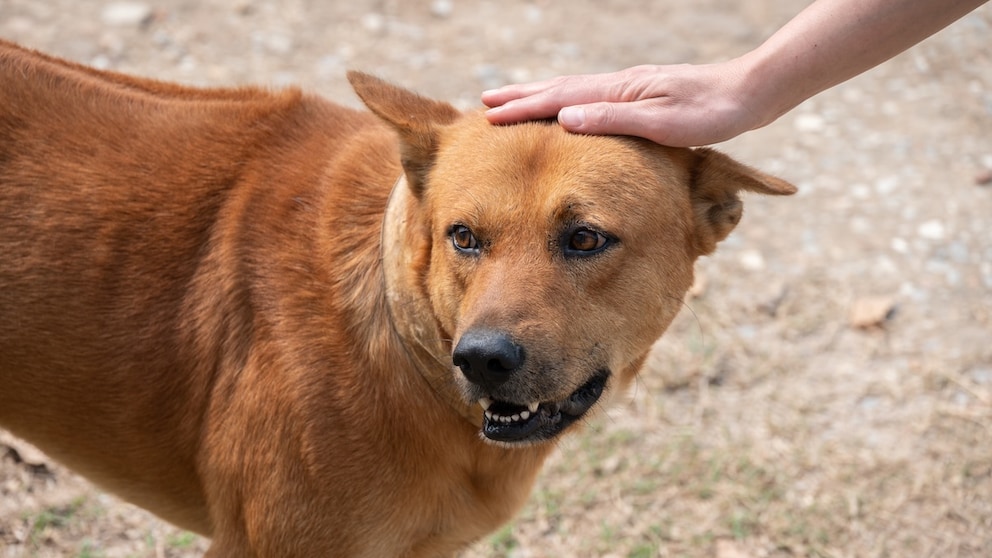
- Don’t pet the dog’s face, head, or belly: These are very sensitive and vulnerable areas for the dog. It’s better to pet dogs on the back first.
- Don’t hug the dog: The dog may feel confined, which can make it aggressive. “I wouldn’t just hug a stranger,” says Luczyk.
- Don’t pet the dog while it’s eating: This can cause the dog to gulp down its food or even bite because it wants to protect its food.
- Don’t pat the dog’s side: For Luczyk, this is an absolute no-go! “It’s a terrible habit.” No dog likes it, and it can lead to internal injuries in the worst case.
How to Pet Dogs Correctly
While you shouldn’t touch certain areas on a stranger’s dog, with your own dog, anything is allowed that the dog enjoys. “The owner usually knows best where and how their dog likes to be touched. There’s no right or wrong,” says Schöning. If the dog enjoys it, owners can also pet their dog on the belly and head, according to Rene Luczyk.
Many dogs, according to Justina Lempe, lie on their backs and present their bellies, which is a clear sign that they want to be petted there. Even if they lay their head on their owner or seek other physical contact, cuddling is welcome.
Almost everyone makes these mistakes when petting cats
Why Many Dogs Allegedly Bite Suddenly
How Dogs Show They Don’t Want to Be Petted
If the dog is tense, you should definitely not pet it. This is first shown by a tense face, often with a slightly turned head, before the body also becomes tense. In professional terms, this is called calming signals. “As soon as the dogs turn away, they want to get out of the situation,” explains Rene Luczyk. Another signal of rejecting petting is when the dog shifts its weight to the other side.
Squinting eyes, ears pointed back, or completely motionless dogs are also not a good sign: “Many dogs freeze when something is uncomfortable for them,” says Justina Lempe. This is a clear sign that many don’t see, and then they wonder why the dog suddenly snaps. Lempe advises dog lovers to wait until the dog makes contact with them on its own.
Always “Make Sure It’s Not Too Much for Them”
According to Schöning and Lempe, you can even hug and kiss your own dog if the dog tolerates it. You should just make sure it’s not too much for them. Also, the four-legged friend should be relaxed. This is more likely indoors on the sofa than outside, where there’s a lot of activity. You shouldn’t pet your dog, however, when it’s showing misbehavior. This could signal to the dog that its behavior was correct. “The dog can understand it as reinforcement,” says Luczyk.
According to Schöning, it’s also not good to startle the dog from sleep just because you want to pet it. If you want to give your dog an especially pleasant petting experience, Lempe has a “top secret tip, but it’s gross”: You can scratch the dog’s ear and then let it lick the earwax. “All dogs love that,” says the dog trainer.
With material from dpa