


April 2, 2026, 9:38 am | Read time: 6 minutes
It’s not enough that ticks suck blood and transmit diseases. There are also specimens that actively pursue their victims: Hyalomma—also known as the tropical giant tick—is typically found in tropical regions of Asia and Africa. In 2018, the parasite was increasingly discovered in Germany and is now considered established. PETBOOK explains how to distinguish Hyalomma ticks from native ones and what danger they pose to humans, dogs, and other pets.
Overview
- Where Does the Giant Tick Come From?
- Tick Pursues Its Victims Over Hundreds of Meters
- Why the Hyalomma Tick Is Dangerous
- Can Also Transmit Q Fever
- Is the Hyalomma Tick Also a Threat to Dogs?
- How to Identify the Hyalomma Tick
- Where the Hyalomma Tick Is Found in Germany
- When Are Hyalomma Ticks Active?
- Discovered a Hyalomma Tick? Here’s What to Do
- Sources
Where Does the Giant Tick Come From?
The tick genus Hyalomma is colloquially referred to as the tropical tick because it typically occurs in parts of Asia and Africa, as well as some regions of Southeast Europe. There isn’t just one Hyalomma tick. Worldwide, there are a total of 27 different species known.
Initial findings of Hyalomma ticks in some regions of Germany were already reported in 2007. It is believed that the parasites arrived via migratory birds. However, it took over ten years for a population to establish. The tick appeared more frequently in Germany in 2018. Scientists assume that millions of Hyalomma larvae or nymphs now arrive in Germany each year with migratory birds. But don’t worry! So far, only relatively few adult—meaning fully grown—Hyalomma ticks have been reported.1
Tick Pursues Its Victims Over Hundreds of Meters
What is special about Hyalomma ticks is that they are about twice as large as our familiar native tick, Ixodes ricinus—the common wood tick. But that’s not the only thing that makes these ticks seem more threatening.
Ticks are usually ambush predators. However, the tropical giant tick has developed a special “hunting behavior.” It actively seeks out its victims and even pursues them—and at a rapid pace: “It’s as fast as a hunting spider,” explained Prof. Dr. Uta Meyding-Lamadé from Klinikum Nordwest in Frankfurt am Main at the 98th Congress of the German Society for Neurology.2
It identifies its prey not only by smell but also with its eyes. This is quite unusual for ticks, as, like many parasites, most species do not have good vision. Thanks to their keen sensory perception, Hyalomma ticks can see their hosts from up to ten meters away.
Why the Hyalomma Tick Is Dangerous
What makes the tick so dangerous to humans is that it is a potential carrier of Crimean-Congo hemorrhagic fever (CCHF). In severe cases, this can lead to intestinal bleeding, vomiting blood, or skin hemorrhages. Depending on the virus strain, the mortality rate can be up to 50 percent. However, there has not been a single case in Germany, and no pathogens have been detected in the ticks found in Germany.
Additionally, Hyalomma ticks can transmit a variant of tropical tick-borne spotted fever. It causes a rash and a feeling of elevated temperature, headaches, muscle pain, and extreme joint pain in humans. In 2019, there was one suspected case in Germany.3
Can Also Transmit Q Fever
In particular, the species Hyalomma marginatum, which is also found here in Germany, can likely transmit the pathogen of Q fever. This involves the bacterium Coxiella burnetii. Humans typically become infected by inhaling contaminated dust from infected ruminants (sheep, goats, cattle). The bacterium is transmitted to sheep via tick feces but can also directly infect humans.
The disease is asymptomatic in half of the cases, but can lead to high fever, chills, muscle pain, and severe frontal headaches when it breaks out. These flu-like symptoms usually resolve spontaneously within one to two weeks.4
Is the Hyalomma Tick Also a Threat to Dogs?
Hyalomma ticks primarily prefer large animals as hosts, especially horses. However, they also infest dogs or humans for a “blood meal.” While dogs can contract tick-borne diseases such as ehrlichiosis, babesiosis, or anaplasmosis, and also Lyme disease, these pathogens have not yet been detected in Hyalomma ticks.5
Additionally, Crimean-Congo fever or tick-borne spotted fever are diseases that only affect humans. As disease carriers, Hyalomma ticks seem to play a minor role for dogs and cats so far.6
However, Hyalomma ticks can transfer from dogs to humans and thus become a potential threat. Therefore, it is important for dog owners to recognize these parasites.
How to Identify the Hyalomma Tick
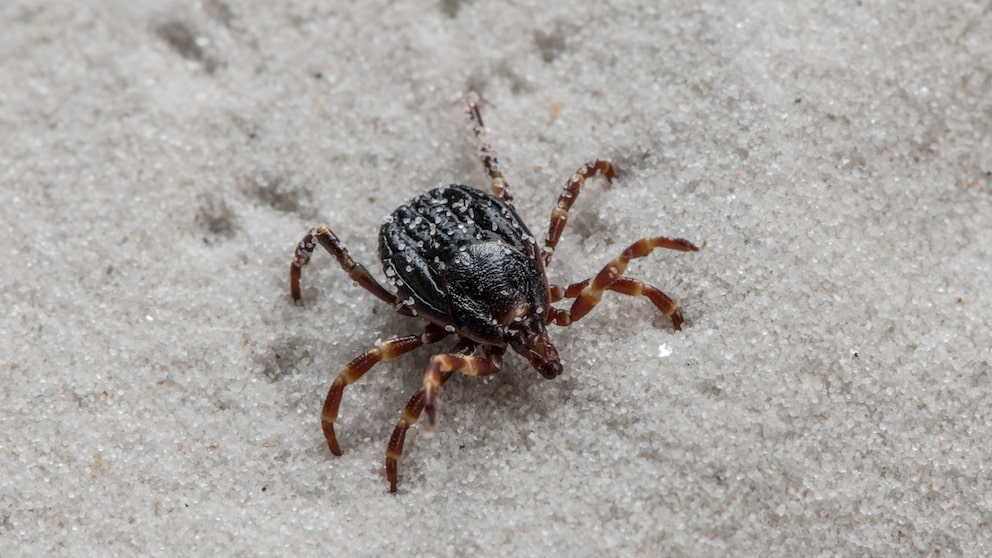
How can you tell if the tick on your dog is indeed a Hyalomma tick? Fortunately, tropical ticks can be easily distinguished from native tick species like the common wood tick (Ixodes ricinus).
You can identify a tick of the genus Hyalomma by the following characteristics:
- with a body length of 5–6 mm, significantly larger than other ticks (usually only 3–4 mm)
- up to 2 cm when engorged
- distinctively striped legs (native species have uniformly brown to black limbs)
Where the Hyalomma Tick Is Found in Germany
So far, there have only been sporadic findings of the Hyalomma tick in Germany. Two species have been identified:
- Hyalomma marginata
- Hyalomma rufipes
In a research project by the University of Hohenheim and its partners, about 200 Hyalomma ticks were found over a three-year investigation period.
In the Tick Radar by biologists Dr. Olaf Kahl and Martin Komorek, 22 specific findings of the two species have been recorded so far. It is notable that the species Hyalomma rufipes has been reported mainly in Hesse and Berlin. However, these are merely published locations from conducted studies—Hyalomma ticks can theoretically occur throughout Germany, as the biologists note on their website.

These Ticks Can Be Dangerous to Dogs

Dogs in Danger: Auwald Tick Continues to Spread
When Are Hyalomma Ticks Active?
Adult ticks become active at temperatures of about 12 degrees Celsius. Thus, Hyalomma ticks can be on the move in Germany as early as March, with their peak activity in May, as these species are very heat-loving. Encounters can increase in hot, dry summers, especially. However, active specimens have also been discovered in the autumn months, indicating that the parasites can occasionally still be active at lower temperatures.
Discovered a Hyalomma Tick? Here’s What to Do
If the tick on your dog is indeed a Hyalomma species, there’s no need to panic! So far, no potentially dangerous pathogens for dogs have been detected in these parasites.
Nevertheless, you should report the finding to help researchers investigate the spread of the parasites. The Robert Koch Institute (RKI) in Berlin and the Institute for Parasitology at the University of Veterinary Medicine Hannover therefore ask that specimens be sent in, including the location (ZIP code) and, if applicable, the affected animal species.