

September 3, 2025, 3:52 am | Read time: 12 minutes
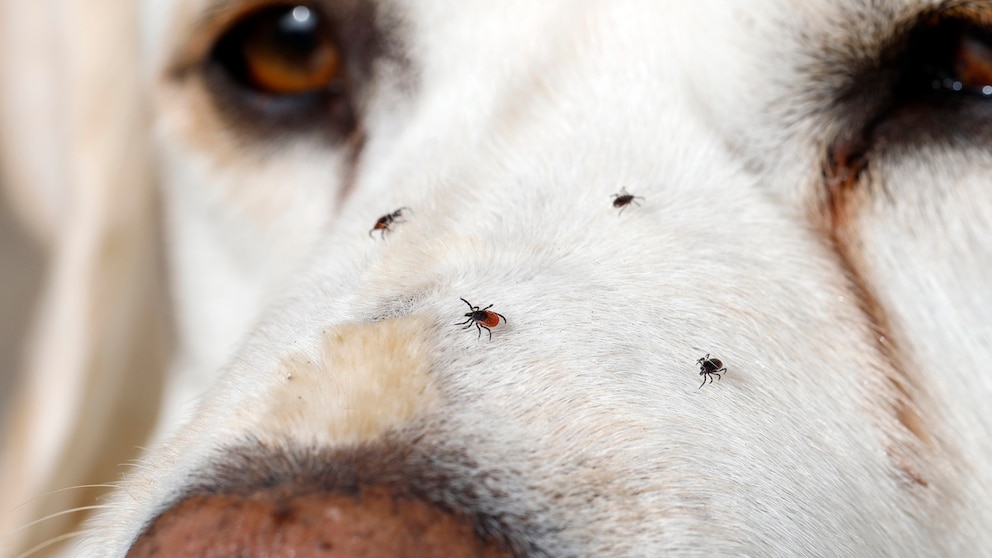
They are the terror of the warm season, and even in winter, you’re not safe from them: ticks. These bloodsuckers are not only annoying but can also transmit dangerous diseases–even to dogs. Which ticks are particularly dangerous, and how can I identify which one has bitten my dog? PETBOOK spoke with an expert.
Ticks, as is now well known, can transmit dangerous diseases–to both humans and animals. People are especially afraid of Lyme disease, a bacterial infection, and tick-borne encephalitis (TBE). This viral disease can cause inflammation of the meninges, spinal cord, and brain. TBE is not treatable; only the symptoms can be alleviated. Dogs are not immune to pathogens that a tick can transmit. In this country, 21 tick species are known, and three species are regularly brought in from travels and can transmit disease-causing pathogens to dogs:1,2,3,4
- the common wood tick,
- the meadow tick, and
- the brown dog tick
Not Every Tick Transmits Pathogens
The giant tick Hyalomma can also transmit diseases, but it is still relatively rare in the wild in Germany, as tick expert and biologist Dr. Olaf Kahl explained in a conversation with Petbook.
“Not every tick immediately transmits pathogens,” Kahl emphasizes. Depending on the region, five to 35 percent of all ticks are infected with Borrelia. In some areas, the number can be even higher. However, a dog or human must first be bitten by such a tick.
And: Not every bite from an infected tick necessarily leads to a Lyme disease infection, neither in humans nor in dogs. The TBE, which is generally reportable in this country, is very rare; for the year 2023, 686 cases were documented nationwide in humans. There are no figures for dogs. “Panic is not warranted, and this year we haven’t had an extreme tick season,” Kahl reassures. By the way: Ticks bite, they don’t sting, as they have piercing tools to penetrate the skin of their host.5
Quick Removal–Even Without the Head
No matter which tick has bitten the pet, the same advice applies to animals as to humans: Remove the parasite as quickly as possible. After a walk, owners should thoroughly check themselves and their four-legged friends to quickly find and remove any ticks picked up along the way. Time is often crucial with ticks, as tick expert Dr. Olaf Kahl explains: “The risk of transmitting Lyme disease pathogens increases the longer a tick can feed.” The bacteria that cause this disease reside in the tick’s gut.
Only after some time of feeding–between 10 and 24 hours–do the bacteria move from the tick’s gut to its mouth, from where they can enter the host. “Therefore, if you find a tick, remove it immediately, regardless of how and whether it’s on a human or dog,” says Kahl. Even if the tick’s head remains in the skin. “The main thing is that no more pathogens can move from the gut to the host, and this is prevented when the tick’s body is separated from the head.” The head can be removed later. “If it stays, it’s really not that bad; transmitted diseases can be more consequential,” Kahl says.6
Also interesting: Parasitologist on tick protection for dogs: “Amber necklaces and garlic don’t help!”
The Common Wood Tick – the “Standard Tick”
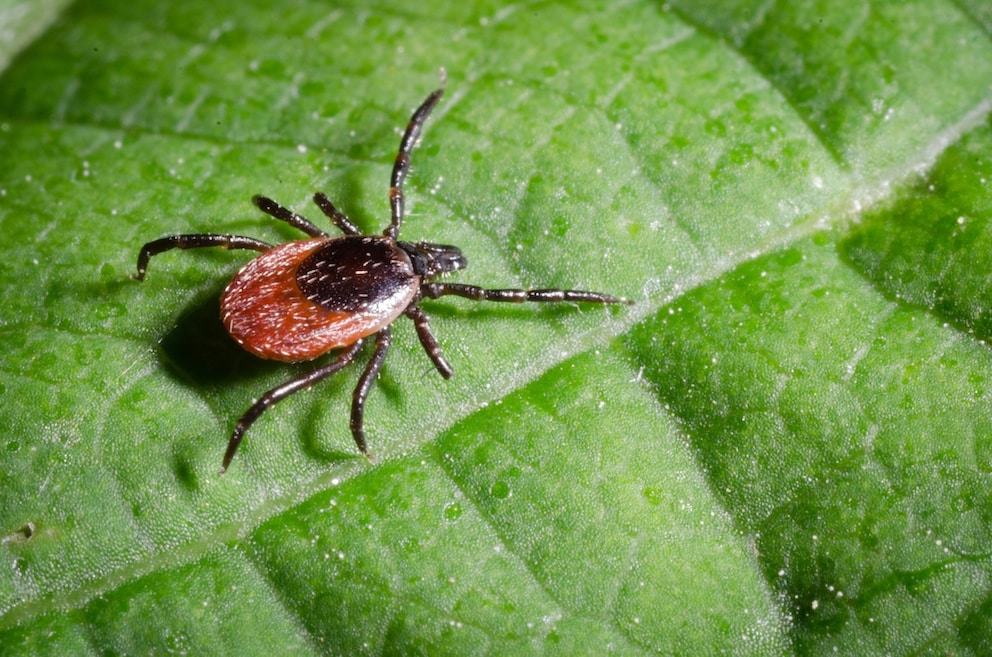
In Germany, when people generally talk about ticks, they are usually referring to the common wood tick (Ixodes ricinus). This species is the most common tick in this country and throughout Central Europe. The parasite prefers to live in forests with dense undergrowth and adjacent clearings, but also in meadows and parks. This tick species likes moisture and becomes active at about seven degrees Celsius. To progress from larva to nymph to adult, the animals need a blood meal at each stage. Adult females also need blood to produce eggs. When fully engorged, they resemble castor seeds in shape, which is how they got their Latin name.
At first glance, one might think a tick is a small spider, as it also has eight legs as an adult. The male’s body is completely protected by a dark, hard shield made of chitin, making it nearly impossible to crush a tick.
How to Recognize the Common Wood Tick
Before a blood meal, smaller male ticks are about 2.8 millimeters in size, while females can be up to four millimeters. When fully engorged, they can reach up to ten millimeters. The shell of female ticks is reddish-brown and covers only half of the body. The color of engorged ticks varies from gray to brown. The common wood tick is particularly recognizable by its oval, sack-shaped body and forward-facing mouthparts.
Diseases Transmitted by the Common Wood Tick
It can primarily transmit Borrelia and TBE pathogens. Although dogs are probably not as at risk as humans, they can still become ill. As with humans, symptoms can appear months after a bite in dogs. Owners often don’t remember their pet had a tick and don’t connect the symptoms with the tick bite.
Symptoms of Lyme disease can include fever, lethargy, lameness in the limbs, swollen joints, and pain. Dogs can also rarely contract TBE, which mainly presents with neurological symptoms. However, studies have shown that even dogs frequently exposed to the pathogens rarely become ill.7,8,9
Meadow Tick–Transmitter of Dog Malaria
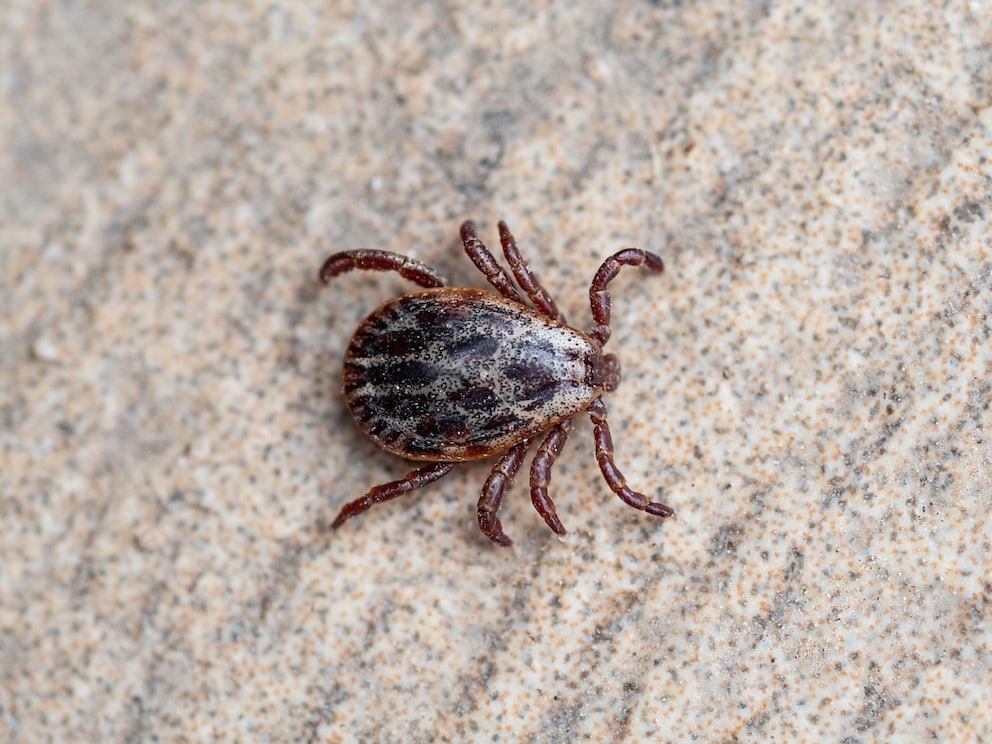
For dogs, the meadow tick, also known as the forest tick, is significantly more dangerous than the common wood tick. The meadow tick (Dermacentor reticulatus) belongs to the so-called ornate ticks. It is not a “new” tick species. Until the late 1990s, it lived mainly in parts of eastern and southwestern Germany. It has since spread northward, likely due to climate change, and frequently infests dogs and horses.
Humans are rarely bitten. The meadow tick likes sunlit, open areas with bushes or trees. It is quite resistant to dryness but can also be found in floodplains, hence its name. Open forests, meadows, forest edges, and fallow land are also its habitat.10,11,12
How to Recognize the Meadow Tick
The name says it all, as its structured, silvery-white shield with a black-yellow pattern is unmistakable. In males, the shield covers the entire body, while in females, it covers only the front third. This tick is larger than the common wood tick. The meadow tick measures between three and a half to six millimeters when unfed. When engorged, it can reach up to 16 millimeters. The legs of the meadow tick extend sideways over half the body length.
Diseases Transmitted by the Meadow Tick
The tricky part about this species: It can transmit the so-called dog malaria, scientifically known as babesiosis. The pathogens of the disease, single-celled parasites, attack the red blood cells of an infected dog and cause anemia, explains biologist and tick expert Dr. Olaf Kahl. Therefore, owners who notice symptoms such as high fever, weight loss, loss of appetite, and lethargy in their dog up to 21 days after a tick bite should quickly consult a veterinarian. If left untreated, the disease can be fatal. Although dog malaria occurs more frequently in countries around the Mediterranean, meadow ticks can also transmit the disease here, as Kahl emphasizes.
Brown Dog Tick–Tough to Handle
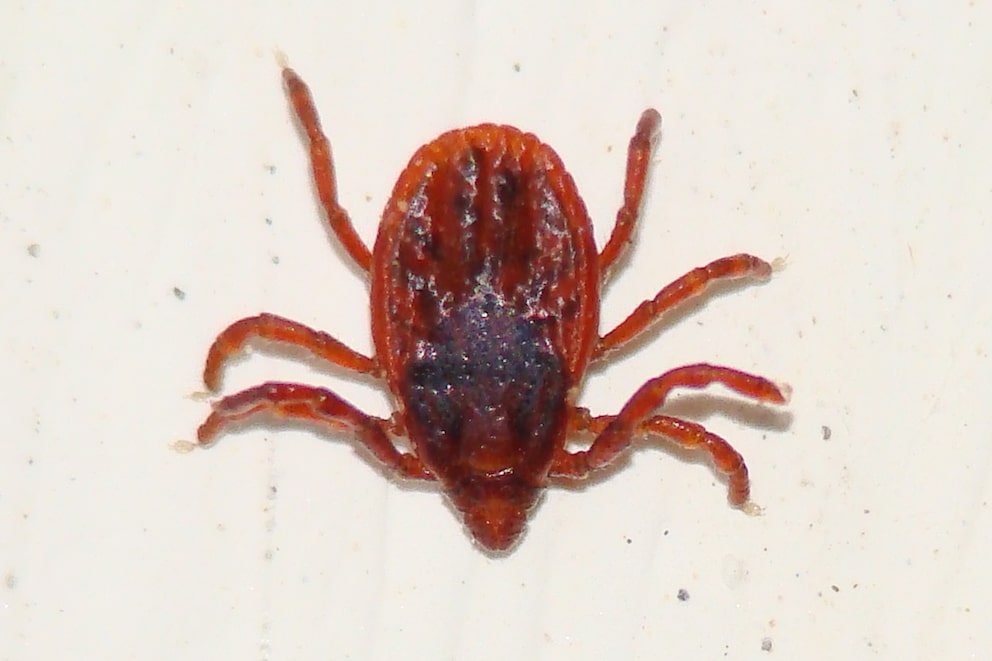
This tick species, originally from North Africa, primarily lives in the Mediterranean region and Southeast Europe, as it prefers warm conditions. In Germany, it does not regularly occur in nature, “but is often brought in from vacations or through adopted animals,” says Kahl. Therefore, it is important to check dogs for ticks even while on vacation. This also applies to newly adopted dogs from animal shelters. In well-heated and dry homes, it finds ideal living conditions and feels comfortable, as Kahl describes.
Brown dog ticks can also nest and multiply in animal boarding facilities, shelters, and kennels. Ventilation and turning down the heating do not help in case of infestation. The tick species is “really tough and copes well with dryness,” says Kahl. Once brought into the house, it hides like bedbugs in cracks, baseboards, furniture, and corners, where it can survive for months without food under good conditions. Brown dog ticks are true reproduction masters.
How to Recognize the Dog Tick
The brown dog tick (Rhipicephalus sanguineus) is difficult for laypeople to distinguish from the common wood tick at first glance. As the name suggests, it is brownish in color and also has a robust shield. It is similar in size to the common wood tick, with females measuring about four millimeters, while males are slightly smaller. After feeding, the tick can grow up to a centimeter and appears more gray than brown.
Diseases Transmitted by the Brown Dog Tick
Contact with this tick species can have unpleasant consequences for the dog, as biologist and tick expert Dr. Olaf Kahl reports. On one hand, the brown dog tick can also transmit diseases such as dog malaria and rickettsia (pathogens of Mediterranean spotted fever, which also affects humans).
A Case for the Exterminator
Compared to other species, the dog tick is a real nuisance, mainly due to its preference for warm and dry environments. “It’s similar to bedbugs,” says Kahl. “Once you’ve brought them home, you can’t get rid of them.” Females can lay up to 5,000 eggs. “And then you have the brown dog tick en masse in the house,” says Kahl. The animals then repeatedly infest the dog living in the household. Although humans are not the preferred host for this tick.
But if no dog is nearby, it will also bite humans or cats, as the brown dog tick is not picky. “Therefore, after a vacation, you should pay attention to whether ticks have settled in the dog’s surroundings, in cracks and corners,” warns Kahl. Especially if the animal or even oneself repeatedly has ticks that couldn’t have been picked up during a walk.
If there is a tick infestation in the house, you should quickly hire an exterminator. “You have to get rid of the animals, but you can’t do it alone.” At least somewhat reassuring: According to current knowledge, this tick species does not transmit Borrelia or TBE pathogens.13,14
Rare Hyalomma Tick Prefers Horses
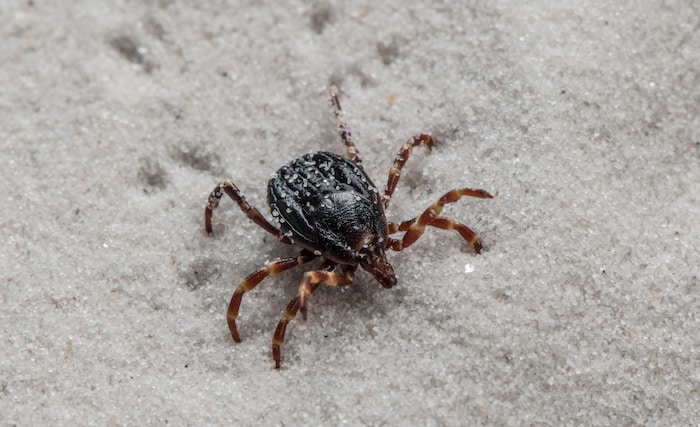
For some time now, it has regularly appeared in the media: the “giant tick” Hyalomma. And it promises something quite creepy: With its five to six millimeters, it is significantly larger than the common wood tick. When fully engorged, it can even grow up to two centimeters.
And not only that: Hyalomma ticks are fast and can follow their hosts for several hundred meters. Sounds unpleasant, and it is. But there is no reason to panic, says biologist Kahl. Ticks of this species are repeatedly found in Germany. This genus (there are several, “the” one Hyalomma does not exist) is only native to Africa, Asia, and Southern Europe. When found north of the Alps, they are usually two specific species that have been repeatedly brought in by migratory birds, says Kahl. In 2018, the discovery of seven Hyalomma ticks in Germany made headlines. “But that was also an ideal tick year,” says Kahl. “The warmest since weather records and extremely low in precipitation.”
How to Recognize the Hyalomma Tick
Its body is brown and also protected by a shield. It is particularly recognizable by its rather orange legs, which are striped yellow or beige. Native tick species have uniformly dark legs. Hyalomma has good eyesight, which also gave it its genus name: Hyalos is Greek and means glass, “Omma” means eye. “This tick actually searches for its victims by sight,” says tick expert Dr. Olaf Kahl.
It is definitely not native or widespread in Germany. This year is rather rainy, which the tick does not like, says Kahl. Moreover, it is so rare that the chance of encountering a tick of the Hyalomma genus is generally extremely low. Hyalomma ticks also prefer larger host animals than dogs, especially horses. Another good news: So far, pathogens that can be dangerous to dogs have been detected in Hyalomma ticks.15,16,17
Giant Tick Chases Its Prey Over 100 Meters

Cats Can Also Get Lyme Disease–Here Are the Symptoms
How to Avoid Ticks on Dogs
Since there are 21 tick species in Germany, there is theoretically a chance of encountering one or another specimen. This is especially true for dogs that like to roam and venture deeper into tall grass or bushes. Hedgehog or sheep ticks prefer to inhabit their namesake host animals, and the Hyalomma tick is rare and likely harmless to dogs.
Nevertheless, dog owners should thoroughly check themselves and their pets after a walk, as the common wood tick and meadow tick, which are found throughout Germany, can indeed transmit disease-causing pathogens to both dogs and humans. It can be critical on vacation, as different climatic conditions allow other tick species to thrive, which can then be brought back.
Tick Bite–Now What?
If you notice symptoms in your dog that match a tick-borne disease, you should definitely consult a veterinarian, advises tick expert Dr. Olaf Kahl. There are also numerous remedies available against ticks, which can be applied to the animal’s skin. The best options should be discussed with a veterinarian. Kahl has one more tip: “To minimize the risk of picking up a tick like the common wood tick, it’s advisable not to wander through tall grass and to stay on paths.” This applies to both humans and dogs.