

March 2, 2026, 4:03 pm | Read time: 3 minutes
Ever heard of the “Railway Dogs”? Behind the name, which sounds like a casting band, are a few guys who are much sweeter than any boy band. The special thing: during their lifetime, they had a real mission. PETBOOK tells the fascinating animal story.
The Forgotten Charity Pioneers on Four Legs
London, Paris, Hamburg–whoever walks through the major train stations of the world today sees the same picture everywhere: hustle, commuter stress, and in between, many people who have been hit hard by fate. Homeless people, those with addiction issues, people hoping for a little spare change. Many train stations are places of need. It was even worse in the past.
In the last and penultimate centuries, working for the railway was a tough and extremely dangerous job. Safety standards as we know them today did not exist. Accidents were a daily occurrence. When railway employees died, their children often remained destitute, as there was no state safety net to support the family income.
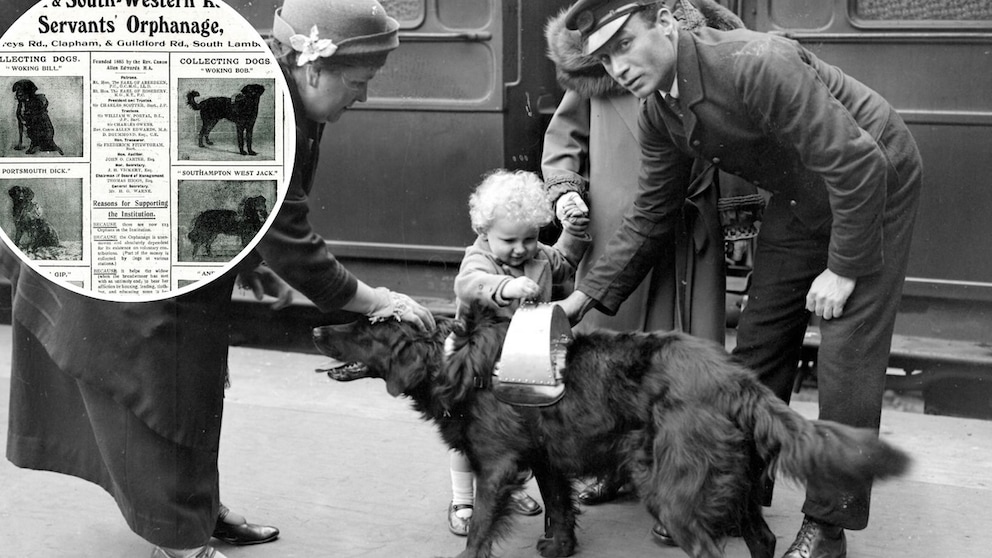
To help children in such cases, the Southern Railway Servants’ Orphanage was founded in Woking in 1885. In the mid-1960s, very special “collectors” gathered donations at the stations. The so-called “Railway Dogs,” dogs equipped with a donation box on their backs, patrolled the waiting halls.
An Honorary Centurian in Retirement
The “Railway Dogs” are considered pioneers of charity culture today and are still celebrated for their exemplary behavior. One of them is now stuffed at Wimbledon station. “Laddie” is an Airedale Terrier, born in 1948, who wagged his way along London’s Waterloo station during his lifetime.
Laddie’s success was so overwhelming that he was made an honorary member of the Tail Waggers Club–a legendary animal welfare organization founded in 1929. Until his retirement in 1956, he achieved the rank of “Honorary Centurian,” the highest rank a dog could reach there. When he finally retired on March 31, 1956, he moved to the railway workers’ retirement home in Woking. He was allowed his bones and his peace.


Dog Smoky Saved Soldiers’ Lives in World War II

Owner of Apollo and Cosmo: “Sometimes, it’s like working with two little drama queens.”
Let’s Be More Like Laddie!
When Laddie died around 1960, it was decided not to just let him go. Professionally preserved, he returned in a display case to Wimbledon station.
There, he replaced his predecessor “Wimbledon Nell,” who had already moved to the museum. In his display case on platform 8, Laddie continued to collect tirelessly. Until 1990–an incredible 30 years after his biological death–passengers continued to feed his donation box. It is estimated that he and his “colleagues,” like the famous “Station Jim,” collected thousands of pounds for widows and orphans over the decades.
What We Can Learn from Laddie
Today, Laddie is safely preserved. Travelers can view Laddie and read his story on small information boards. The little anecdote from the 20th century reminds us of the community and care we all rely on.
My takeaway from walking through the station: When we encounter homeless people and those in need of help, let’s not walk by silently. A little more “Laddie spirit” feels good in the commuter chaos.