

March 4, 2026, 12:13 pm | Read time: 9 minutes
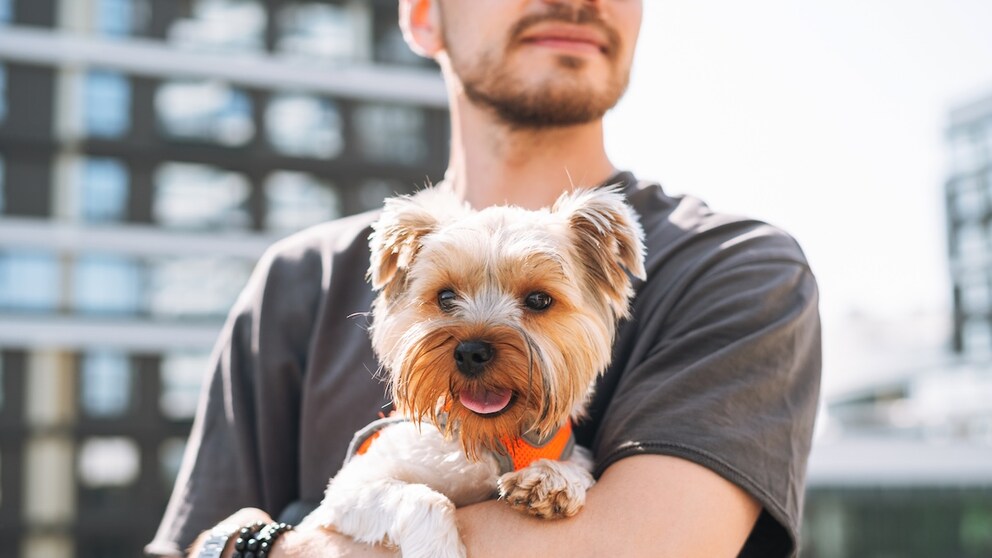
Dogs that accompany or emotionally support people in everyday life are now widespread. They are especially helpful in crises and after traumatic experiences. One of the first documented “therapy dogs” was the barely two-kilogram Yorkshire Terrier Smoky. After World War II, he supported injured and traumatized U.S. soldiers. Today, he is considered one of the first therapy dogs, even though he wasn’t called that at the time. PETBOOK tells his story.
Assistance and therapy dogs are likely familiar to almost everyone. Depending on their field of work, they are specially trained, such as guide dogs and diabetes alert dogs. Other animals provide emotional support in times of loneliness, crises, and anxiety. There are also dogs that help people who have experienced severe trauma. Therapy dogs regularly visit schools, nursing homes, and children’s hospitals, providing emotional support there.
Scientific studies have shown that people respond to the proximity of dogs and interactions with them. Touches like petting lead to increased release of oxytocin, a happiness and bonding hormone. At the same time, the amount of the stress hormone cortisol decreases. The first known assistance dog used as an emotional supporter is considered to be a Yorkshire Terrier named Smoky. The dog of a U.S. soldier visited injured and traumatized soldiers during and after World War II, providing comfort and entertaining with small tricks.1
With Smoky, the success story of animal-assisted therapies began. Because the little dog noticeably lifted the spirits of the wounded and provided comfort to soldiers, more and more dogs were subsequently used in numerous hospitals across the United States. Today, dogs are recognized worldwide as therapy supporters. Smoky paved the way for them.2, 3
In the Field, Carried in a Backpack
Smoky’s career as an assistance dog began anything but sheltered. When and where the dog was born is unknown. What is certain is that the little terrier had a rough start in life. In 1944, during World War II, he was found in the jungle of New Guinea amid ongoing combat between Allied and Japanese troops. A U.S. soldier named Ed Downey was reportedly trying to pull a military jeep out of the mud when he heard a whimper. Following the sound, he found a small terrier puppy in a foxhole, took him in, and likely saved his life.4
Reportedly needing money for a poker game, Downey soon sold the little dog to another U.S. soldier, Corporal William (“Bill”) A. Wynne. The war photographer brought experience in dog training from his hometown of Cleveland, Ohio. In his memoirs about Smoky, later published as a book, Wynne recounted that he quickly found the dog to be “unusually adventurous, tough, and smart.” These traits would serve Smoky well amid the war.5

Years of War in a Backpack
Together with Bill Wynne, who was serving in the Air Force, Smoky survived a year and a half of war. The tiny dog slept in a tent with his owner during this time. His food consisted of rations that Wynne shared with him. Since Smoky was not officially deployed as a war dog, he received neither dog food nor medical care. Nevertheless, Wynne managed to keep his dog alive. According to reports, he and Smoky survived 150 air raids on New Guinea and participated in 12 rescue and reconnaissance missions.
During these missions, Smoky sat in his handler’s backpack. When Wynne served aboard a ship, he and his dog survived several kamikaze attacks and a typhoon. Smoky proved to be not only tough and resilient but also particularly smart: He had learned about 200 tricks and commands that his handler had taught him.
Lifesaver and Messenger
Shortly thereafter, the terrier even saved his owner’s life, according to Wynne’s recollections. When the soldier and his comrades were suddenly attacked with a grenade, Smoky reportedly recognized the impending danger in time and warned his handler. Wynne then brought himself and some comrades to safety and survived. Eight soldiers, however, died in this attack. Later, Smoky took on “messenger” duties during the war, delivering messages to other units by crawling through tunnels too narrow for humans and crossing combat zones. In Indonesia, Smoky assisted in the construction of an airbase.
In January 1945, Wynne was sent to the Gulf of Lingayen. There, his unit had to build an airbase under heavy bombing, according to contemporary reports. During the work, a cable had to be pulled through a pipe only 20 centimeters in diameter. Instead of digging an access, which would have meant several days of work under fire, Smoky was used: Wynne tied the cable around his little dog’s neck and sent him through the pipe. Photos from the time show Smoky, Wynne, and other soldiers in front of the pipe. Smoky completed this task with flying colors and increasingly became a mascot for the troops.
“America’s Smallest Soldier”
Eventually, Bill Wynne sent a photo of his dog to a magazine that regularly published reports and news for U.S. soldiers. The still well-known and internet-accessible photo showed the tiny Smoky sitting in his handler’s helmet. Smoky, whose exploits had by then become well-known, was subsequently given the title “Champion Mascot in the Southwest Pacific.” Many more honors for “America’s Smallest Soldier,” as the dog was now called, were to follow.
Help for Traumatized Soldiers
As a therapy animal, Smoky had not yet been noticed at that time. But that was about to change, albeit through dramatic circumstances. Smoky’s owner Bill Wynne fell seriously ill with dengue fever and was hospitalized. However, he was not allowed to take his beloved dog with him, as animals were not permitted in hospitals. Since the dog and handler apparently missed each other, a comrade of Wynne’s, who was taking care of Smoky, smuggled the animal into the hospital to his owner. Once there, Smoky showed his true talent: He cheered up not only Wynne but also numerous other injured and traumatized soldiers. The hospital base commander, Charles Mayo, namesake of today’s world-renowned Mayo Clinics, noticed the dog’s effect on traumatized soldiers and took Smoky to some of his patients.
Thus began the “career” of the little found dog as the first known therapy animal. One of the soldiers Smoky helped reportedly suffered from trauma and post-traumatic stress disorder. He had completely withdrawn and stopped speaking. However, after Smoky was placed on his lap and interacted with the man, he reportedly smiled, communicated again, and spoke with others.
From the Battlefield to Hospitals
When Wynne recovered, he and Smoky, due to these experiences, regularly visited wounded soldiers in hospitals throughout the Pacific region. The dog’s story was initially spread in military magazines and led to more dogs being used in hospitals and in the treatment of traumatized soldiers in the U.S.
According to reports, with the help of donations, around 700 dogs were officially deployed as therapy dogs in U.S. clinics by the end of 1947–thanks to Smoky, who had shown the impact animals can have on traumatized and injured people. Smoky continued to visit hospitals regularly, visiting former soldiers and helping them cope with their war experiences.
Smoky Wasn’t Even Supposed to Be Allowed in the U.S.
That Smoky is today considered the first known therapy dog and paved the way for this form of therapy almost didn’t happen. Only because his handler Bill Wynne defied an official U.S. Army order after his service ended did his dog come to the U.S. The military had actually ordered that animals from deployment areas were not to be brought back but were to remain in the respective country. However, Wynne did not comply and took his loyal friend home. Long after the war ended, Smoky continued to work as a therapy dog, appeared on local children’s television, and visited nursing homes and schools. In 1955, the dog finally “retired.” Two years later, Smoky died peacefully in his sleep at about 14 years old. His owner Bill Wynne and he were together until the end.
The Sad and True Story Behind Winnie the Pooh

Peta on animal rescue in Ukraine: “Russian drones shoot at everything that moves”
A Monument for the Little Terrier
Wynne buried his beloved animal in a discarded ammunition box in the Rocky River Reservation near his home in Cleveland. For more than five decades, the little dog’s grave remained unknown. However, his story was not forgotten. A Vietnam veteran who had heard of Smoky eventually contacted Wynne and learned where the dog was buried. The veteran ensured that Smoky was given a monument.6
He raised funds to erect a statue for the little terrier. The figure recreates the iconic photo that Wynne once sent to a military magazine, showing Smoky sitting in a soldier’s helmet. It stands at the spot in the Rocky River Reservation where Smoky is buried. The statue is dedicated not only to the terrier but to all dogs used in wars.7
Late Honors and Lasting Legacy
For his service in World War II, Smoky was posthumously awarded the “Animals in War and Peace Distinguished Service Medal” in 2022, the highest U.S. medal that can be awarded to an animal. Australia also honored the animal. There, he was awarded the “Purple Heart,” which recognizes actions by animals that risked their lives to save humans from injury or death.
Smoky’s handler William Wynne worked as a photojournalist after the war. In 1996, at the age of 74, he wrote a book about his special dog (Yorkie Doodle Dandy: A Memoir). In it, he recounted Smoky’s experiences during the war and the years that followed. Smoky also inspired other authors, resulting in a novel and a children’s story about the dog. Not only is there a monument at the dog’s grave in Ohio today, reminding us of the world’s first known therapy dog, but there is also a Smoky monument in Brisbane, Australia. Smoky’s handler Bill Wynne passed away in 2021 at the age of 99.