


April 10, 2026, 10:48 am | Read time: 5 minutes
A hissing cat blocking the path—what sounds like a curious story became a real challenge for a 19-year-old. In the end, even the police had to be called. But how dangerous is such a situation really—and how should one behave? PETBOOK editor and cat behavior expert Saskia Schneider explains what lies behind the hissing and how to safely pass a cat.
Hissing Cat Triggers Police Response
A hissing cat blocking the way to one’s own apartment—what initially sounds like a curious story became a real challenge for a 19-year-old on the night of Thursday, April 9, 2026. According to police, the animal sat in the hallway and wouldn’t let the young woman pass. In the end, officers had to come and carefully guide her past the cat, as reported by “Welt,” among others.
Many people wonder with such a report: How can this happen—and what would you have done?
Hissing Looks Dangerous–But It’s a Warning
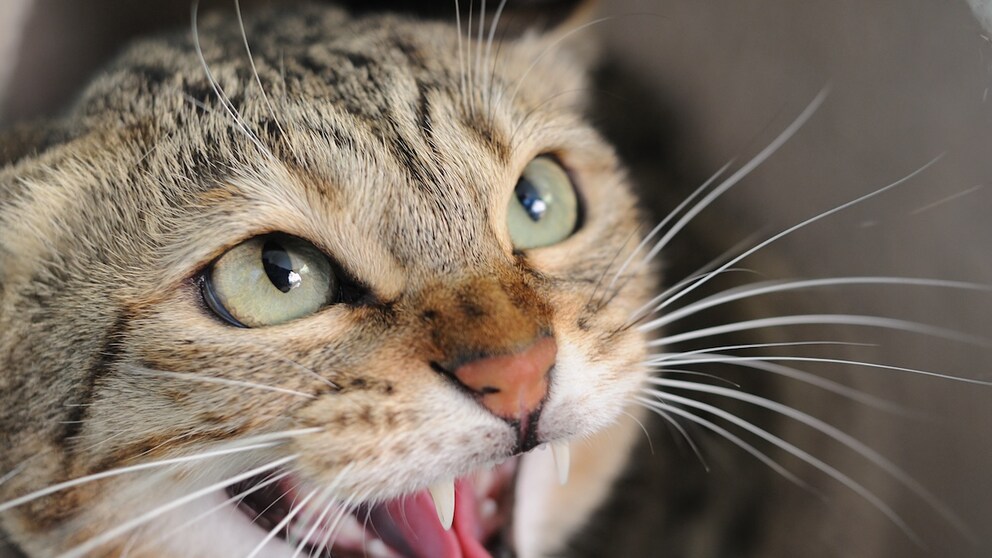
When a cat hisses, many people automatically show fear. Understandably, as the animal bares its teeth, makes itself appear larger, and seems aggressive. In reality, however, something else is usually behind it: defensive aggression.
This means: The cat doesn’t want to attack but wants to create distance. Hissing is nothing more than a clear “Please don’t come any closer.” And it’s extremely effective—for us humans as well as other animals.
Why You Should Take Hissing Seriously
The problem arises when we ignore this warning. If you continue to approach the cat, the situation can escalate. The defensive threat can then turn into an offensive reaction—such as scratching or biting.
The good news: Most cats choose to flee in such a situation. But you shouldn’t rely on that.
When the Cat Sits Exactly Where You Need to Go
That seemed to be the problem in the described case: The cat blocked the path—and the woman couldn’t get past.
Many people instinctively try to shoo the animal away. I advise against that. Because if the cat feels cornered, the risk increases that it will actually move forward.
How to Behave Correctly
It’s more important to relieve the pressure from the situation and show the cat that you are not a threat.
This means specifically:
- Take a step back
- Avoid eye contact
- Turn slightly away
- Make yourself as small as possible
In such a situation, I would even go so far as to sit down or crouch. This appears significantly less threatening to the cat.
If you wish, you can also speak softly to the animal or blink slowly. Among cats, this is a signal of trust. But: Not every cat responds to this—especially if it is highly stressed at the moment.
Often a Stalemate Is Behind It
Such encounters often occur because the cat has been startled and suddenly sees no escape route. Then it freezes, stays put, and tries to keep the “disturbance”—in this case, the human—at a distance by hissing.
The simplest solution is often: Remove yourself from the situation. A short walk around the block can be enough. In many cases, the cat is gone afterward.
If You Can’t Avoid It
Sometimes that’s not possible. Then you can try to gently encourage the cat to flee—for example, by making a noise, like clapping your hands.
In an emergency, you can also throw an object next to the animal (not at the cat!) to trigger a startle response. But this should really be the last option. If possible, ring the neighbors’ doorbell or try to find out who the cat belongs to.
Outside: Increase Distance
If the cat is outside and you have enough space, you can clearly show it that you are keeping your distance–by walking in a wide arc. Many cats then simply stay put and let you pass.
Even if it feels unusual to us: It can even help to briefly turn your back to the cat. For them, this is often less threatening than being stared at. However, this doesn’t work in a narrow hallway—here you shouldn’t squeeze past the cat.
For the Cat, the Situation Is Also Stressful
As “funny” as the report initially sounds—for the cat itself, this is not a pleasant situation.
In such moments, it has several options: flee, freeze, or threaten. In this case, it chose to hiss and hold its ground to keep people at bay.

What Happens When a Grass Snake Bites?

This is what happens when the baby is suddenly attacked by the cat
Responsibility Also Lies with the Owners
Such situations can often be avoided. Those who let their cat roam the hallway should keep a few things in mind:
- Coordinate with neighbors
- Ensure the cat can return at any time
- Don’t leave the animal unattended outside
I absolutely understand that hallways are exciting for cats—new smells, doormats, unfamiliar impressions. But it’s important that neither the animal nor other people end up in uncomfortable situations because of it.
Conclusion
A hissing cat is not an “attacker,” but an animal that feels threatened.
If you understand this and react calmly, the situation can usually be defused—without involving the police.
About the Author
Dr. Saskia Schneider is a Ph.D. biologist. In her studies at the Free University of Berlin, she focused primarily on zoology and animal behavior. In addition to training as an editor, she completed training as a behavior consultant with a focus on cats.