

October 30, 2022, 7:37 am | Read time: 9 minutes
At first glance, a hissing cat may seem aggressive–but it’s usually just a clear warning signal. Why they react this way, what exactly happens in their body, and how owners should handle it is explained by PETBOOK editor and cat sitter Louisa Stoeffler below.
Hissing Cats Are Not Malicious
I once took care of a cat that greeted me with an impressive mix of affection and defense. As soon as I entered the apartment, she stood in front of me with bristled fur and pinned-back ears, hissing as if to say, “What are you doing here?”
But as soon as I started filling her food bowl, her behavior changed abruptly. She rubbed against my legs, purring, and nuzzled her head against my calves–only to hiss at me again the moment the bowl was filled and set down.
This contradictory behavior was not a sign of malice but an expression of inner ambivalence: The cat was unsure of who I was in her territory, yet curious and hungry enough to tolerate my presence. Such situations wonderfully illustrate how complex and nuanced cat communication is–and that even hissing has more to do with insecurity than aggression.
How Does Hissing Work in Cats?
Cats make a variety of sounds when communicating with humans. One of these is hissing, which they can use for different purposes. However, almost every hiss has one thing in common: The animal is showing that it is uncomfortable.
The tone and expression are often perceived as aggressive. In reality, hissing in cats is more of a passive, initial warning sign before the animal begins to defend itself.
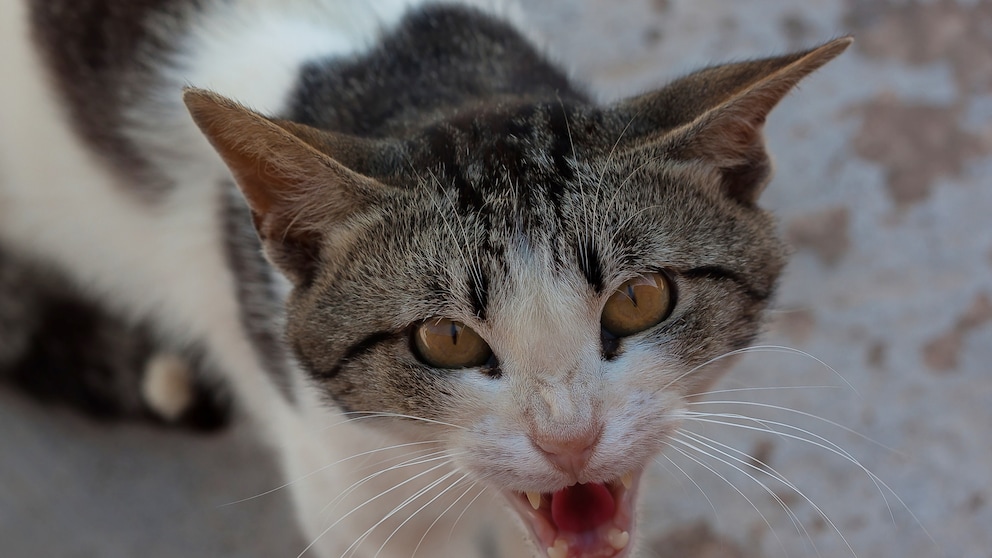
Cats that hiss undergo noticeable changes. The animal flattens its ears and arches its back. The fur on its back and tail stands on end and becomes bushy. Then the cat opens its mouth wide and shows its teeth. It curls its tongue upward at the sides. Through rapid exhalation and inhalation, a hissing sound is produced with the curled tongue. The longer the cat inhales beforehand, the longer the hiss lasts. The animal is preparing for defense and clearly wants to indicate that it desires distance. With this defensive behavior, the cat primarily wants to deter but initially only express its discomfort.
What Are the Reasons for a Cat to Hiss?
When a cat hisses, it wants to make it clear that it would like to escape a situation. The following circumstances can lead to this.
Warning
The cat wants to issue a clear warning to the humans it lives with by hissing. It does this, among other things, when it feels threatened and wants people to keep their distance. Some cats also use hissing as a clear signal to other cats–for example, when another gets too close or crosses boundaries.
Pain
If a cat starts hissing when touched in a specific spot, it likely felt pain from the touch. Cats with dental pain may even hiss at their food bowl while eating. In addition to acute pain, chronic illnesses, hormonal changes (such as during heat), or age-related issues like arthritis can cause cats to react sensitively and hiss.
Stress
In response to loud noises, such as at raucous parties or on New Year’s Eve, some cats react to the volume with stress and begin to hiss. In these cases, the cat should be able to retreat to a quiet room or a protected place. Too many stimuli–such as loud music, many visitors, new furniture, or unfamiliar smells–can also overwhelm cats. Even small changes in their familiar environment can trigger stress, which may manifest as hissing.
Frustration
During intense play, a cat may hiss. This can be an expression of frustration if the toy or feather wand remains out of reach. This is also why laser pointers are only somewhat suitable as toys for cats. It’s better to let the cat win sometimes during play so it can experience success in the hunt.
Frustration can also arise if the owner misinterprets the cat’s body language–for example, if it is petted in a sensitive area or feels cornered. The hissing is then not aggressive behavior but a clear “Please don’t!”
Fright
One should not intentionally scare their cat. In such cases, cats may suddenly hiss out of fright or even develop a fear of their owners. Particularly sensitive animals also react to sudden movements or new sounds–such as falling objects or a door opening–with a brief, reflexive hiss.
Insecurity
When cats find themselves in an unfamiliar environment or with unknown people, it can cause insecurity in the animal. This can lead them to hiss more frequently than they usually would. Typically, this type of hissing subsides after a while.
Cats that have had bad experiences or an uncertain past often hiss more quickly. Sudden changes in their environment–a move, new people, or furniture–can also trigger insecurity. In such moments, it helps to give them time and places to retreat.
Fear
Cats are very skittish animals and show fear reactions to loud or sudden noises. Similar to a brief fright, they often first respond to prolonged fear with hissing. Even with loud electronic devices, like a vacuum cleaner or a hairdryer, the animals can exhibit this fear reaction.
Older cats or animals with impaired vision or hearing often react more fearfully to unfamiliar situations. Hissing can then be a kind of defense mechanism to maintain control.
Playfulness or Rough Play
If a cat reaches for its owner with its paw during play and hisses, the sound is usually harmless, as hissing is part of the animals’ exuberant play. Especially young or spirited cats sometimes hiss out of exuberance or overwhelm when the play becomes too wild.
However, cats can also issue warnings during rough play to indicate that they’ve had enough and are annoyed. This is especially important among kittens so they learn proper behavior and don’t play too roughly with each other.
The Unknown
When a new cat enters the household, the resident cat may react with territorial behavior toward the “intruder.” Cats sometimes also react defensively to strangers, especially if they perceive them as intruders in their territory.
Mirroring
If the owner and cat have a particularly good relationship, cats may mirror our mood. Cats are very sensitive to their humans’ emotions, especially if the owner is stressed, loud, or restless. This tension can transfer to the animal–it then reacts with hissing, without knowing exactly why.
Cognitive Changes
As cats age, their behavior can change–sometimes hissing seems “groundless.” Older animals can become confused, disoriented, or more irritable, especially at dusk or night. This is often due to cognitive dysfunction, a type of dementia in cats.
In such cases, they don’t hiss because they’re angry or scared, but because they simply can’t make sense of what’s happening–for example, when their human suddenly stands in front of them or a familiar room seems “strange.” 1 , 2
Also interesting: Why does my cat constantly bring me toys even though she doesn’t want to play?
What Can I Do if My Cat Suddenly Hisses?
If the cat hisses at the owner, one should first check which of the above reasons might apply. Is the animal in pain, feeling cornered, or perhaps tired of playing? In any case, owners should give the animal enough space if it shows that it is uncomfortable. Owners should respect the cat’s needs and not pet or pick it up if it doesn’t want to be.
If unsure whether one or more of the above reasons apply, the animal should be thoroughly examined. Does it hiss when touched in certain areas? This could indeed be a sign that the animal is in pain. In any case, the cat should be taken to a veterinarian to clarify the cause of the sudden hissing.
Children should also be taught to treat animals with respect. If the cat hisses when a child pulls its tail, it has a very good reason for this warning sign. Proper handling and petting of an animal need to be learned.

Cat Attacks Out of Nowhere? Here’s What’s Behind It

Why Do Cats Suddenly Kick with Their Hind Legs?
Cat Hisses at Another Cat–What Could Be the Reason?
Even cats that usually get along well sometimes literally get into each other’s hair and hiss at each other. Generally, this is no cause for concern but simply a sign that one of the animals has crossed a clear boundary or the play has become too wild. Then hissing can be a clear sign that it’s time to stop roughhousing.
However, hissing becomes concerning if it becomes a habit or if only one cat regularly hisses at the other. Harmony in a multi-cat household can be maintained if the quarrelsome cats have their own places to retreat. If peace doesn’t settle, hissing may have already become a learned behavior. In this case, support from behavior experts and a veterinarian should be sought.
Can You Train a Cat Not to Hiss?
Hissing is a natural sound for cats, and one should not try to train it out of them or punish them for it. Instead, try to find out why the animal is uncomfortable and act accordingly. If the cat lacks space or places to retreat, one should cater to the animal’s needs. For example, by providing the cat with quiet resting places or even a room of its own as a retreat. This also helps if the cat constantly hisses at another animal living in the household, ensuring the animal feels more comfortable again.
If there is truly no reason for the cat to hiss at a person, it is also possible that it perceives them as an intruder, as in my experience. In this case, it wants to drive them out of its territory by hissing. This can happen if the animal is uncomfortable with someone being in its territory. In this case, it is advisable to simply go about your business until the cat no longer perceives you as an intruder.