


April 24, 2026, 3:01 pm | Read time: 4 minutes
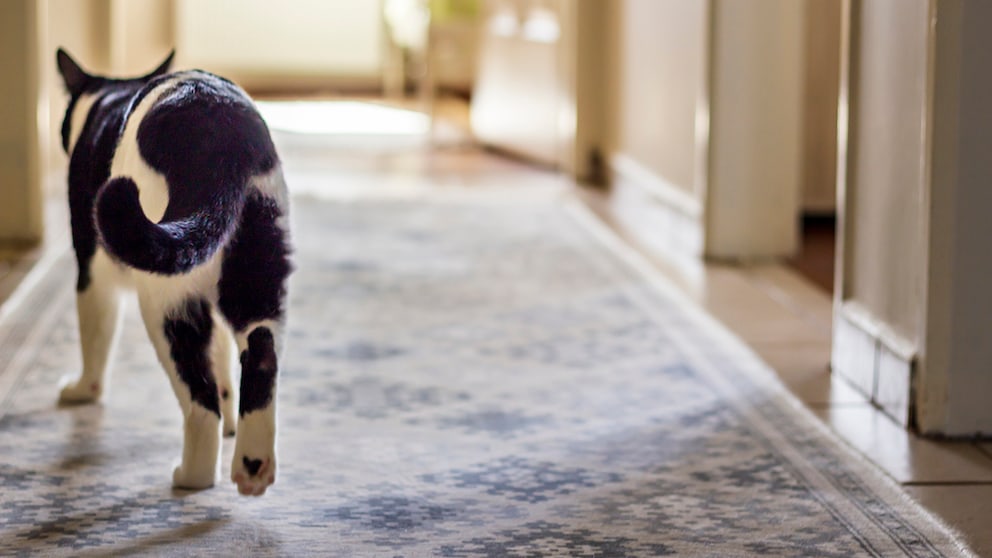
Do you know this scenario? Your cat approaches you, rubs against your legs, maybe even looks at you–and just when you want to pet her, she’s suddenly gone. To many owners, this seems contradictory or even a bit “finicky.” PETBOOK editor and behavioral biologist Saskia Schneider explains why this behavior is quite typical and what really lies behind it when the cat suddenly runs away.
“I just wanted to pet you…”
The situation is a classic: The cat seemingly seeks contact, maybe even purrs, and just as you reach out to touch her, she turns away. It’s easy to get the impression that cats are moody or willful. But in most cases, it’s simply a misunderstanding. We often interpret our cats’ signals differently than they are intended.
Eye contact is not always an invitation
A common mistake is that we see eye contact as an invitation. While this may often be true for dogs, it is not necessarily the case for cats. When cats stare directly at each other, it has a more controlling or slightly threatening meaning. Especially animals that do not know us well use this look. When we then reach out, we cross a boundary from the cat’s perspective, and she withdraws from the situation.
A cat that actually wants to be petted, on the other hand, appears much softer in her body language. She slightly squints her eyes, turns her head a bit away, or actively offers a part of her body. These subtle differences determine whether our approach is welcome or not.
Our approach often seems threatening
Additionally, our way of approaching can quickly seem intimidating to cats. We are significantly larger and tend to lean over the animal from above or reach directly for the head. This behavior can seem threatening to many cats. Particularly insecure, young, or poorly socialized animals respond by retreating.
It is much more relaxing for the cat if we get down to her level, position ourselves more to the side, and offer our hand calmly at nose height. This way, the cat has the opportunity to decide for herself if and how much contact she wants.
Also interesting: How your cat shows when she wants to be petted–and when not
“Follow me!” instead of “Pet me!”
Another typical everyday situation also often causes confusion: The cat approaches her human with her tail raised, seems friendly and attentive, but walks away again as soon as you want to pet her. This behavior is often misunderstood. A raised tail is in many cases not a sign that the cat wants to be petted now, but rather an invitation to follow her.
Many cats lead their humans to a specific place, such as the food bowl, a toy, or their favorite resting spot. Some have set rituals and want to take a little “tour” before they engage in closeness. This behavior is individual but very common in living with cats.
When touches are uncomfortable
There are also situations where cats suddenly get up and leave during petting, especially when a certain spot is touched. In such cases, it’s worth taking a closer look. There may be physical causes behind it, such as pain from arthritis, injuries, or even problems in the head area like dental pain.
Cats are masters at hiding discomfort and often end an unpleasant situation simply by withdrawing. If this behavior repeats and always occurs at similar moments, it should be monitored and possibly checked by a veterinarian.

How Your Cat Shows When It Wants to Be Petted–and When It Doesn’t

How to Tell If Your Cat Likes You
Smells can also be the reason
Last but not least, the cat’s sense of smell plays a significant role. What smells pleasant to us can be very intense or even unpleasant for cats. Freshly applied hand cream or perfume often leads to a cat avoiding contact. Some animals react very clearly to this by briefly wrinkling their face or even sneezing before withdrawing. In such moments, the reason lies not in the cat’s behavior but simply in our scent trail.
Conclusion: Walking away is not rejection
When cats suddenly leave during petting, it rarely has anything to do with a lack of affection. Much more often, it reflects their subtle way of communicating and their need to control situations themselves. Especially cats that approach their humans with their tails raised often show a close bond. Those who learn to recognize and respect the subtle signals will find that the cat is not simply “running away,” but is very clearly communicating what she wants–or doesn’t want at the moment.
About the Author
Dr. Saskia Schneider is a biologist with a Ph.D. During her studies at the Free University of Berlin, she focused primarily on zoology and animal behavior. In addition to training as an editor, she completed training as a behavioral consultant with a focus on cats.