

April 9, 2026, 6:51 am | Read time: 6 minutes
Cats are often seen as contradictory: one moment they’re purring on your lap, the next they’re pulling away or swatting at your hand. In reality, cats communicate very clearly—just often quietly. PETBOOK editor and cat sitter Louisa Stoeffler offers insights into cats’ avoidance behavior, how to recognize when they want to be petted, and how to correctly interpret their subtle cues.
What Does Avoidance Behavior Mean in Cats?
Many misunderstandings between humans and cats don’t stem from ignorance but from well-intentioned actions: We want closeness—the cat might not. The good news: There’s a simple, cat-friendly way to find out if petting is welcome. Behavior experts call it the consent test.
The consent test is a brief, nonverbal inquiry to the cat: Do you want contact right now? Instead of just starting to pet, let the cat decide if and how closeness occurs. The principle is simple: The cat gives the first signal.
How the Consent Test Works Step by Step
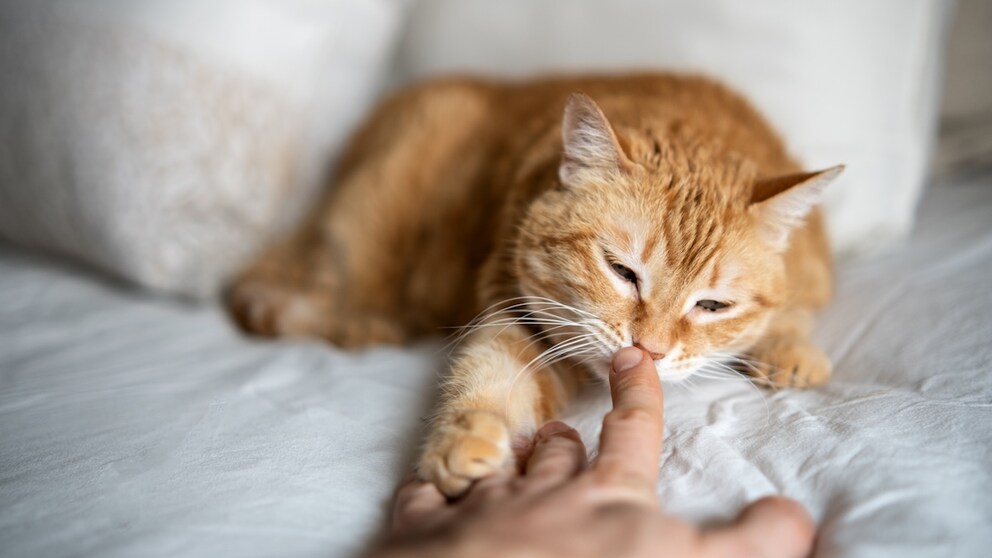
- Offer your hand calmly: Slowly extend your knuckle or the back of your hand to the cat, around nose level. No quick movements, no following.
- Wait: Now comes the most important part: do nothing. The cat decides whether to respond.
- Read the cat’s reaction: Depending on the animal’s behavior, you’ll know if petting is currently desired—or not.
These Reactions Mean: Yes, Petting Is Okay
- The cat nudges your knuckle or hand with its nose (head bumping)
- It rubs its head or cheeks against it
- It stands still or even comes closer
- Ears are upright, body appears relaxed
- Slow blinking (cat “smile”)
- Tail upright, tip slightly curved
- It deliberately positions itself for petting
- Purring (Note: not always synonymous with well-being, but usually positive in context)
This is a clear invitation. You can now start petting gently—preferably first on the head, cheeks, or neck.
These Reactions Mean: Prefer Not to Be Petted Right Now
- The cat briefly sniffs without making contact
- It licks its lips or yawns
- It turns its head or body away
- It takes a few steps back
This is also a clear answer. At this moment, the cat doesn’t want physical contact—and that should be respected.
Why the Consent Test Is So Important
As a cat sitter, when I meet new cats, the consent test is indispensable for me. Especially for many cats, strangers are initially a source of uncertainty—it’s all the more important to let them have control from the start.
I always proceed the same way: I sit quietly, move slowly, and offer the cat—if it approaches on its own—my knuckle or the back of my hand. Then I wait. No coaxing, no following, no “Come on over.” That’s why the consent test is so important:
- It prevents overwhelming and stress
- It significantly reduces scratching and biting
- It builds trust because the cat retains control
- It makes closeness voluntary rather than forced
Respecting this decision almost always ensures that cats later seek closeness on their own. Animals whose signals are taken seriously show more closeness in the long run—not less.
Important: Test Applies to Your Own Cats Too
What seems obvious with unfamiliar cats is often forgotten in everyday life with your own pets. But even familiar cats have bad days, are tired, stressed, or simply not in the mood for petting.
The consent test is therefore not just a tool for new acquaintances but a sensible everyday check. Even if your own cat says “yes” more often than a stranger, it doesn’t mean you can always grab and pet without asking. If the cat shows avoidance behavior even once, it should, of course, be respected in every case. Closeness remains voluntary, respectful, and conflict-free.
And What If the Cat Reacts Uncertainly?
Some cats need a moment. If they sniff longer or stand hesitantly, it helps to:
- stay calm
- not move your hand further
- give the outcome time
Under no circumstances should you approach a cat with an uncertain reaction to give it the “final push” or say “Come on.” If the cat later decides to make contact, it will do so on its own.

Common Mistakes Everyone Makes When Greeting Cats

How to Recognize a Good Cat Sitter
Stay Attentive While Petting
A one-time “yes” doesn’t automatically mean ongoing consent. The cat’s mood can change later, especially if you pet it for a long time, absentmindedly, or particularly intensely. Avoidance behavior can be recognized by body language and general behavior:
- twitching or flicking the tail
- ears turning sideways or backward
- increasing body tension
- dilated pupils, fixed gaze
- fur lying flat, sometimes with slight head withdrawal
- turning head or body away
- standing up and changing location
- freezing (“freeze” as a warning signal)
- soft growling, hissing, or short meowing with a deep tone
Then it’s time to stop touching before the cat has to. Otherwise, you might quickly wonder why the cat suddenly bites while being petted.
Avoidance behavior describes all signals and actions by which a cat shows that it currently doesn’t want contact, touch, or closeness. This isn’t “disobedience,” but an important means of self-regulation. Cats decide situationally whether social interaction is pleasant or burdensome for them. Through their avoidance behavior, they can stop overstimulation from repeated touch. They also express their individual preferences for closeness, depending on their mood, stress level, or health factors.
How Cats Actively Demand Petting–and Show They Want More
Cats are not only good at setting boundaries, but they can also clearly show when they actively seek closeness or want to be petted more. The key is: The initiative to be petted more clearly comes from the cat.
Typical signals are:
- tail held high, often with a slightly curved tip (“question mark tail”)
- the cat deliberately positions itself: It stands sideways next to the hand, walks under it, turns its head or body against it, or simply lies on your lap
- curved back, especially in the lower back area, as an invitation to continue petting
- head bumping or repeated nudging with the forehead or cheeks
- calm, short meowing with an inviting character
- decreased touch is “commented on” by the cat immediately resuming contact
Again, many cats “manage” petting themselves. If the person stops, even though the cat wants more, it often leads to renewed contact—not out of dominance, but as a clear request: “Not done yet.” In short: When cats want to be petted, they make sure you know.

About the Author
Louisa Stoeffler has been keeping cats since 2003 and has worked as a freelance cat sitter since 2016. She knows the subtle nuances in animal behavior from experience. In addition to care, she advises owners on all “furry” questions about cat behavior. As a specialist editor, she has been writing in-depth articles for PETBOOK since 2022 on cat care, wildlife, animal protection legislation, and natural history studies.