

May 20, 2026, 6:53 am | Read time: 7 minutes
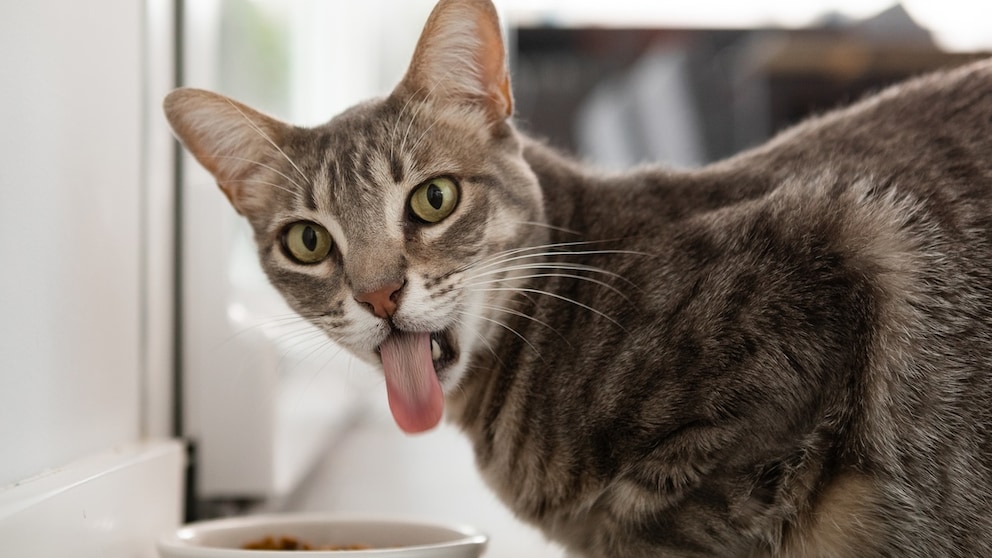
For a while now, social media has been circulating a warning that cats should never face the wall while eating. This could stress them, is unnatural, or might even cause them to leave their food. As a result, many pet owners are quite unsettled. PETBOOK editor and cat expert Louisa Stoeffler conducted a test with her cat Remo to explore where this idea comes from.
Do Cats Really Dislike Facing the Wall While Eating?
The notion “cats don’t like to eat with their heads facing the wall” has been coming up repeatedly for several months—both in conversations with friends and in my work as a cat sitter. Many are now convinced that the food bowl should never be positioned so that the cat faces the wall while eating.
The reasoning behind this seems logical at first: Cats are small predators and are in a vulnerable moment while eating. They are distracted, cannot fully control their surroundings, and want to detect potential disturbances early to prevent anyone from taking their prey or attacking them while eating. In nature and for cats that roam freely, this makes sense.
On the other hand, for us humans, a bowl against the wall is often a much more practical solution: It is less in the way, looks tidier, and is often in a quieter spot than in the middle of the room. Many owners try to resolve this apparent contradiction by placing the food differently as a precaution. I wondered if this concern is really justified—and conducted a classic self-experiment with my cat Remo.
My Self-Experiment with Remo
Remo has been with me since 2019. He has experienced several living situations and feeding spots, which makes him a pretty good “test subject” for this question. In my old apartment, the kitchen was at the very end, making it quite peaceful there. His bowl was next to the sink, with no through traffic and little movement. Interestingly, Remo always positioned himself while eating so that his back was to the room. This is exactly the opposite of what many would consider ideal.
In the new apartment, his feeding spot has changed several times. Since he has been undergoing treatment for FORL, he eats much messier, spreads his food more, drops bits, or “fishes” them out of the bowl. Initially, his bowl was again in a quiet, slightly hidden spot by the window. The result: He regularly fished the pieces out of the bowl and flung them against the kitchen cabinets.
Now he eats at the front end of the kitchen, with wallpaper protection on the wall—right where there is the most movement. Anyone going to the fridge has to pass by him, sometimes even stepping over his tail. Theoretically, Remo could position himself sideways to keep an eye on the doorframe. But he doesn’t. He continues to sit with his back mostly to the room.
The Result
For my small experiment, I deliberately placed the bowl differently—further into the room, with a clear view. If the social media theory is correct, this should have been the more comfortable option for him. But it wasn’t. Remo actively turned himself so that he didn’t have to look into the room.
What stands out is that he shows no signs of insecurity. Even when someone walks past him or steps over him, he doesn’t flinch. He just keeps eating. For him, it seems clear: Nothing is happening here, I don’t need to keep an eye on anything.
Of course, this can’t be generalized to every cat. But with Remo, many factors suggest that other elements are more crucial for his sense of security than the direction he faces while eating. He lives alone, doesn’t have to compete for resources, and gets his food reliably—even if it’s five minutes late in the evening. Apparently, this reliability is enough for him to completely relax while eating.
The Idea Behind It Isn’t Wrong—But Often Oversimplified
The idea that many people have—that cats don’t want to face the wall while eating—is not unfounded and actually makes sense. Cats are indeed more vulnerable in such moments because they can’t fully focus on their surroundings. However, this natural inclination often leads to a very simplified conclusion: that an open view is automatically the best solution. Many house cats today live like Remo and not in constant fear, guarding their food.
For cats, security doesn’t necessarily mean having a wide view while eating. It is often more important that they can eat in a quiet, predictable, and disturbance-free place. An open area in the middle of the room, where people constantly walk around, can be much more uncomfortable for a cat than a bowl in a protected corner. So, facing the wall isn’t automatically the problem—the overall context is what matters.
Cats Primarily Want Peace While Eating
Cats often prefer to retreat a bit while eating rather than positioning themselves in the middle of the room with maximum visibility. This seems contradictory at first glance, but makes sense behaviorally. During feeding, they can’t fully concentrate on their environment and are distracted. This is why the questionable trend of scaring them with cucumbers while eating works.
For many cats, the stress factor isn’t the wall in front of their face while eating, but everything happening around them: noise, movement, tight spaces, hustle, or unwanted proximity. If the bowl is next to a trash can, in a busy hallway, or directly in a spot where people or other animals frequently pass by, it can be much more disruptive than the direction the cat is facing. Therefore, a safe, quiet place is often more valuable than theoretical 360-degree visibility.
Why Remo Isn’t a Counterexample for All Cats
That Remo isn’t bothered by the direction he faces doesn’t mean it applies to every cat. Particularly insecure, skittish, or environmentally sensitive animals can indeed react to how their feeding spot is set up. Some prefer to have the room in view, while others favor a more protected position. As is often the case with cat behavior, there is no rigid rule that works for everyone.
But that’s precisely the key point: The claim “cats don’t like to face the wall while eating” is too general as a universal truth. For some, it may matter; for others, not at all. Remo clearly demonstrates that this theory doesn’t automatically hold true.

9 Reasons Cats Scratch Around Their Food Bowl
Why Cats Steal Our Seats
When It’s Worth Repositioning the Bowl
Still, it can be worthwhile to experiment with the bowl’s orientation—especially if your cat seems uneasy at their feeding spot, doesn’t like to eat there, or frequently stops eating even when hungry. In such cases, a small change can help: a different location, a bit more distance from walkways, less commotion, or a different orientation.
More important than the mere direction of view are the basics of a good feeding spot. The cat should be able to eat there as undisturbed as possible. The bowl shouldn’t be right next to the trash can, water and food shouldn’t be placed next to each other, and the animal should simply be left alone while eating. These factors often play a much stronger role in practice in determining whether a feeding spot is perceived as pleasant than the question of whether there is a wall or not.
Conclusion
The assumption that cats generally don’t want to face the wall while eating is understandable. It is based on the correct observation that cats are vulnerable while eating, but it often draws too simple a conclusion. Not every cat needs a clear view of the room to eat comfortably. Many primarily need one thing: peace, security, and a reliable place.