


February 17, 2026, 5:35 am | Read time: 8 minutes
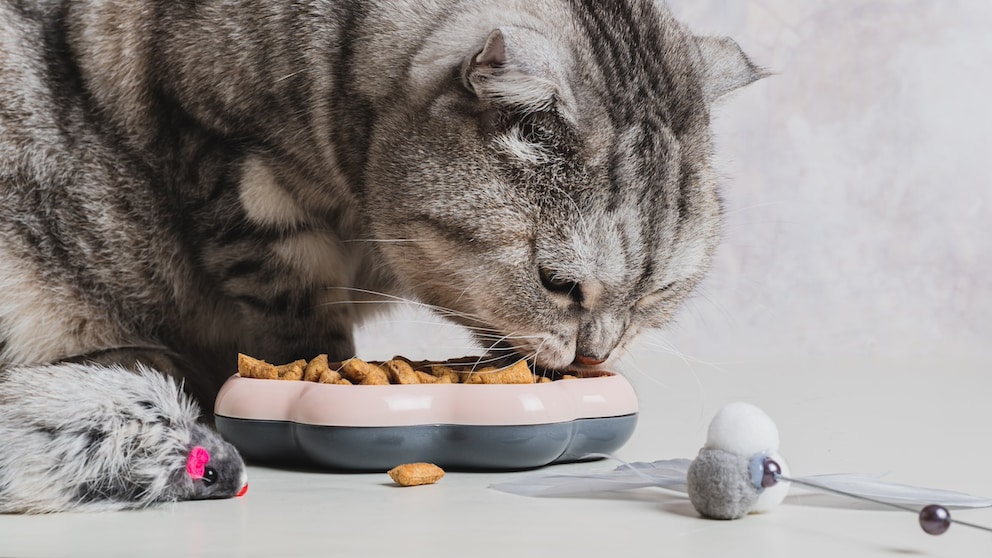
Cats can sometimes be quite messy eaters, and it gets especially “messy” when toys like a stuffed mouse or feather wand end up in the bowl. What many know from their own pets caused quite a stir on the internet when a video showed a cat placing its stuffed snake in the bowl as if it were feeding it. Does it really want to feed its stuffed animal? PETBOOK editor and biologist Saskia Schneider explored the question and developed her own theory.
Does the Cat Want to Feed Its Toy?
“This snake looks a bit thin… I can understand why she’s worried about her friend” – that’s one of the many comments under the now-famous video where a cat places its toy in the bowl. The video shows a young Siamese cat (or tomcat) carrying its green stuffed snake to the food bowl and placing its head directly in the bowl.
What’s particularly remarkable is that the cat repeatedly adjusts the snake’s head to ensure it is really in the bowl and touching the food. This indeed gives the impression that the cat intends to feed its toy. But can cats even perform this mental feat? Or are we anthropomorphizing a behavior that has entirely different causes?

Not Unusual Behavior for Cats
To answer this question for the mentioned video, one would need to consider the context: Does the cat exhibit this behavior often? Does it carry the snake to its sleeping area or the litter box? What happens before and after the behavior? Unfortunately, there is little information on this. It first appeared online on October 13, 2025 – a post on Facebook by the Humane Society of Somerset County, MD is likely the original source. Since then, the video has been shared and widely debated and commented on in various forums on the social news and discussion platform Reddit. It also circulates on social media from time to time.
As unique as this behavior seems, it is not. Many videos and reports can be found online where owners describe how their cats place toys in the bowl. The topic already caused a stir in the media world in 2018 when Maureen Johnson, a U.S. bestselling author of young adult novels, reported on X (formerly Twitter) about the strange behavior of her parents’ cat:
Once again, my parents’ cat has retrieved every cat toy from every corner of the house and placed their faces in the bowl to feed them. It seemed like he was feeding them. But he also regularly eats their faces.

Hunting and Prey Drive
Even back then, behavior experts weighed in on the case. Mieshelle Nagelschneider, a well-known U.S. cat expert and founder of the Cat Behavior Clinic in Portland, believes that the behavior of the cat Sherlock is simply the result of a very strong prey drive. An important indication of this is that all the toy faces were chewed, as she explained in an article in the U.S. newspaper “The Seattle Times.”
“The cat hunts the toy prey in the house and instinctively brings it back to the nest or feeding area,” she explains. In the wild, this would prevent competitors from finding the prey first. Many cats do this with socks or toy mice, whatever they like – and some even dip the toy in water, as if they want to drown or immobilize it. “It’s all about survival,” says the expert.
The Bowl as a Safe Haven
In this case, the toy would not be a “friend” that needs to be fed and cared for, but prey that needs to be secured. In fact, the well-known cat behavior expert Dr. Mikel Delgado also holds this view. She commented last year in the U.S. news magazine “Newsweek” on the video with the stuffed snake and said: “When cats hunt, they often take their prey elsewhere to eat it, presumably because they feel safer there.” The cat is reenacting this part of the hunting sequence – the toy is clearly the prey being brought to safety.

My Cat “Feeds” His Wands
“My cat Remo has long stopped carrying his favorite toys (two rainbow wands and a plush wand we call ‘the rat’ due to its gray color) around the apartment for play – he only does so when he wants to bring them to me. Recently, he has started placing them in his bowl when I’m not there to take them from him. It almost seems like he wants to bring them – and deposits them in the safest place he knows due to the lack of a recipient.
For me, it always feels like he’s sharing something valuable. His favorite toys are highly emotionally significant to him – and those are the ones that end up in the bowl, a place that signifies safety and provision. The fact that he doesn’t play with them but only places them there speaks against pure play behavior.
There is speculation that Remo wants to ‘do something good’ for me with this behavior. Cats do indeed show so-called object-carrying behavior in a social context – especially towards close caregivers. Perhaps the wand is less prey for him at that moment and more of a bonding object. Whether he now thinks they also need to be fed is another question.”
Play Behavior and Positive Reinforcement
Besides this explanation, there are other reasons why cats place their toys in the bowl – this applies to both food and water bowls. On the one hand, it could be pure play behavior. Some animals – especially kittens – find it amusing to fish their toys out of somewhere. Therefore, you can often observe toy mice or paper balls landing in the water bowl, only to be fished out again.1,2
Another major factor lies in learning behavior. Cats love positive attention, and as owners, we often react very amused when our cat suddenly wants to feed the little mouse. Maybe we praise them or pet them at that moment. But even a laugh can be enough to signal to the cat: This behavior triggers positive reactions and attention – so I’ll do it more often now. With our behavior, we have thus reinforced our cat’s behavior – consciously or unconsciously.3

Cat Watches “Cats” Musical on TV–What Does She Really See?

What Lies Behind the Cucumber Shock in Cats
Could It Be “Friendship” After All?
A few years ago, as a behavioral biologist, I would have agreed with the explanations of the cited experts and been convinced: Cats don’t “feed” their toys – but then came “Flounder.” The cat, along with its owner Nina Leipold, is a small internet celebrity because it can communicate using a soundboard. In my assessment, the communication is so complex that one cannot assume the animal is randomly pressing buttons and the human is reading into it.
With her soundboard, Flounder can not only communicate desires like walks, food, and outings but also express a deep bond with her favorite toy “Mouse Toy.” This is a chewed-up stuffed mouse, already missing half, but it plays an important role in the cat’s life. Mouse Toy is also regularly fed by Flounder, who places it in the bowl of her fellow cat Fiki.
But that’s not all – Mouse Toy must also accompany outings (in a small backpack on Flounder’s harness), sit next to the cat while watching TV, and even go to the bathroom. Flounder communicates all this via the soundboard (“Mouse Toy” + “Potty”). Although owner Nina Leipold is not entirely sure whether Mouse Toy is just the “best friend” or even an “alter ego” of Flounder, it clearly shows: This is not a prey game.
Toys as Social Partners?
Flounder’s behavior cannot be easily compared to that of an ordinary house cat. Her owner is an animal trainer and spends a significant amount of time training and living with Flounder. Nevertheless, it shows: Cats are indeed capable of seeing their toys as a kind of social partner and not as prey.
So, the next time your cat’s toy ends up in the bowl, take a closer look: What else does the cat do with it? Is it just kicked around wildly and repeatedly “hunted,” or does it also carry it to the sofa or take it to sleep? Maybe there’s more to it, and even a “friendship” behind it.
About the Author
Dr. Saskia Schneider is a Ph.D. biologist. During her studies at the Free University of Berlin, she focused primarily on zoology and animal behavior. In addition to training as an editor, she completed training as a behavior consultant with a focus on cats.