


October 8, 2025, 9:17 am | Read time: 6 minutes
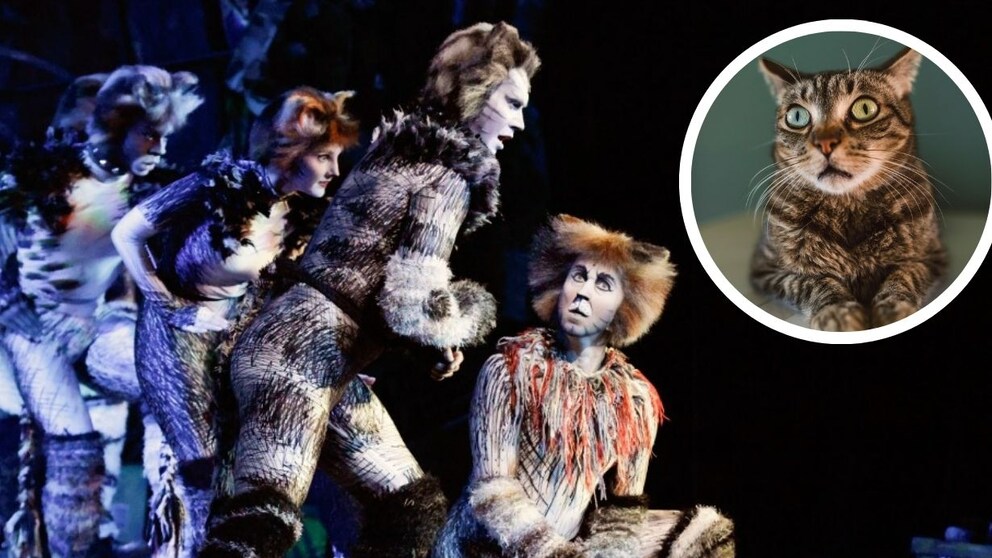
Cats watch TV too. A video recently went viral on TikTok showing a cat watching the musical “Cats” and appearing quite puzzled–if not shocked–by the sight of people in cat costumes. But do cats see the same thing we do when they look at the screen? And what do they think about it? PETBOOK editor Saskia Schneider, an expert in cat behavior, investigates.
“She looks like she’s making a face,” “My cats were also totally captivated when I showed it to them,” and “Do cats think that’s racist?” are some of the comments under the video from the TikTok account “donnamarie03.” In it, she shows her cat intently watching the finale of the musical “Cats” and poses the question from the animal’s perspective: “Is this damn play about us?”
The video has now garnered nearly 350,000 views and almost 60,000 likes (as of October 8, 2025). While many focus on the original version of the musical and praise it (“the only true version–it’s the only one to watch”), others wonder if the cat on TV actually sees people in cat costumes and what it thinks of them. After all, its expression seems shocked.
Do Cats See the Same Thing on TV as We Do?
When you look at how cats perceive their world, there are significant differences compared to humans. The biggest differences relate to their sense of smell, hearing, and touch. However, the vision of our cats differs less. They can perceive movement and even see colors, but only in the blue and yellow/green range. They do not perceive pure red. However, they can see ultraviolet light. It is unclear how this affects the TV image for cats.
Another difference is that cats perceive movement much better than humans–especially at greater distances. This is partly because their eyes allow more light to enter, but also due to their higher temporal resolution. Cats can process 70 to 80 frames per second, while humans can only see about 30 to 50 frames per second. But how does this affect the images on TV for cats?
Standard frame rates are 24 frames per second (fps) for movies. TV shows can be up to 50 fps, and sports broadcasts even 60 fps.1 At least the latter should appear as smooth motion to cats. However, it can be assumed that other formats are not just individual images for cats. Many videos online show how fascinated the animals are by what they see on TV–especially when birds or fish dart across the screen.
Now follow the PETBOOK channel on WhatsApp!
Why Many Cats Like Watching TV–and Even Have Favorite Shows
There are now even studies that have examined the behavior of cats while watching TV. These have shown that cats are particularly sensitive to movement, especially when it mimics natural prey patterns. Particularly popular with the animals: birds and small animals in motion, swimming fish, crawling or flying insects, and other cats or animals that move naturally. Exactly what would interest cats in nature.2
However, some animals have developed their own preferences that cannot yet be scientifically explained. For example, Milo the cat likes to watch the cartoon “SpongeBob,” as his owner shows on the well-known Instagram channel “mr.milothechonk.” As soon as the channel is changed, Milo becomes visibly irritated and even starts nibbling on his owner’s leg to get his favorite show back on the screen.


Cat Puts Toy in Bowl–Is It Really Trying to “Feed” It?

Can Dogs Watch TV?
Is Watching TV Good for Cats?
There is no blanket answer here, as it very much depends on the cat and its reaction to the TV. Some cats are generally uninterested. For them, it takes more than just a moving image to trigger their hunting instinct. Others are crazy about so-called cat TV and even jump up at the devices to catch the bird or mouse on the screen.
This is not only dangerous but can also lead to frustration. After all, the animals never catch the prey. Yet they keep trying. Some develop a real obsession, and herein lies the danger. Constant frustration can lead to aggression or even depression. If you notice your cat pacing nervously in front of the TV, desperately searching for the prey, and not calming down quickly afterward, you should not use the TV as a form of entertainment for your pet. Learn more about the risks of such “cat games” in this article: Expert warns against these games for cats.
In the case of Milo the cat, watching TV is not a problem for now. The animal sits quietly in front of it, intently watching the images. Almost like how we humans (especially the younger ones) behave when we sit in front of the screen. Still, this should be monitored. A cat that only stares at the TV and no longer plays or goes outside is something I have not yet encountered (except for severely overweight animals whose only diversion in life was the TV), but everything in moderation–that applies to cats too.
Do Cats Think TV Is Real?
Another famous example of cats that like to watch TV is Flounder the cat, who even communicates her TV preferences via a soundboard: Pocahontas. The Disney classic practically runs constantly in “Flounderland,” as owner Nina Leipold repeatedly shows on the Instagram channel “flounder_meatloaf.” She often wonders if her cat knows that what she sees on TV isn’t real.
Recently, Flounder even gave a hint after meeting the “real” Pocahontas–an actress in costume–on her birthday. By combining buttons on her soundboard, she communicated that “Pocahontas” on “TV” is just “pretend.” Whether other cats come to this conclusion and what exactly the animals see remains a mystery and requires much more extensive research.
Nevertheless, such videos on social media repeatedly show us how similar animals are to us in their perception. However, we should be careful not to overinterpret their behavior. The cat in the video looking shocked at the musical “Cats” could have many reasons. Loud noises can be particularly irritating to the animals, and probably less the fact that people in cat costumes are jumping across the screen–but we can’t be sure.