

September 2, 2025, 12:02 pm | Read time: 7 minutes
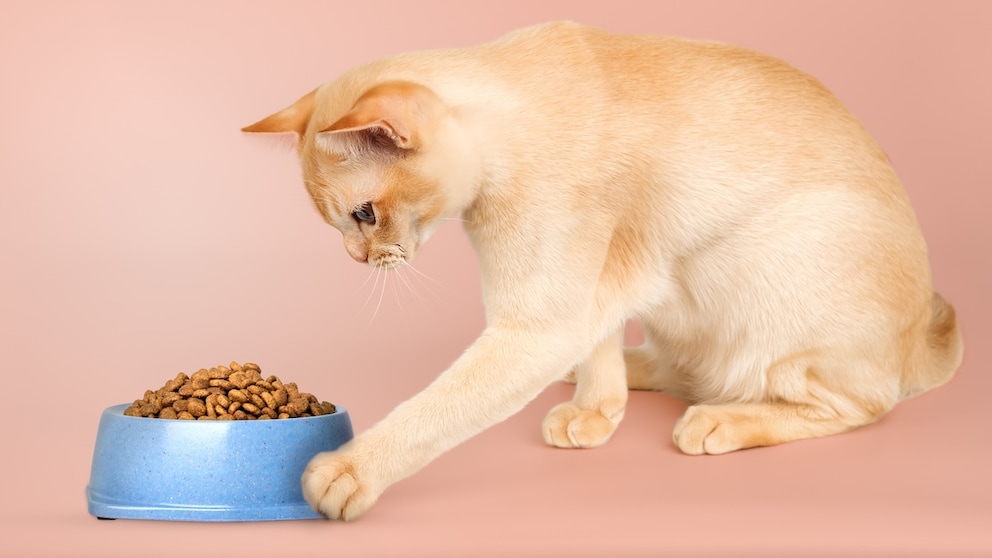
When a cat suddenly starts scratching at its food bowl as if confusing it with its litter box, it can be quite puzzling for owners. PETBOOK editor and cat expert Louisa Stoeffler knows the reasons behind this behavior—and why it sometimes relates to instinct, but other times to everyday problems.
Overview
My Observations from Cat Sitting and Care
As a cat sitter, I regularly get insights into households with multiple cats – and it’s in these homes that I’ve particularly noticed the scratching at the food bowl. Once, I took care of a pair of cats, a male and a female. The dynamic between them was completely off. The female was the “bully,” while the male was more withdrawn. She wouldn’t even share a room with him, and he only found peace on the scratching post.
Their bowls were placed close together, and the feeding area wasn’t particularly clean. Naturally, the female was the first at the bowl. As soon as she had gobbled a few bites, she would scratch at the floor as if trying to make the leftovers disappear. When the male was finally “allowed” to approach the bowl, he would scratch as well. To me, it seemed like she wanted to challenge her roommate for the food, while he was trying to protect himself from the dominant roommate and relieve his stress.
But this phenomenon is not only seen between different genders; it also occurs with two female cats who express the same issue in their own way. Here, too, the bowls are placed too close together. One cat likes to pounce on the food, often leading to the other trying to cover it up—clearly to prevent the other from getting it. This behavior mixes ancient instincts with everyday issues. I’ve also noticed this behavior in my cat Remo a few times. Since he lives alone, there are other reasons for his scratching at the bowl.
Did You Know? Why Cats Always Use a Freshly Cleaned Litter Box
Why Is My Cat Scratching at the Litter Box?
9 Reasons Why Cats Scratch at the Bowl
This behavior is primarily about the resource of food. Some report that their pet also does this at the water bowl, but it’s much more common with food.
As always with cats, there is usually not just one reason for a particular behavior, but several. Some reasons are harmless. Others are related to everyday problems or instincts.
Hiding Leftovers
The so-called food caching is deeply rooted in biology. In the wild, it would be dangerous to leave food out in the open. Some house cats still have this behavior so deeply ingrained that they continue to try to bury their food even in the safety of their home. This could be why Remo, my cat from Spanish animal rescue, sometimes tries to “bury” his food for later. Some cats even try to cover things like old food.
Marking Territory
Cats have pheromone glands between their toes. They use these to spread their scent when scratching and mark places as particularly valuable to them. In a multi-cat household, this can serve not only as an impulse to secure food but also to keep rivals away. I’ve noticed this with Remo, especially after I’ve cleaned his spot. Since he lives alone, he has other reasons for scratching at the bowl.
Creating Order
Some cats are so meticulous that they start scratching right after a meal to avoid being discovered by a larger animal because they didn’t leave their feeding spot tidy. Those who sleep near the bowl, such as by the scratching post, may prefer to keep it especially neat.
Treading Anticipation
When cats knead with their paws at the bowl, it’s similar to how they knead pillows, blankets, or their owners’ laps when cuddling. This behavior originates from their wild kitten days and signals excitement. At the bowl, it means, “I’m looking forward to eating.” Soft surfaces can further encourage this kneading.
Rejection or Intolerance
This is especially evident with “free feeding,” where a bowl is always filled with dry food. This food often loses its appeal outside the package, and many cats then refuse to eat it. They begin to scratch at the remaining food, symbolically trying to bury it, indicating that they want it to “disappear” so something better can come along.
If cats are only used to a certain type of food, they may categorically reject a new one. However, if scratching is a new behavior and the cat is eating less, a vet should be consulted.
Dirty Feeding Area
Just as a too-clean feeding area can trigger the behavior, so can a too-dirty one. Cats have a keen sense of smell and can be very sensitive to cleanliness. A dirty bowl or a strongly smelling plastic mat at the feeding spot can lead to scratching as a way to express, “I don’t like eating this way.” A freshly cleaned bowl and a clean area often make the behavior disappear as quickly as it appeared.
Scratching at the bowl is neither dangerous nor unhealthy. Many owners even find it charming when their cat pretends to bury the floor after eating. It can be a remnant from their wild days or an expression of a love for order. However, it often indicates that something isn’t quite right.
In general, if the bowl is in the wrong place, it’s best to find a quieter spot that can be easily cleaned. Smaller portions also help, as they leave less food behind for the cat to try to “bury.” Wet food leftovers should be removed after 15 to 30 minutes, as they spoil quickly.
In a multi-cat household, it can be a sign of resource guarding or an attempt to keep rivals away. If one cat constantly steals food from another or if one is a slower eater, it might be wise to feed them in separate rooms with closed doors. This way, each cat can eat in peace. If scratching is a new behavior and the cat is eating less, a vet should be consulted. 2
How to Prevent the Behavior
In general, scratching at the bowl is neither dangerous nor unhealthy. Many owners even find it charming when their cat scratches the floor after eating. It can be a leftover instinct from their wild days or an expression of a love for tidiness. However, it often indicates that something isn’t quite right.
In general, if the bowl is in the wrong place, it can cause stress. A bowl that’s too close or too deep can irritate a cat’s sensitive whiskers and cause it to leave food on the edge of the bowl. Loud environments, high-traffic areas, or proximity to the litter box can also cause stress. In such cases, the cat tries to compensate for the problem by scratching, as a way to release tension. It doesn’t really feel comfortable eating in such a setting.
In a multi-cat household, it can be a sign of resource guarding or an attempt to keep rivals away. If one cat constantly steals food from another or if one is a slower eater, it might be wise to feed them in separate rooms with closed doors. This way, each cat can eat in peace without feeling threatened.