

June 30, 2026, 11:25 am | Read time: 5 minutes
Cats are considered independent yet affectionate animals. It can be all the more puzzling for many owners when their cat immediately starts licking the spot that was just petted—almost as if trying to “wipe off” the touch. I observe this behavior in my cat Remo as well. I used to think he just wanted to get rid of my scent. But that’s not true. In fact, this behavior is a completely normal instinct that many cats exhibit.
What It Means When a Cat Licks Itself Frantically After Being Petted
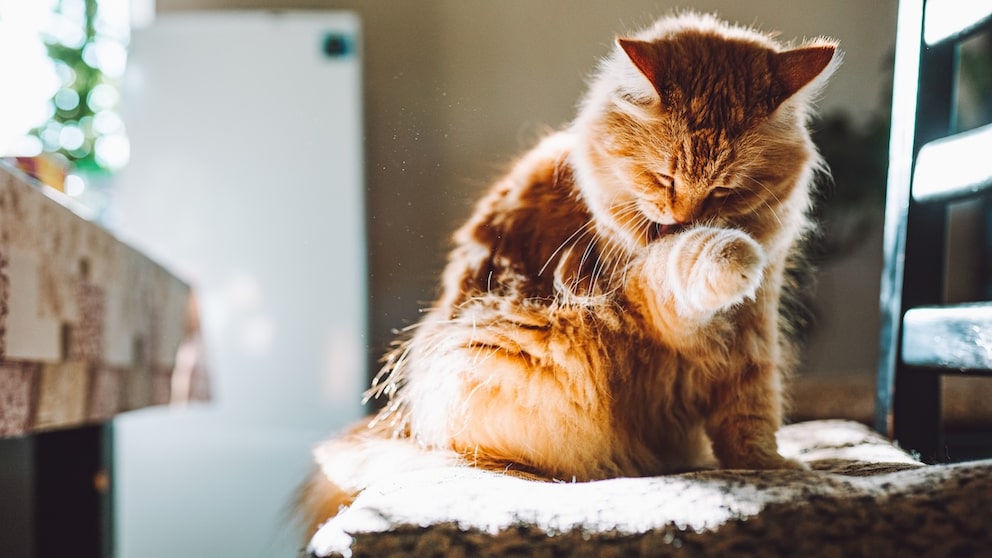
Many cat owners observe this behavior: After being petted, the cat starts grooming itself frantically for no apparent reason. I notice this behavior in Remo too, especially if I touch him on the flank at the wrong moment. If he’s on his way to the food bowl and not in the mood for cuddling, a touch leads to a brief pause, followed by frantic licking exactly where I touched him.
The idea that he’s trying to remove my scent seems obvious. But that’s not the case—Remo is displaying completely normal behavior stemming from internal tension. The cat doesn’t quite know how to react at that moment. It wavers between “That feels good!” and “That was a bit much!” To resolve this minor emotional conflict, it resorts to a familiar behavior: grooming.
What Is a Displacement Activity?
The cat doesn’t quite know how to react at that moment: “That was pleasant—but also surprising!” or “I’m actually busy right now, and that felt weird!” The frantic licking helps it emotionally process this moment of uncertainty. The frantic grooming after being petted is a displacement activity.
Cats exhibit this behavior in an internal conflict situation—when they feel uncertain or overwhelmed. Instead of fleeing, purring, or scratching, they do something entirely different, seemingly inappropriate: They lick themselves, yawn, scratch the air, or sniff into the void.
It may seem strange to us, but it’s completely normal. It helps the cat regulate its emotions—just as we humans run our fingers through our hair or take a deep breath when we’re nervous. 1
Why Petting Can Become Overstimulation
Cats have particularly sensitive nerves in their skin, especially along the spine. Even if they enjoy physical contact, too much of it can quickly become “too much of a good thing.”
The frantic licking after being petted is not a sign of rejection but a way to relieve stress and regain balance. The repetitive motion is calming: Licking releases endorphins that relax cats.
For many cats, petting is pleasant but also stimulating. The subsequent grooming serves to calm them. Just as humans take a deep breath or consciously relax after an exciting experience, the cat finds its emotional balance through licking. This behavior should not be interpreted negatively—on the contrary: It shows that the cat feels comfortable with itself.
Social Grooming as a Bonding Gesture
In cat groups, mutual licking is also a sign of closeness and trust. When cats groom themselves after human contact, it can also be a sign of social interaction. The human is perceived as part of the “group” at that moment—the subsequent licking is a continuation of social contact in cat fashion. They are not covering up their human’s scent but mixing their own with it.
Why Does My Cat Lick My Hand?

Why Do Cats Lie on the Ground to Greet You?
When Grooming Becomes a Warning Signal
As normal as grooming behavior and minor displacement activities are—there are limits. If it becomes excessive, it can indicate health or emotional problems.
Several hours of daily grooming are completely normal for cats. It becomes noticeable, however, when bald spots, skin irritations, or constant licking of the same spot occur. Such signs can indicate excessive grooming—often caused by stress, boredom, or health issues. This is also known as feline self-induced alopecia.
Excessive licking can indicate allergies, skin conditions, or parasites. Therefore, it’s important to consult a veterinarian if the behavior is noticeable. Changes in appetite or behavior can also provide additional clues. Early clarification helps identify potential illnesses in time. However, if the cat licks itself every time or particularly intensely after being petted, it may be a sign of being overwhelmed. The following questions can help assess the behavior:
- How long does it take for the cat to lick itself after being petted?
- Are there areas of the body it doesn’t like (e.g., belly or back)?
- Does it show other stress signals, such as tail twitching or tense body posture?
Then it may help to keep petting sessions shorter or let the cat decide when and where it wants to be touched. 2
Conclusion: A Normal Behavior With Many Meanings
When a cat licks itself after being petted, it’s usually completely normal—and part of its complex, instinctive grooming behavior. It shows a displacement activity to balance its emotions. This is not a sign of disgust or rejection—but an expression of its sensitivity. It can serve self-soothing or social communication by creating a group scent. Those who know their cat and its needs can quickly tell if the behavior is still within normal limits—or if there might be a health issue behind it.