

May 21, 2026, 2:53 pm | Read time: 5 minutes
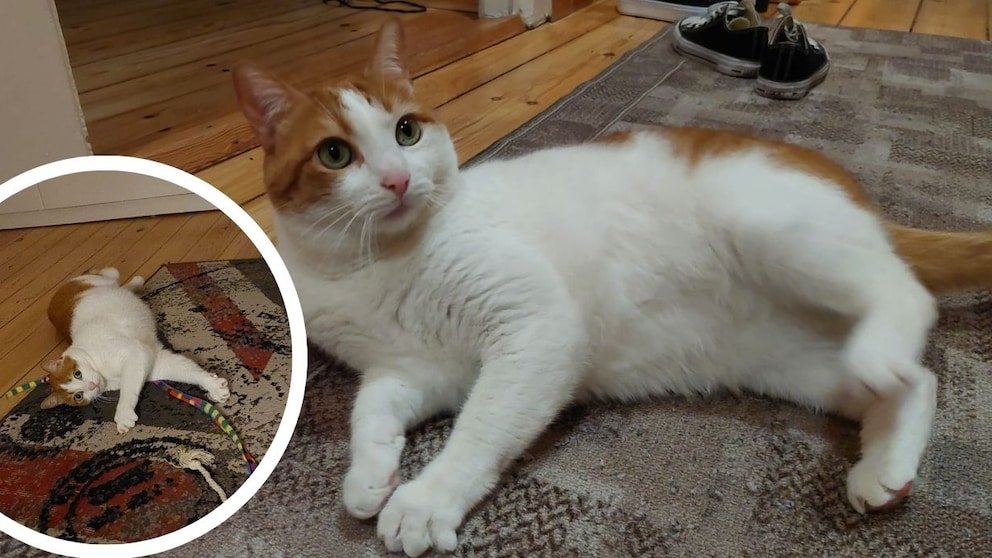
Few things are cuter than when a cat rolls onto its back, shows its belly, and purrs or stretches contentedly. But as relaxed as this sight may seem, the behavior is more than just adorable. It can have many meanings–from pure joy to a hidden cry for help. Editorial cat Remo, a confident and curious feline, provides vivid examples of how varied this rolling can be. His owner, PETBOOK editor Louisa Stoeffler, explains.
Cat Rolls on the Floor–A Greeting Ritual on Four Paws
A particularly noticeable situation where many cats throw themselves onto their backs is when greeting their person. This behavior is well established with Remo: As soon as the apartment door opens, he waits, takes a few steps ahead, and then falls onto his back in the middle of the hallway. With outstretched paws, a gentle purr, and a curious look, he shows: “Welcome home!”
When my cat rolls on the floor, it’s part of a familiar ritual and expresses both joy at my return and a desire for closeness and attention. Some cats also meow or rub against legs–Remo, however, makes it very clear with his back rolling alone that it’s time for him now.
This behavior is by no means unusual–on the contrary: Many cats associate certain routines with positive experiences. If a person’s return is regularly accompanied by petting or food, rolling becomes routine. It creates a kind of daily reunion ritual that underscores bonding and trust, especially if dinner follows shortly after.
A Sign of Trust with Limits
When Remo shows his belly, it’s a clear sign: He feels safe and secure. He often displays this behavior when being greeted–a genuine compliment to me. But this shouldn’t be misunderstood: This rolling is not an invitation to pet.
This behavior primarily expresses positive emotions: joy, trust, and the desire for closeness. It shows: The cat feels safe and secure. Presenting the belly–a very sensitive area–is a strong signal: “I trust you.” As an owner, one should not “exploit” this by petting the animal’s sensitive belly. Some animals might perceive this as a breach of trust and may not visibly enjoy their human’s return in the future.
Playfulness and Learned Attention
Besides greeting, many cats use back rolling to directly invite play or simply to gain their human’s attention. Remo quickly learned: When he throws himself on the floor, I stop, talk to him, or toss him a toy so he can show his excitement that I’m finally back. It could be a ball he chases or one of his wands. Especially in the morning before feeding or in the evening when he’s looking for activity, he uses this strategy outside of the greeting ritual as well.
The rolling can then be accompanied by other playful gestures: an excited tail, a light chirp, or a playful swipe with the paw. In such moments, a small play offer helps–Remo immediately jumps up and chases his favorite toy.
Insecurity and Displacement Behavior
For many cats, rolling is part of a very personal greeting ritual. Accordingly, they sometimes show it to unfamiliar people they want to appease because they can’t assess them. Then they present their belly to show: “I’m not dangerous. Are you?”
A typical example from Remo’s everyday life: When visitors come and he can’t decide whether to approach or retreat, he sometimes lies on his back, grooms, or rolls seemingly relaxed–but remains alert. This behavior serves stress management and should not be understood as an invitation.
In this situation, it can also be displacement behavior–for instance, when there is internal uncertainty. This behavior occurs when the cat is torn between two opposing impulses, such as curiosity and caution. Opportunities for retreat and calm help the cat regain emotional balance and later sniff the unfamiliar visitor in peace.
Doing Yoga With Your Cat? Editor Offers Tips on Strengthening Your Bond

Playing Catch and Hide-and-Seek With Cats? It’s Possible, Says Expert
Other Reasons for Rolling
Rolling on the back can also have practical causes–such as the onset of heat in female cats. Especially when outdoor cats roll on rough ground, particularly after a longer stay in the garden, rolling can also occur due to itching. They often try to scratch hard-to-reach areas. Also, after waking up, rolling serves to stretch muscles–comparable to humans stretching in the morning.
Another trigger: scent marking. Cats have scent glands on their heads, flanks, and backs, through which they release pheromones. By rolling on carpets or favorite spots, Remo leaves clear traces–a clear “I was here.” Therefore, he shows rolling particularly often on carpets, which he has also worked on with his claws. This territorial behavior is harmless as long as it doesn’t include urine marking.
And finally, there’s catnip, valerian, matatabi or silver vine: A stuffed pillow, his unicorn toy or a spray on a stuffed animal–and a true spectacle begins. He rolls around blissfully, purrs, rolls over the floor, drools, and seems temporarily in a trance. Many cats show this euphoric reaction, and it is completely harmless.
Conclusion
Whether for greeting, playfulness, communication, or as a reaction to internal tension–rolling on the floor is a fascinating part of cat language. Cat Remo shows how multifaceted this behavior can be: sometimes friendly, sometimes demanding, sometimes reserved. The context is always crucial. Those who observe their cat closely quickly recognize whether it is expressing joy when rolling on the floor–or prefers to be left alone.