

March 16, 2026, 10:23 am | Read time: 10 minutes
Many cat owners know the situation: The cat suddenly licks the hand, arm, or even the face, after having thoroughly groomed itself. But why do cats do this? PETBOOK editor and cat owner Louisa Stoeffler explains the reasons behind this behavior.
Overview
“Cat Washing” Is an Important Ritual
Grooming is as much a part of a cat’s daily routine as eating or sleeping. Grooming in cats is anything but superficial. On the contrary, they invest a lot of time in their daily hygiene and are very thorough.
Grooming is one of the most important and primal behaviors of cats. It not only serves hygiene but also helps cats calm down, reduce stress, and regulate their bodies. Many cats only begin to truly relax or fall asleep after they have thoroughly groomed themselves.
Sometimes this ritual is not limited to their own fur. Some cats—like my cat Remo—include their owners in this grooming routine. Cats often lick their humans’ hands. But why does my cat lick me? And when should this behavior be discouraged?
7 Reasons Why the Cat Licks Its Humans
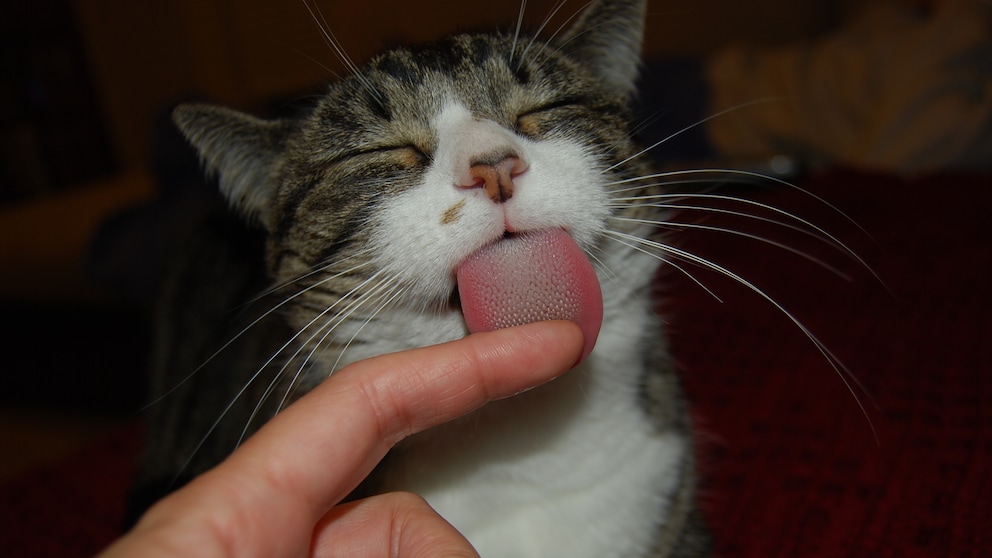
Cat tongues are covered with papillae—horn-like, backward-facing hooks. These not only aid in grooming but can also efficiently pick up food residues. That’s why a cat’s licking often feels quite rough.
When a cat’s tongue suddenly glides over its owner’s hand, face, or hair, it can have various reasons. Cats are very social animals and use grooming as a means of communication. By licking their humans, they often want to express something specific.
Affection
Grooming is a social act in feline communication. If you have multiple cats that get along well, you can often observe them grooming each other. This behavior often extends to humans with whom cats feel comfortable. When a cat licks its owner’s fingers while being petted, it’s usually a clear sign of affection.
In a cat’s life, licking plays an important role: Mother cats clean their young intensively, calming them and stimulating digestion. Many cats retain this behavior and later show it to humans with whom they have a close bond. Especially in hand-raised cats, this licking can be more pronounced.
Trust
In general, grooming is a pure pleasure for cats. They show this behavior especially when they feel comfortable and trust that they won’t be disturbed or need to defend themselves. If they do this with their owners, it’s the ultimate proof that the cat feels safe and trusts us.
Distributing Pheromones
Cats often distribute their pheromones by rubbing against objects or people, thus marking them. They also do this by licking their owner. This is not done out of a desire to mark territory but rather to cover other scents or create a communal scent.
For example, if you’ve petted another animal or brought foreign smells into the home, the cat may want to remove or cover them. At the same time, through close contact with the animal, there is an exchange of pheromones between human and cat, which is particularly intense for the animal when the human has sweated. The pheromones and salts that form on the skin are a true licking and sniffing pleasure for the animals.
Food Smells
Cats have a much keener sense of smell than taste. This means they can still smell some food odors that humans carry as scent particles on their skin while cooking and eating, even when we can no longer perceive them.
A cooked steak still smells delicious to cats on a human hand, even when it’s long gone. Even reaching into a bag of chips can excite many cats. They are often thrilled by the intense smells of fat and spices emanating from the bag and human fingers. When licking the hand, there’s a good chance of snagging a few crumbs. This marks a rewarding behavior for the animal.
Comforting and Reducing Stress
Cats groom each other when they notice a member of their social group is sad or stressed. This behavior can also transfer to humans. However, sometimes the animals do this because they are stressed themselves, and it calms them to groom someone else.
Attention
Cats learn a lot through positive reinforcement. If they lick their owner once and get a reaction—even just a laugh or a pet—the behavior is rewarding for them, and they will show it more often. However, it can also become a sign that the animal generally wants more attention.
Routine and Positive Reinforcement
Cats are creatures of habit and incorporate many of their social interactions into fixed rituals. If a cat regularly licks its owner—for example, in the evening on the sofa or in the morning in bed—it can be part of a learned routine.
Often, positive reinforcement plays a role. If the human responds to the licking with attention, petting, or even a treat, the cat associates this behavior with a positive experience. For them, licking is “worth it.”
Over time, this can become a fixed ritual. Especially in quiet moments, such as relaxing together on the sofa, licking the hand becomes part of the interaction with their human for some cats.
Why Does the Cat Lick My Hair?
When cats lick their owners’ hair, it’s again part of their grooming routine. The human head smells interesting, and hair collects many scents and pheromones throughout the day. However, many owners find it uncomfortable when the cat grooms their hair.
This can also have health consequences for the animal. If you regularly use hair products containing chemicals, the cat may develop digestive problems or mild poisoning symptoms from intense grooming of human hair.
There is also a risk, especially with long hair, that the animal will swallow loose hairs. These must then be regurgitated along with their own hairballs or end up in the litter box. Not infrequently, cat feces line up on individual long hairs like a string of pearls. If the swallowed hair is too long and the cat can’t shake it off, it can lead to unpleasant surprises at the cat’s rear.

Why Does the Cat Lick My Hand and Then Bite?
Sometimes you can observe that the cat first licks and then bites people. This can have various reasons. Young cats being groomed by their mother sometimes don’t want the “cat wash” and prefer to play. The adult cat then lightly bites to show the young one that it’s grooming time, not playtime. If a human flinches when the cat starts grooming, it can trigger this reflex in the animal.
Additionally, you can often see cats lightly biting their fur while grooming. They use their small front teeth to untangle knots in their fur and then smooth it out. This reflex could explain why cats lick and then bite humans, especially when licking hairy areas like arms. There’s also the case where cats seemingly suddenly bite their humans while being petted, which has its own reasons.
Can Cats Transmit Diseases Through Licking?
Many owners don’t mind if their cats lick them sometimes, while others find it rather unhygienic. In fact, the animals, especially if they are outdoor cats, can carry parasites or other pathogens that rarely affect humans. Therefore, you should regularly deworm and vaccinate your pet. If the cat tends to groom humans frequently and you want to allow it, you can clean the affected areas with water and soap afterward.
Special caution is advised with weakened immune systems, open wounds, or certain skin conditions. In families with small children or dependent relatives, increased hygiene should be observed. In these cases, licking should be avoided.

My Experience with Cats Licking
“You can especially observe cats grooming each other if you have multiple animals. However, all my cats have transferred this social behavior to me. Minka, whom I got at 13, went through my teenage years and very difficult phases with me. My cat always came under my blanket when I was stressed and purred on my stomach while licking my arms.
My cat Remo, whom I adopted as a single cat from a shelter in 2019, is less inclined to groom and comfort me. He seems to catch me only by chance while he’s grooming himself. Then he acts as if he didn’t intentionally groom me and returns to his own grooming routine. However, he loves licking my fingers when there are chips. Typical orange, food-motivated cat.
At a friend’s house, I also observed her cat licking her hair. That’s where the fun stops for me. Even though I use vegan and eco-friendly shampoo and no poisoning threat looms for the cat, I really don’t need long hairs with feces strung like little sausages coming out of the cat, preferably distributed everywhere except in the litter box.”

How to Tell If Your Cat Likes You

Why Cats Lick Sweaty Feet
Can I Prevent the Cat From Licking Me (or Others)?
Generally, when cats lick hands or hair, they want to express that they like and trust their owner. You can reciprocate this behavior by brushing or petting the animal. This is a sign to the cat that its social behavior is desired and positively evaluated. Usually, this is normal behavior for the animals and occurs less frequently than, for example, in dogs.
But what can I do if it becomes too much and I don’t want the cat to lick me? Or worse, if guests are over and the cat is happily licking their arms? If you don’t want to reinforce the cat’s behavior, you should distract the animal when it starts grooming the owner or guests, or simply move away.
Sometimes it’s enough to just move your hand away so the cat understands that you don’t want to be groomed at the moment. You can then positively reinforce the behavior by giving a treat instead of a grooming routine.
Grooming Behavior Can Also Be Disturbed
Generally, it’s normal behavior for cats to lick themselves and others. However, there are cases where it goes beyond a healthy level. There are various disorders of cat grooming behavior. These usually relate to the animal itself. Cats sometimes groom themselves and others compulsively, to the point where bald spots appear in their fur.
If the animal persistently tries to lick you even in the most unlikely situations, like at night, action is needed. This indicates a behavior that is stereotypically repeated and signals a deep-seated problem. Either the cat is particularly insecure or cannot sleep for other medical reasons and tries to calm itself by licking. In this case, you should seek advice from a veterinarian, animal psychologist, or cat behavior therapist.