

December 10, 2022, 7:43 am | Read time: 20 minutes
Sharpening claws, resting, and playing: A cat tree fulfills several needs for cats at once. It’s also recommended for owners who want to protect their furniture. But the selection is huge. PETBOOK has answers to what to look for when buying a cat tree and which models are particularly recommended.
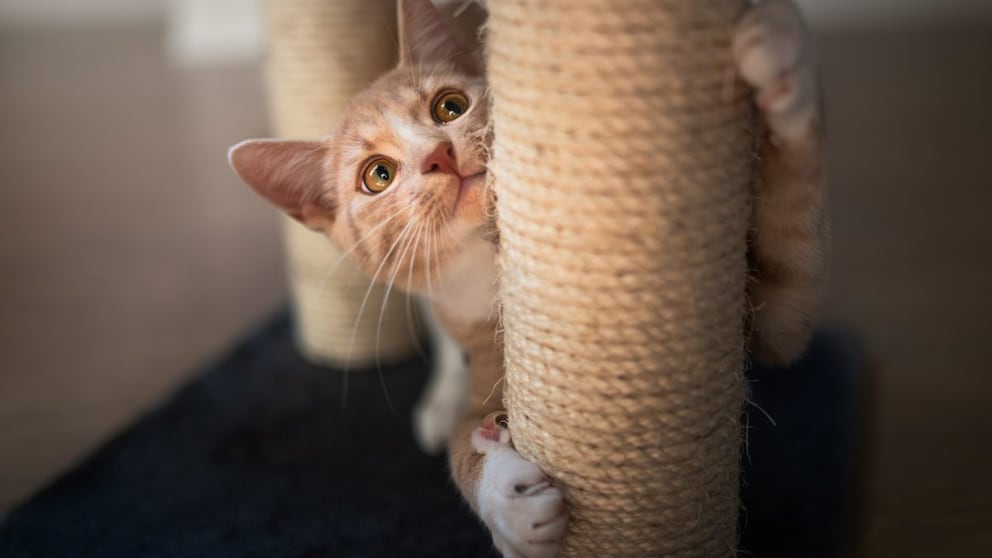
Cats scratch objects to signal to other cats: I live here. They leave not only visible marks but also scent markers. This marking of objects also occurs in the cat’s core territory–the apartment or house. Therefore, even cats that roam outside feel the need to follow their natural instinct to sharpen their claws. When scratching, the cat not only maintains its claws but also stretches its limbs and relieves stress through movement. Cat owners know: If owners don’t provide an opportunity for this urge, the cats will take matters into their own paws–at the expense of furniture and wallpaper.
The Veterinary Association for Animal Welfare writes in its recommendations for keeping cats in private households: “For a cat that lives only indoors, a way to sharpen its claws must be provided (e.g., a cat tree), if scratching the furnishings and furniture is undesirable.”1 A cat tree should be part of the basic equipment for every cat owner, if only to prevent the cat from destroying the interior. But which one to choose? After all, there are cat trees in a wide variety of designs: from simple posts or scratching boards and barrels to elaborate, ceiling-high constructions. And the latter models certainly have their merits.
Overview
Buying a Cat Tree–What to Consider
A cat tree can be more than just a place for cats to sharpen their claws; it can cover several basic needs. PETBOOK knows which needs these are and what to look for when buying a cat tree.
Weight
A cat tree must withstand a cat leaning its full weight against it or jumping onto it. Even if the cat jumps from one level to another with momentum, it should remain stable and not tip over–otherwise, there’s a risk of injury to the animal.
Theoretically, the heavier the cat tree, the more it can withstand. A heavy base plate can also provide stability to the entire cat tree. It’s practical if not only the weight determines whether the tree holds up, for example, when a fully grown Maine Coon uses it with full force to sharpen its claws or jumps from one level to another. The construction is just as important for the stability of the cat tree. All components must be securely screwed together so that nothing wobbles. Of course, screws and nails should not be visible or protruding, so the animals don’t get caught and injured. The materials used also determine whether it’s a high-quality cat tree.
Material
Cats not only like to use their claws but also like to nibble. Plastic, which can be easily nibbled by the animals, is therefore less suitable as a cat tree material, as swallowing hard plastic can lead to potentially life-threatening internal injuries. Lacquer and glue should also not be used on the cat tree, or only in places that the animals cannot reach, as these substances can be toxic to cats.
Ideally, the cat tree is made of solid wood. However, since these models can be expensive, particle board is also a suitable alternative. It’s important that the boards are thick enough to provide the tree with the necessary stability. To ensure the animals can lie comfortably and stay warm and cozy, parts of the cat tree, especially levels and caves, are often covered with fleece, carpet, or other soft materials. All covers should ideally be washable, as they can quickly become dirty–for example, if the cat eats food or treats on the tree, vomits, or leaves fecal residue on it.
Material, Covering, and Diameter of the Trunk
The trunk is particularly important for a cat tree. Not only because it supports the weight of the various levels and the cat itself, but because it allows the animals to sharpen their claws as the most important part of the construction. Therefore, it should, like the rest of the tree, be made of high-quality, untreated wood.
There are also cat tree trunks made of plastic. When buying, however, make sure that the trunks are tightly wrapped so that the cats cannot nibble on the plastic. Many cat tree trunks are wrapped with natural materials such as sisal, water hyacinth, or raffia, and others with fabrics such as plush made of cotton or synthetic fibers. Sisal is considered a particularly durable, albeit expensive, material. Plush and other fabrics are cheaper but are also more quickly shredded by the cat. Additionally, the trunk of the tree should be as long as possible so that the animals can fully stretch when scratching.
Height
Cats want to keep an eye on everything and view their territory from above. Heat also rises in rooms, creating higher temperatures in the upper areas of rooms. Many cats like it warm, which is why they prefer to lie in lofty heights. A cat tree should therefore be as tall as possible, or the cat should have a platform placed as high as possible.
At the same time, the cat tree must match the cat’s age and needs. A kitten or a senior cat will have difficulty climbing great heights and needs steps or platforms that are easy to reach.
Also interesting: Setting up a cat-friendly apartment–here’s how
The Best Cat Trees for Cats Compared
The selection of cat trees is quite large. To give you an overview, PETBOOK has selected nine recommended models and presents them to you.
Cat Tree “Lina” by Pet Fun
Whether the cat is more relaxed and needs a place for a nap or is looking for entertainment: The “Lina” cat tree by Pet Fun offers several sleeping and playing options. The animals can lie in a hammock on the top level, hide in a cave on the middle level, or play with a thick sisal rope. The base plate is made of birch wood. The fabric covers of the hammock are removable and machine washable at 60 degrees. The birch wood trunk is available with a diameter of 12 or 14 centimeters.
Key Features at a Glance
Pros and Cons
It is particularly positive that all components of the cat tree are customizable. The “basic version” of the cat tree includes an unlined hammock. However, you can also choose a lined model in different sizes, colors like natural white, dark blue, and gray, and from various materials like microfiber or cotton.
The base plate is also customizable and available with a waxed surface, clear oiled, or in walnut or chestnut colors. The same applies to the hammock frame. The underside of all elements, as well as the top of the cave and the plate that forms the first level of the cat tree, can be covered with sisal upon request. This gives cats additional opportunities to sharpen their claws. Another plus: The tree can be expanded with additional elements if needed.
Due to the numerous customization options, this cat tree can be designed to suit the various needs of each cat. When buying, make sure that sisal and carpet have different durability and that the carpet may need to be replaced more quickly.
Natural Paradise Cat Tree “Magnolia XL Plus”
Particularly stable and designed for large, heavy cats, the Natural Paradise Cat Tree “Magnolia XL Plus” features a thick, sisal-wrapped scratching post with a diameter of 14.3 centimeters, providing high stability.
The animals can retreat into a birch plywood cave equipped with cushions or sit on the cave, in a hammock, or on two observation platforms to watch their territory. Balls for playing are located on the lowest and highest platforms and the underside of the wooden cave.
Key Features at a Glance
[table “23” not found /]Pros and Cons
It is positive to note that all cushions used for the cat tree are certified according to “Oeko-Tex Standard 100” and are therefore safe for the cats’ health. The cushions can be easily removed with Velcro fasteners and washed in the machine at 30 degrees if needed. The birch wood used for the base plate and the cave slats is untreated and comes from sustainable forestry.
Negatively, the limited customization options are worth mentioning. While the cushions, plush covers, and play balls of the “Magnolia XL Plus” are available in cream, gray, and Bordeaux red, there is no choice between different types of wood or additional sisal covers for the components. Additionally, no spare parts are available in the shop. If a component breaks, you have to be handy yourself.
Cat Tree “Kilimandjaro” by RHR Quality
Unlike the two previously presented models, the “Kilimandjaro” by RHR Quality is completely covered with cream-colored plush. The 185-centimeter-high cat tree has three observation platforms, one of which is equipped with a cushion. Another platform contains a lounging area reinforced with a metal frame, allowing it to support the weight of cats up to 23 kilograms.
Additionally, the cat tree features a cave equipped with a cushion and partially open at the top, which the cats can reach via a ramp, as well as a thick rope for playing and claw sharpening.
Key Features at a Glance
[table “24” not found /]Pros and Cons
Unlike the “Magnolia XL Plus,” replacement parts for the “Kilimandjaro” can be easily reordered according to the manufacturer. The cushions are attached to the cat tree with Velcro fasteners, so they can be easily removed if needed. The tree is robust, and the metal reinforcement of the individual elements provides additional stability, allowing this cat tree to support even heavy cats. It should be noted that the trunk of the “Kilimandjaro” is not made of wood but of plastic wrapped with sisal. It also requires some skill from the cats to climb the cat tree to the top level. For this reason, and because it cannot be expanded with steps or similar elements to make climbing easier for older cats, the tree is not suitable for senior cats.
Additionally, the entrance to the sleeping area is relatively small–it might be difficult for large cats to squeeze through. Moreover, the entire construction, apart from the trunks, is covered with plush. This material is usually less durable than sisal or a tightly woven carpet. It is also unclear from the manufacturer’s information whether the cushions are machine washable.
Cat Tree by Nanook
Like the “Kilimandjaro” by RHR Quality, the cat tree by Nanook offers cats various activities, climbing, and resting options. It features a sisal rope, a hammock, a lounging area, a cave equipped with cushions, and several small platforms.
The four square-arranged trunks of the tree are wrapped with sisal. Whether they are made of wood or plastic is not specified in the product information. According to the manufacturer, the cat tree is specifically designed for the needs of large cats like Ragdolls, Norwegian Forest Cats, and Maine Coons.
Key Features at a Glance
[table “25” not found /]Pros and Cons
Weighing 51 kilograms, the model from Nanook is the second heaviest cat tree in the comparison. Unlike the “Kilimandjaro,” in addition to the four scratching posts, the cat cave is also wrapped with sisal, providing the animals with additional scratching surfaces. The top floor is spacious enough for very large cats, measuring 72 x 52 centimeters.
However, not all floors are designed to provide enough space for Maine Coons and other large cat breeds. The hammock under the 60 x 35 centimeter side lounging plate, in particular, seems very small. While the cushions located in the height and on the cat lounge can be removed, it is not clear from the manufacturer’s information whether they can also be cleaned in the washing machine. Due to the square arrangement of the cat tree trunks, the animals can climb up them, but this design makes it difficult for the cats to jump from platform to platform. Colors and materials are not customizable.
Kerbl Cat Tree “Safari Big”
The Kerbl Cat Tree “Safari Big” comes with a bed, a lounging area, a cave, and two platforms. A tunnel and two fabric mice hanging from the bed and lounging area appeal to the play and exploration instincts of the animals. The cat tree is covered with brown plush. At only 122 centimeters high, this model is the smallest cat tree in the comparison.
Key Features at a Glance
[table “26” not found /]Pros and Cons
It is positive to note that the lounging area, cave, and tunnel are lined with sisal or have individual sisal strips attached to them. This provides cats with the opportunity to sharpen their claws not only on the tree’s trunks. The base plate, measuring 59.5 x 36 x 2 centimeters, provides stability, although this cat tree is designed more for smaller, lighter animals.
With a diameter of only 7.5 centimeters, the trunks of the “Safari Big” by Kerbl are significantly slimmer than those of the other cat trees in this comparison. Unlike, for example, the “Kilimandjaro” by RHR Quality, the bed and cave are not equipped with cushions. To provide their cats with a comfortable vantage point and sleeping place, owners should additionally equip them with soft, washable cushions.
Cleaning the cat tree is quite labor-intensive. To thoroughly clean the tree and not just wipe it with a damp cloth, a steam cleaner must be used. The tree should dry thoroughly after steam cleaning to prevent mold formation. It is also unclear what material the sisal-wrapped trunks are made of.
“Creative Adventure” by Kerbl
The “Creative Adventure” by Kerbl is a particularly elaborate construction and features a sleeping cave, a bed, a hammock, steps, observation platforms, and various activities that appeal to the animals’ play instincts. The trunk has a diameter of 8.5 centimeters and is wrapped with sisal. The cave is 28 x 30 centimeters in size. The bed has a diameter of about 35 centimeters, and the base mats are 38 x 38 x 3.2 centimeters.
Key Features at a Glance
[table “27” not found /]Pros and Cons
As the only one in this comparison, the “Creative Adventure” cat tree by Kerbl comes equipped with steps, making it easier for older animals to reach the hammock and upper observation platforms. The numerous sleeping and activity options, such as the play balls and sisal rope, are also worth mentioning. The construction allows cats to jump from one platform to the next. Due to the dimensions of the individual elements and the thickness of the trunks, this cat tree is more suitable for smaller and lighter house cats.
“Lookout 198” by Petrebels
The “Lookout 198” cat tree by Petrebels is, as the name suggests, a full 198 centimeters high, making it the largest model in this comparison. It features an observation platform at the top, two lounging areas, a forward-open cave, a hammock, several other observation platforms, a play ball, and a sisal rope. The construction is covered with microfiber plush. The scratching posts are wrapped with gray-dyed sisal.
Key Features at a Glance
[table “28” not found /]Pros and Cons
Although this cat tree is tall, the individual elements are arranged close to each other, making it possible for older cats to enjoy the view from the top platform. The four supporting trunks appear robust. The weight of 77 kilograms also speaks for the stability of the construction.
With two lounging areas, this cat tree is ideal for multi-cat households. Notably, the inside of the hammock is lined with wood, providing the animals with an additional opportunity to sharpen their claws, in addition to the sisal. The top platform measures 100 x 45 centimeters, providing plenty of space for large animals.
The manufacturer does not provide information on possible cleaning. The insert in the forward-open cave also does not appear to be removable for cleaning if needed. A drawback, as if the cat eats food in the cave, it quickly becomes dirty, which can look unsightly with the off-white cover. However, the cat tree is also available with a darker cover in the “Pepper” color variant.
“Premium Lovely” by Dehner
Less elaborate and significantly shorter at 110 centimeters high, the “Premium Lovely” cat tree by Dehner features two platforms, a lounging area at the top, a cave at the bottom, and two play balls. Unlike the previous models, this construction is not covered with plush–the scratching posts are two massive wooden posts wrapped with sisal.
Key Features at a Glance
[table “29” not found /]Pros and Cons
The “Premium Lovely” cat tree is particularly suitable for owners of small cats who value stylish interior design and want to provide their animals with additional activity and sleeping options besides the cat tree. Compared to the other models presented, which are equipped with hammocks, lounging areas, and tunnels, this cat tree by Dehner seems somewhat simple. Positively, in addition to the construction from natural wood, the particularly thick and soft plush stands out, providing the cats with a comfortable surface.
Cat owners must expect that their animals will not only use the sisal-wrapped tree trunks but also the tree trunks themselves for scratching, which means this model will need to be replaced after some time. With a very low weight of only 5.2 kilograms, this cat tree is only suitable for light animals.
“Boogie” by More For
The “Boogie” cat tree by More For offers significantly more lounging space and room for large cats. The construction, covered with gray plush and featuring two massive, sisal-wrapped scratching posts, includes an observation platform, a bed at the top, a lounging area, and a large cave, the top of which can also be used by cats as a lounging area.
Key Features at a Glance
[table “30” not found /]Pros and Cons
The “Boogie” cat tree offers enough space for two cats to hide, with dimensions of 82 x 60 x 130 centimeters. The covers can be removed if needed and are machine washable at 30 degrees. While this cat tree provides the animals with plenty of opportunities to hide, sharpen their claws, observe their surroundings, and sleep, play opportunities are not available and must be provided separately by cat owners.
Also interesting: The 6 Best Mini GPS Trackers for Cats
Other Important Features
Now you know which cat tree models are particularly worthwhile. However, besides the material, weight, size, etc., there are other points to consider before buying.
Number of Levels
Many cats, especially when they are young, have a strong urge to move. If the opportunity to move is lacking, the animals quickly tend to become overweight and sluggish. Cat trees with various hiding spots, scratching opportunities, and levels specifically address this feline need.
It is important that the levels are designed to support the weight of the cats. Levels that are supposed to support the weight of large, heavy cats like Forest Cats or Maine Coons must therefore be particularly stable.
Modular or Expandable
Some cats love to rest, romp, or snuggle in hammocks or caves attached to the cat tree levels. Others use the tree only for scratching and have little interest in playing or lying on it.
Especially when a cat has just moved into a home, it is often not known how much interest it will show in the cat tree. Modular or expandable cat trees are therefore a good choice for cat owners whose pet has not been with them for long. Or for those who want to offer their cat some variety and address different needs over time.
Even as the cat ages, it makes sense to adapt the cat tree to the new stage of life and, for example, expand it with steps. A modular or expandable cat tree makes this possible.
Extra: Customizable
Even though the needs of the pet should definitely be the focus when choosing the right cat tree, it is still a plus for buyers to have the option to customize it. After all, the tree takes up a lot of space and should be placed in a location like the living room, where people often spend time, so the cat can watch “its” humans and not get bored.
Therefore, it is nice, especially for cat owners who value their interior design, if the tree, in addition to the already mentioned quality features, can be well integrated into their own home. Customization options such as the choice of materials and colors ensure this.
The following nine cat tree models meet the presented quality features and the natural needs of the cat to sharpen its claws, move, and view the surroundings from above. Additionally, some of them appeal to their play instincts with integrated toys like plush balls and offer them a cozy place for a nap with softly padded caves and observation platforms.
7 Recommended Cat Scratching Barrels Compared

What to Consider When Choosing Natural Cat Trees
Conclusion on Cat Trees: Consider Weight and Needs of Cats
Cat trees are a play, retreat, and claw-sharpening opportunity for cats all in one. However, not every model is suitable for every cat. When buying, cat owners should definitely consider the weight and age of their pet. Not every construction can withstand a heavy animal leaning its full weight against it to scratch or jumping from one platform to another with momentum. Some platforms are also very high, making it difficult or only possible with great effort for kittens or seniors to reach them.
Especially for heavy animals, the cat tree should be particularly stable and provide enough space so that it does not tip over and the animals have enough room to sleep on the tree or observe their surroundings. If the cat is very clean, it is not necessarily necessary to opt for a model with machine-washable covers. However, if the cat likes to nibble treats on the cat tree, you should make sure that the covers are removable and washable when buying.
Source
- Veterinary Association for Animal Welfare, “Merkblatt Nr. 139, Recommendations for Keeping Cats in Private Households” (accessed on 11/29/2022)