

August 29, 2025, 10:36 am | Read time: 5 minutes
Scratch marks as far as the eye can see. Whether on doors, expensive wallpaper, or even the leather couch. This can primarily happen when cats live in a household that isn’t particularly cat-friendly. But help is on the way: the scratching post. Cat furniture made from natural materials is especially popular. PETBOOK explains what to look for in a natural scratching post and how to maintain it.
Cats Want to Scratch
Scratching, sometimes called sharpening, is one of the most natural instincts in cats. Yet some owners still think the animals do it mainly to annoy them. However, this doesn’t align with the animals’ “mindset.” Instead, it has various causes, as my colleague Louisa Stoeffler, PETBOOK editor and cat sitter, explains in this article: Why Cats Develop Unwanted Scratching Behavior and What You Can Do.
Additionally, the instinct to hunt prey is still present in house cats. Besides that, scratch marks serve another function: Cats distribute pheromones with their paw pads and mark certain places as safe for themselves. Especially in unneutered male cats, this can also be territorial behavior.1
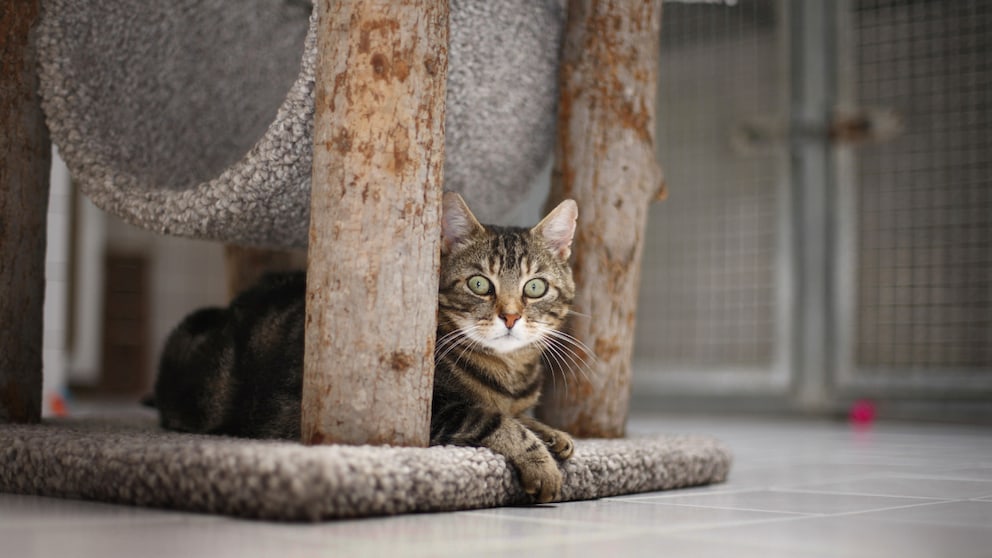
Ultimately, the animals need to sharpen their claws on something—it’s essential for their care. This mainly involves the front paws, which are practically filed and sharpened during scratching. Accordingly, you often see the animals stretching on the trunk of the scratching post and standing on their hind legs. During scratching, the outer, brittle layers of the claw wear off. What remains are the vital, sharp, and healthy claws. Outdoor cats usually use tree bark for this, while house cats ideally use the scratching post or other provided scratching furniture. Many owners therefore wish to make the furnishings for indoor cats as natural as possible. If you want to build or buy a natural scratching post, there are a few things to consider.
What Matters in a Scratching Post?
Imagine a ten-kilogram Maine Coon cat. When the cat jumps and climbs on a scratching post, you become aware of the force the post must withstand. Especially compared to a light kitten that clumsily explores the columns and caves. When choosing a scratching post, you should consider the various needs—and also the safety—of the cat.
The foundation is always a solidly built base. With it, cats can romp, climb, and play extensively—without the scratching post wobbling or even tipping over. Good stability should also be ensured at the columns, the numerous hiding places, and viewing platforms. Additionally, it should be ensured that the scratching post can definitely bear enough weight. Also, for safety reasons, very tall trees should be additionally secured to walls or the ceiling.
To allow the animals to stretch fully while sharpening, at least one of the columns should be 80 cm high. Viewing platforms are an absolute must—because cats have the need to keep everything in view. 2
Which Natural Materials Are Suitable?
For the columns of scratching posts made from natural materials, wood is used instead of hard cardboard. Native tree species such as oak, beech, birch, or hazelnut are particularly suitable for solid wood scratching posts. Fruit tree varieties like apple, cherry, or plum are also excellent.
That’s why sisal yarn (made from agave leaves) or hemp rope is usually wrapped around them. Both materials are considered robust, durable, and resilient—ideal for the next stretch and sharpening session of the cat. Most scratching posts not only offer a large scratching and lounging area but also serve as a playground. Balls or small feathers hang from strings, where hemp or sisal is mostly used as yarn.
On the covering of the scratching posts, you often find raffia, also known as bast paper. Raffia belongs—like sisal—to the straw-like, so-called hard fibers and is made from palms. Since it is quite difficult to wrap, it is braided as bast. Often, the caves are also clad with wooden slats from the outside.
A good scratching post should not lack baskets and caves either. Here you usually find wickerwork or cozy-soft padding, often made from cotton. Important: It’s worth taking a close look at the material description here, as polyester is still often standard for padding fabric. If you don’t want to buy a scratching post, you can also build one yourself. In this DIY project, you’ll learn how: How to Easily Build a Scratching Post for Cats Yourself
Can Cats Be Trained to Stop Scratching?

Cyber Monday 2025 – The Best Deals for Your Cat
What to Consider with Natural Scratching Posts?
First and foremost is the quality of the product: The materials should be free of harmful substances. Additionally, the wood should be untreated and come from sustainable trade. There are several sustainability and quality seals that can guide you. Besides the common seals FSC (Forest Stewardship Council) and PEFC (Programme for the Endorsement of Forest Certification), you can also look for the EU Ecolabel or Holz von Hier (HVH). Whether buying or building yourself: Avoid strong-smelling paints or adhesives.
Otherwise, the scratching post should also be checked for its workmanship, as errors can occur during production. To protect the animals, the post should primarily be checked for injury risks, such as protruding nails or spikes, the firmness of the trunk, or the stability of the caves. 3
Does the Natural Scratching Post Require Special Care?
Like conventional scratching posts, natural scratching posts also need regular cleaning. A routine should include vacuuming the cushions. Special attachments can be used to efficiently remove hair and any dirt present.
Over time, the scratching post will certainly wear out. Especially the sisal is often used by the cats, as it helps them with claw care. Accordingly, the columns may look worn or damaged. If that’s the case, manufacturers often offer the option to purchase replacement parts or to wrap them with new sisal rope yourself. 4