


January 8, 2026, 5:43 am | Read time: 7 minutes
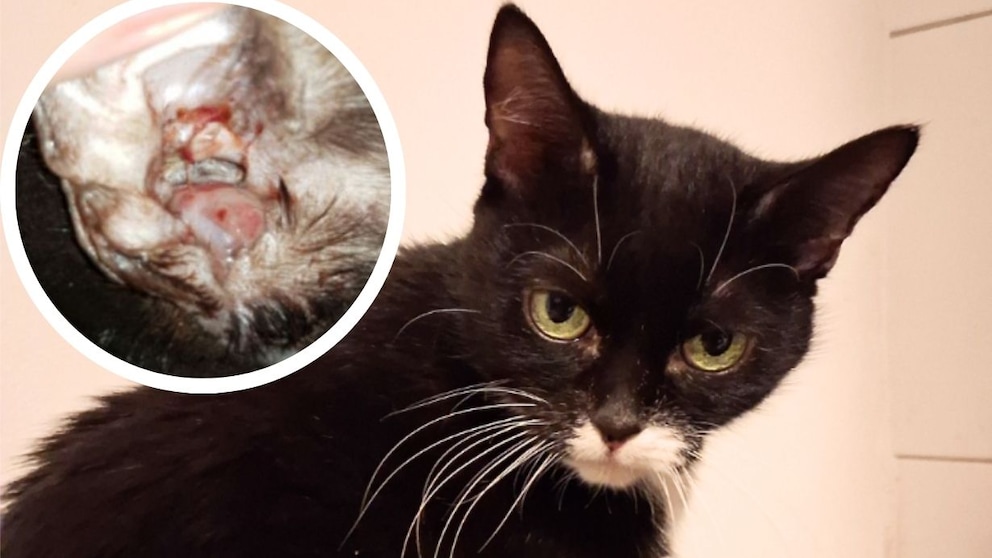
A benign polyp in the ear can burden cats for years. Often, surgery is the only treatment option—frequently a major procedure with risks. However, the case of the cat Kicia is exceptional: Her owner reports that the growth completely receded after treatment with a mixture of Manuka honey and salt. PETBOOK has reconstructed the course and obtained a statement from the treating veterinarian.
“A Foul-Smelling, Brown Secretion Was Running Out of Her Ear”
Benign tumors like ear polyps are usually not an acute but a long-term problem for cats. They grow slowly, repeatedly causing inflammation, itching, or pain—and generally do not disappear on their own. Often, surgery is the only option left. However, the case of the cat Kicia shows that disease courses can sometimes take a surprising turn.
Kicia was diagnosed with an ear polyp in her right ear, which, according to the veterinarian’s assessment, had been present for several years and was growing slowly. Owner Rey Spandel vividly recalls the first symptoms: “A foul-smelling, yellowish, and brown discharge came from her ear, and she often shook her head.” Initially, the polyp was not visible as it was deep in the ear canal and only gradually grew outward. Over time, it became increasingly burdensome for the cat—especially due to itching and recurring inflammations.
Many Veterinarians Advised Surgery
Between 2023 and 2024, Kicia was examined by veterinarians multiple times. The veterinary practice at Vogelsfeldchen first treated the cat in September 2023. This is evident from documents available to the PETBOOK editorial team. Further appointments followed in October and November 2024. At that time, the polyp was still present, and an inflammation of the right ear had developed. To treat this, ear drops were prescribed, containing an antibiotic, an antifungal agent, and cortisone.
Other veterinarians and clinics where Rey Spandel presented her cat over the years came to similar conclusions. The recommendations were almost always surgery or an expensive laser therapy, Spandel summarizes. Particularly distressing was the recommendation to remove the entire ear along with the ear canal to eliminate the roots of the polyp. The potential consequences seemed too severe. “It would have been very risky for her,” Spandel said.
Manuka Ointment Brought Initial Success
In October 2024, an incident occurred, which the treating veterinarian at the time, Dr. Lidia Lesniczak, also describes: The ear reacted with severe inflammation, and part of the skin on the ear flap was lost. Consequently, a Manuka ointment was prescribed. At that time, the polyp was still present, although somewhat smaller. After a few weeks, the condition of the ear improved significantly: The inflammation subsided, and the skin regenerated. Nevertheless, Kicia continued to scratch intensely, causing the polyp to bleed repeatedly. Therefore, an additional ear medication was used.
In response to a PETBOOK inquiry, veterinarian Dr. Lidia Lesniczak speaks positively about the use of honey in veterinary medicine. She writes that she has “had very good experiences with honey/Manuka,” but also emphasizes that additional medications like cortisone or local antibiotics are often necessary. From a professional perspective, she still considers surgical removal—preferably using a laser—the recommended standard therapy for ear polyps.
Polyp Disappeared Completely After One Month of Treatment
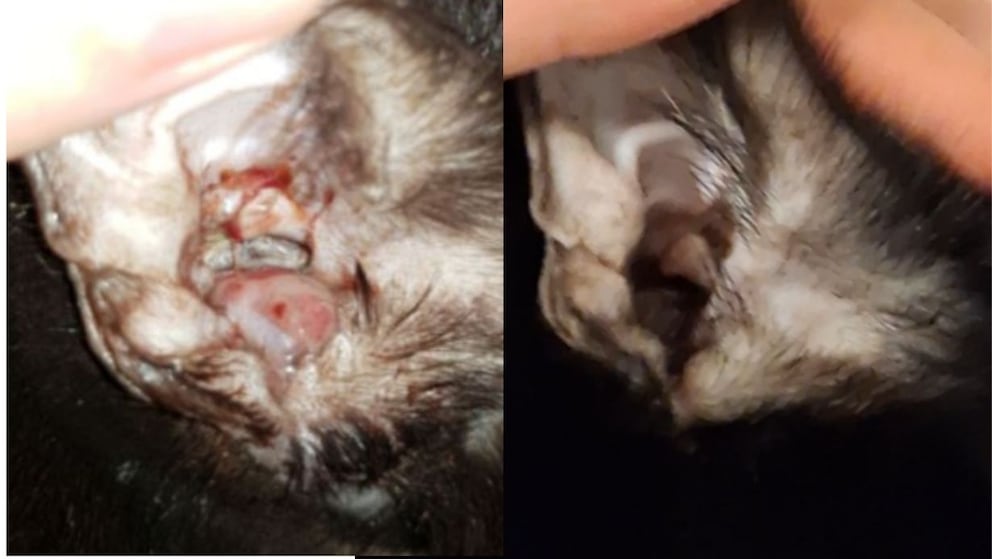
The decisive change, from the owner’s perspective, occurred during a phase of intensive daily treatment. Over several weeks, she regularly cleaned the ear and treated it with Manuka honey and salt. A noticeable reaction was evident after the first application. “The next day, [the polyp] was smaller, the smell was gone, and the ear was dry,” Spandel told PETBOOK. “I continued this treatment for about a month until the polyp completely disappeared. It did not return afterward.”
The treating veterinarian also indirectly confirms this outcome. In her statement, she writes that the owner reported in October 2025 that the polyps had disappeared after several weeks of intensive therapy with Otisur, Manuka, and salt. A follow-up examination is planned for early January. The PETBOOK editorial team has photos of the cat before and after the treatment.
Why Honey Also Has Healing Properties
Honey has long been valued not only as a food but also for its antimicrobial properties. A key factor is the enzyme glucose oxidase, which is present in natural, unheated honey. When honey is diluted, this enzyme releases hydrogen peroxide, which can inhibit the growth of bacteria, viruses, and fungi.
Incidentally, this is not only true for Manuka honey. Local varieties can also be used for wound care. Studies show that particularly gently processed honeys from beekeeping—such as varieties like sweet chestnut or summer blossom—exhibit relevant enzyme activities.

Cat Fur Smells Nice, but Mouth Stinks–Why?

Stingless Bees Granted Rights as the World’s First Insects
Manuka Honey Also Works Against Resistant Bacteria
Manuka honey differs from other honeys due to its high content of methylglyoxal (MGO), a particularly stable antibacterial agent that remains active even in acidic or enzyme-rich environments. Studies show that Manuka honey and high-quality local honeys can have comparable antibacterial effects—even against germs that are resistant to many antibiotics.
The advantage of Manuka honey lies mainly in its consistent and measurable potency, while the effectiveness of other honeys depends greatly on variety, processing, and storage. It is important to note that the positive properties of honey are sensitive to light and heat and are only preserved if the honey is kept natural, cool, and dark.
No Universal Solution
Rey Spandel is convinced: “The combination of Manuka honey and salt was crucial.” The honey has antibacterial properties and keeps the tissue supple, while salt acts osmotically, drawing water from the polyp. This mechanism is not yet scientifically proven—and this is important for Kicia’s owner to emphasize.
Today, the cat is doing well. “The polyp is completely gone, she kept her ear, has no more problems, and is completely healthy for an older cat lady.” At the same time, Rey Spandel explicitly warns against understanding her approach as a universal solution. “My method would need to be tested on other cats first.” Those facing similar problems should be well-informed and take responsibility.
Experiences with Honey on Animal Wounds
“As a beekeeper and biologist who has worked with bees for decades, I am also familiar with apitherapy. This refers to the therapeutic use of bee products like honey, propolis, or bee venom for the prevention and treatment of various ailments. When my cat Kimmie had a severe skin inflammation on her rear, we tested everything possible and treated her against fungi and bacteria. Unfortunately, nothing helped in the long run, and the wound kept getting worse. Since I always have honey at home anyway, I applied some to the wound. After a few days, the wound looked significantly better, and after two weeks, fur finally started to grow back, and I could stop the treatment. Since then, honey is often used for small wounds at our place—thick, already crystallized honey stored cool and dark is best suited for this.”
Important note from the PETBOOK editorial team
The case described here represents an individual course and does not constitute a treatment recommendation. Ear polyps in cats are serious conditions that must always be clarified and accompanied by a veterinarian. Surgical removal remains the medical standard. Although Manuka honey is used as a supportive measure in veterinary medicine, the application of honey or saline solutions in a cat’s ear has not been scientifically studied and can—if applied incorrectly—lead to severe inflammation or injury.
Pet owners should therefore not conduct self-experiments without veterinary consultation. PETBOOK assumes no liability for damages resulting from the imitation of the described procedure.