

November 13, 2026, 11:07 am | Read time: 3 minutes
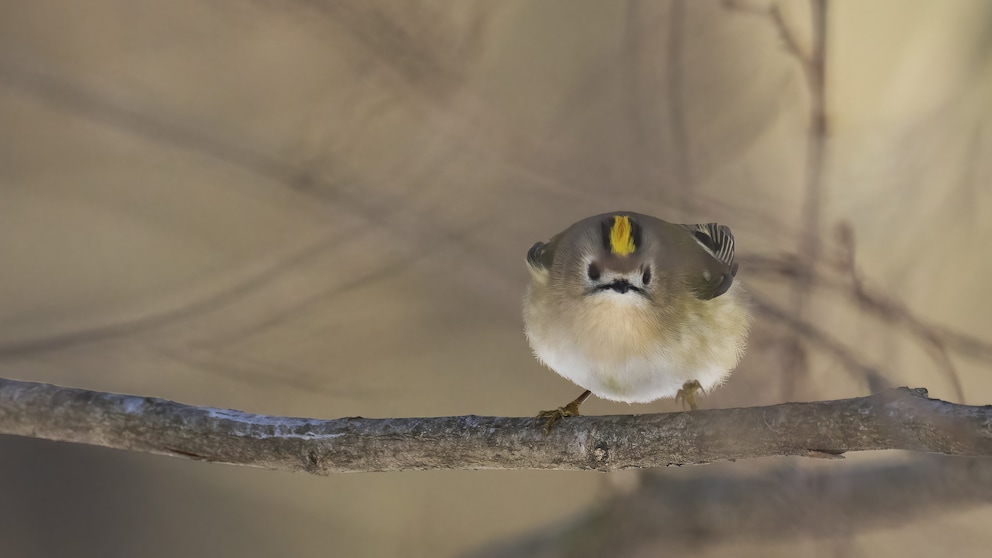
Weighing only five to six grams, it must endure subzero temperatures every winter night and looks like Germany’s angriest bird: the goldcrest. The NABU considers it one of the smallest and lightest birds in Europe. How such a tiny bird survives the cold season is a small survival story. PETBOOK introduces it.
What does the goldcrest look like?
The goldcrest is eight to nine centimeters long. Its upper side is olive green, and the underside is dirty white. It has a stripe on its crown, orange in males and yellow in females, bordered by black longitudinal stripes. In males, the orange feathers are often covered by yellow ones. The Latin genus name “Regulus” means “little king.” Its characteristic call, a shrill “sri-sri-sri,” is so high-pitched that older people often can’t hear it.1,2
Where does it live and what does it eat?
The goldcrest lives in coniferous and mixed forests and usually nests in spruces. In winter, it can also be found in parks and gardens. It primarily eats tiny insects such as springtails and spiders.
How does it survive icy winter nights?
The energy requirement is enormous. According to the Swiss Ornithological Institute, the bird needs daily food equal to its own body weight. In winter, it must catch enough insects in six to seven hours to survive the approximately 17-hour night outside in the cold. During long, cold nights, it can lose up to a quarter of its body weight, according to the Alpenzoo Innsbruck. To save energy, the birds huddle together.3,4
Also interesting: The 16 most common winter birds in Germany
The birds completely vacate their breeding areas in the far north during winter because the short winter days there likely don’t provide enough time to gather reserves for the night. Goldcrests from the far north winter in Central Europe and the Mediterranean region, while Central European birds are partial migrants. It becomes particularly dangerous when trees and shrubs freeze over: According to a NABU local group, mortality can be high then.5
How does the goldcrest breed?
The nest is a hanging, spherical cup that the birds weave into dense conifer branches. They usually breed twice a year, and the female can lay up to twelve eggs. The clutch can weigh up to one and a half times as much as the bird itself.

Do You Know Them All? These 6 Types of Tits Are Found in Germany

How Bumblebees Suffer for Tomato Cultivation
Is it endangered?
No. The Red List of Breeding Birds (2020) lists the goldcrest as not endangered. In Germany, 910,000 to 1,350,000 pairs breed, and the long-term trend is considered stable.
Also interesting: How a ping-pong ball helps wild birds in winter
How can you help?
At the feeding station, goldcrests like suet and dried insects, according to NABU. Spruce branches at the feeding station make it more inviting.