

May 22, 2026, 1:49 pm | Read time: 15 minutes
They are considered diligent helpers in greenhouses—especially tomatoes benefit from the unique vibration pollination by bumblebees. But what sounds like natural agriculture has a dark side: Millions of bred bumblebees die under questionable conditions after their work is done. PETBOOK reveals how a lucrative business operates at the expense of animal welfare and biodiversity—and why the use of bred bumblebees needs to be critically examined.
Bumblebees play an important role as diligent pollinators not only in the wild. A special ability, vibration pollination, also makes them ideal livestock in commercial fruit and vegetable cultivation. Tomato growers, in particular, who cultivate their fruits in greenhouses, benefit from the special bumblebee pollination. But what sounds natural and organic is apparently anything but pleasant for the bumblebees used in tomato cultivation. Bred by the millions in large halls for agriculture, they face death by burning or freezing after their work is done, as conservationists and bumblebee experts criticize.
The reason: The animals are not allowed to be released into the wild because they are considered a threat to native insects. PETBOOK has investigated these allegations and explains the problems that bred bumblebees can cause and how traders and vegetable producers deal with them. The research has shown: Apparently, a lot of money can be made with bumblebees—not just in tomato cultivation. The business is tightly organized. However, inquiries are not welcome.
Bumblebees as Cost-Effective Livestock in Vegetable Cultivation
Flowering and crop plants need to be pollinated to reproduce. Additionally, the yield of pollinated fruit and vegetable plants is higher, and the quality of the fruits is better. Especially nightshade plants like tomatoes, eggplants, and potatoes require pollination. In the wild, this task is performed by wind, birds, bees, and bumblebees, among others. 1
However, plants grown in greenhouses or polytunnels are almost inaccessible to wild insects. Tomatoes, especially, are often grown in protected environments and thus do not come into contact with bees or bumblebees. Until the late 1980s, growers had to painstakingly shake their plants by hand to ensure pollination. Even today, hobby gardeners are advised to use an electric toothbrush on tomato blossoms to mimic bumblebee pollination and achieve good yields.
Bumblebees Are the Only Suitable Pollinators for Tomatoes in Greenhouses
What works for a handful of plants is far too time-consuming and—due to the high labor costs—very expensive in commercial cultivation. Therefore, more and more vegetable and fruit farms have turned to bumblebees: Specially bred colonies take over the pollination work in protected cultivation. Unlike honeybees, bumblebees do not lose their orientation in greenhouses. Thus, they are currently considered the only pollinator insect that successfully pollinates in greenhouses.
Bumblebees belong to the wild bees. There are about 250 species of bumblebees worldwide, 41 of which are found in Germany. Besides the field, meadow, and garden bumblebee, the dark earth bumblebee is probably the best-known representative. It is recognizable by its white abdomen and two dark yellow stripes on its black-brown body. Its close relative, the light earth bumblebee, has lighter yellow stripes on its body. Workers of the dark earth bumblebee measure about 11 to 17 millimeters, while male drones measure 14 to 16 millimeters. In nature, earth bumblebees prefer to nest in abandoned mouse burrows and other underground holes. 2 3
The colonies live for one season; in the fall, workers, drones, and old queens die. In the spring, the young queen, who is the only one to have overwintered, forms a new colony. Bumblebees are diligent and visit around 3,000 flowers per bee during their 18-hour workday. They are also usually active much earlier than their relatives, the honeybees. While honeybees only start flying at a minimum of 10 degrees Celsius, bumblebees are active at daytime temperatures of two to six degrees. Bumblebees generate the body heat needed for flying by vibrating their thoracic muscles.
Better Harvests Through Vibrations
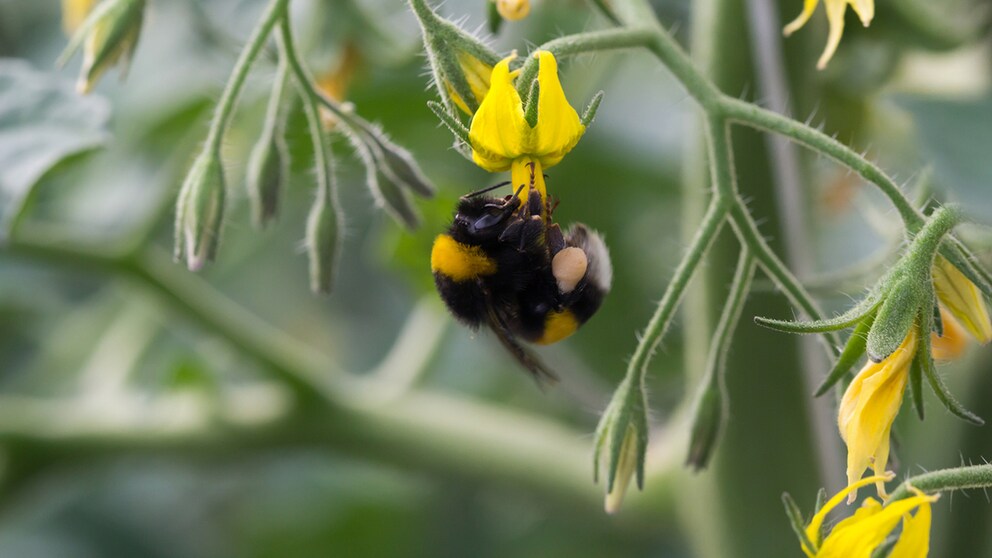
The ability to vibrate not only keeps the bumblebees warm but is also useful for pollinating certain plants. Bumblebees can do what neither bees nor butterflies can: shake loose pollen that is deeply embedded in a tomato blossom. To do this, the bumblebee settles under the stamens of the tomato blossom, bites into it, and vibrates with its wing muscles. This process is aptly called vibration pollination.
This causes the pollen to fall from the blossom onto both the surrounding flowers and the bumblebee itself, thus pollinating nearby flowers. Additionally, the bee carries pollen from its fur to other flowers, where it sticks to the sticky stigma of the pistil and pollinates the plant as well. This effect makes bumblebees interesting for commercial agriculture, especially for tomato growers. Since the late 1980s, the animals have been specifically bred for this purpose. 4
Environmental Groups Criticize Mass Breeding of Bumblebees for Tomato Pollination
While a honeybee colony provides several thousand foragers for pollination, a bumblebee colony averages 500 animals. Depending on the need and size of the area to be pollinated, several boxes of bumblebee colonies are used at different locations in the greenhouses. Forty workers can pollinate about 1,000 square meters of tomato plants for eight to 12 weeks. The advantage: Not only is the expensive and laborious manual handling of the plants eliminated, but where bumblebees are active, significantly fewer chemical agents against pests and plant diseases are used, as these could also harm the bumblebee.
Nevertheless, environmental groups and bumblebee experts are not enthusiastic about the large-scale use of these buzzing pollinators. They criticize, among other things, the mass breeding of these animals under poor conditions, preventive medication, the spread of diseases, and threats to the native insect world. Additionally, bumblebees that are no longer needed are simply killed. Is there any truth to these allegations?
Dark Earth Bumblebee Preferred
The dark earth bumblebee, scientifically known as Bombus terrestris, is mostly bred. Originally, bumblebee breeding began with wild captures from Turkey and Greece. Nowadays, bumblebees are bred by the millions in large halls specifically for use in greenhouses and polytunnels.
Through selective breeding, bumblebees are now apparently optimized for peak performance. They no longer have much in common with their wild relatives, as bumblebee expert Harry Abraham from Willich in North Rhine-Westphalia explains in an interview with PETBOOK. “Bumblebees are going the same way as honeybees, which have been bred further and further for human needs.”
Most of the World’s Tomatoes Are Pollinated by Bumblebees
The fact is: A Dutch bumblebee breeder, whose animals are also used in Germany, advertises with particularly long-lasting and large colonies. The “pollination potential” of his animals is up to 30 percent higher than that of bumblebees from other suppliers. Around 30 companies worldwide are engaged in bumblebee breeding, with Belgium, the Netherlands, and Spain leading in Europe. And the bumblebee business is booming: The majority of tomatoes produced worldwide are now pollinated by bumblebees. This was reported by the animal protection organization Peta, citing figures from the Federal Information Center for Agriculture (BZL) several years ago.
For orientation: In 2023, around 190 million kilograms of tomatoes were produced worldwide. German bumblebee breeders mostly act as local distribution partners for large breeders from neighboring countries, as two companies told PETBOOK upon request. They distribute what is bred in the Netherlands, among other places. 5 6
Bred Bumblebees as a Threat to Native Insects
Even if the bumblebees used for tomato cultivation in domestic greenhouses are bred forms of the naturally occurring dark earth bumblebee, they should not escape from their deployment sites and mate with their wild relatives. Not only because it is simply forbidden in Germany to release non-native animals, as bumblebee expert Abraham emphasizes. He has been involved with bumblebees since the 1970s, educating people about the animals and knowing how to best attract them to the garden. 7
Like many nature and environmental organizations, he is also a critic of commercial bumblebee pollination. Among other things, the escape of bred animals poses a threat to their wild relatives, as reported by the Nature Conservation Union (Nabu) South Baden and the Foundation for Man and Environment.
Earth Bumblebee Pushed Native Species in Chile to the Brink of Extinction
Experts fear that the mating of bred, escaped bumblebees with wild animals would result in native wild bumblebee species eventually no longer existing in their original form. This “faunal distortion” could sustainably change the species composition in an area, according to Nabu. 8
As early as 2018, the Belgian Radio and Television Station BRF reported that bumblebees bred in Belgium were causing a stir in South America. The reason: The dark earth bumblebee, which is native to Europe but not South America, thrived in its new home and became an invasive species. From Chile, it quickly spread to Argentina, where it pushed the native South American giant bumblebee Bombus dahlbomii to the brink of extinction. In some regions, it soon disappeared. 9
Commercially Bred Bumblebee Colonies Often Infested with Parasites
In North America, escaped export bumblebees also caused damage. They are said to have displaced the native yellow-banded bumblebee and the rusty-patched bumblebee. The Franklin’s bumblebee is even considered extinct since 2006, according to Nabu South Baden. The animals were either displaced by the strong competition from the bred bumblebees or by introduced diseases. Exported bumblebees apparently cause problems not only as competitors for food and habitat. Bred specimens bring their wild relatives into contact with unknown parasites and diseases to which wild bumblebees have no defense.
A British study from 2013 showed that commercially bred bumblebee colonies were infested with parasites in 37 out of 48 cases. These can also spread to wild relatives. Escaped or intentionally released animals could transmit pathogens either directly to other bumblebees or indirectly, for example, through traces left on flowers. If an infected bumblebee feeds on the pollen of a flower, it can leave traces of its pathogens there. If another insect visits this flower, it can pick up the pathogens along with the pollen. 10
Factory Farming and Antibiotic Use?
Parasites also apparently played a role in the drastic decline of the orange earth bumblebee from South America. Its European relative, which was imported for pollinating crops, apparently brought parasites with it. These severely affected the native bumblebee species.
Bumblebee experts like Harry Abraham see the mass breeding of the animals as a reason why parasites have an easy time among bred bumblebees. Bred bumblebees are raised in large halls, crammed together in plastic boxes, as bumblebee expert Harry Abraham and the Nature Conservation Union Nabu report. “The animals are stacked by the thousands in plastic boxes, fed with sugar solution to grow, and then shipped all over the world,” says Abraham. “This has nothing to do with eco-friendliness anymore.” This factory farming provides an ideal environment for fungi, viruses, and bacteria. In the cramped boxes, parasites and bacteria can quickly spread from colony to colony.
To contain this, bumblebee breeders would have to resort to preventive medication, similar to the fattening of pigs and chickens. “We know the problem from factory farming, for example, with breeding pigs,” says Nabu South Baden on its website. “There, medications like antibiotics are used prophylactically.” This is also the approach with bumblebees, as Abraham says: “The animals are given antibiotics just to ensure they survive the few weeks they are supposed to pollinate in a greenhouse.”
One Million Bred Bumblebees Per Year
Those who want their crops pollinated by bumblebees can order the animals online like clothing or books. Depending on the crop to be pollinated and the size of the area, individual or combined larger boxes with around 60 to 70 animals per colony can be ordered. 11
However, the prices for the animal goods are not publicly available. Even when PETBOOK inquired with several dealers, they did not disclose prices. Only that the animals are traded with the reduced value-added tax rate of seven percent, a dealer shared upon request. The animals are shipped in the containers in which they will later live in the greenhouse. These are usually sturdy boxes with an outer carton containing the bumblebee nest. 12 13
Typically, workers, including cocoons, pupae, and a queen, are shipped. In the early days of bumblebee breeding, the animals were shipped without a queen, according to bumblebee expert Harry Abraham. However, this practice has since been abandoned, as a colony with a queen lives significantly longer than one without.
Bumblebee Colony Dealers Provide Little Information
Depending on the type and quantity of plants to be pollinated, bumblebees are typically used for eight to 12 weeks. More than a million bumblebee colonies are used annually in Europe alone for commercial purposes. Although bumblebee breeding sounds mostly like a seasonal business, especially when it comes to pollinating local berries, “We actually sell year-round for greenhouses,” a dealer told PETBOOK. Otherwise, he remained tight-lipped—as did all of his colleagues interviewed.
One of the largest bumblebee breeding companies based in the Netherlands advertises its buzzing export hits and a large dealer network. However, the parties involved do not want to let anyone look behind the scenes and apparently ensure that their distribution partners and customers do not reveal too much either. Almost every bumblebee dealer active in Germany seems to have connections to the large breeder from the Netherlands.
“We don’t breed the animals; we only distribute them,” was a common response to PETBOOK inquiries. Questions about bumblebee husbandry, shipping, and what happens to the animals after their work is done were not answered by any of the German partners. Since living bumblebees, as already described, cannot be released or returned, as a bumblebee dealer interviewed by PETBOOK stated, the fate of the animals seems sealed.
Are Bumblebees Cruelly Killed After Their Work?
In the UK, bumblebees used for pollination are reportedly killed after their work is done. This is a requirement from breeders. Users are instructed to either freeze the nests or burn them along with the animals. The German Animal Welfare Federation reported in their magazine “Du und das Tier” that this practice is “common” among bumblebee users. Bumblebee breeders recommend packing the boxes with the living animals in plastic bags and freezing them for at least a week.
“Often, however, they are not cooled cold or long enough for cost reasons,” the report states. “In these cases, during subsequent disposal, animals may awaken from their cold stupor and then either suffocate or starve in the plastic bags.” To avoid the costs of freezing, bumblebee nests are often burned. “However, some animals always escape, dying in a long death struggle because their wings and fur are singed or stuck with wax,” the animal rights activists say. “Both methods of killing are associated with very high animal suffering—not to mention that countless bumblebees have to die this way every year.”
Surveys from the UK Show: Many Release Bumblebees Out of Pity
However, surveys in the UK showed that only a few vegetable farmers adhered to these guidelines. Many released the animals out of pity or used them directly outdoors, such as in orchards. A German distribution partner interviewed by PETBOOK assured that his customers are not required to destroy the bumblebee colonies after pollination work. “The animals only live for a maximum of 23 weeks anyway, then they die on their own.” Therefore, killing the animals is not necessary.
The suggestion that escaped bumblebees might pose a threat to their wild relatives was also dismissed upon inquiry. “The bumblebees do not escape; they always return to their colony, which is in the greenhouse,” said the managing director of the distribution partner. He did not want to say more.
Why Can’t I Buy Bumblebee Honey?
Stingless Bees Granted Rights as the World’s First Insects
Tomato Producer Silent on Bumblebee Fate
Plant breeders who use bumblebees in their plantations also remain silent when asked. A large Dutch tomato producer, who sells his fruits in this country through a northern German discount store and a cooperative supermarket chain, explicitly advertises bumblebee pollination. When asked if they would like to answer a few questions, they initially responded friendly and accommodating. However, they ultimately did not respond to the sent questionnaire.
Initially, it was said that the responsible employees were on vacation. Eventually, the questions were forwarded “internally,” as it was said. The answers finally submitted were surprising: They did not come from the tomato producer himself but from one of the largest European bumblebee breeders from the Netherlands, who distributes his animals through those German dealers who had previously also withheld information. The questions about what happens to the bumblebees when all the tomato blossoms are pollinated and what happens if some of the animals escape their greenhouse were not answered this time either. Instead, the bumblebee breeder sent a short, well-sounding promotional flyer through the tomato producer, containing all the sentences already made by the German dealers.
“Bumblebee breeding is a closely guarded secret for many reasons,” says bumblebee expert Harry Abraham in an interview with PETBOOK. Not only because there is obviously a lot of money behind it, but mass breeding and medication do not fit the often-promoted image of natural cultivation. The fact that breeding consumes a lot of energy and bumblebee colonies are shipped worldwide has little to do with ecological and environmentally friendly practices. The suspicion that bumblebees are cruelly killed after their work tarnishes the image of commercial bumblebee pollination.
Conclusion: Bumblebees Are Bred Under Questionable Conditions for Tomato Cultivation–Their Fate Is Uncertain
The pollination of tomatoes by bumblebees in greenhouses results in healthier plants, better growth, and higher yields. Once bumblebees are in use, fewer pesticides are applied. This is good for producers and consumers. However, breeding bumblebees consumes a lot of energy, and their transport across Europe and worldwide is CO₂-intensive and not environmentally friendly.
Additionally, the animals are apparently bred and used under questionable conditions. Their fate after completing pollination work is uncertain, and their impact on native insects needs further observation. Responding to these allegations with transparency and openness should be the task of bumblebee breeders and vegetable growers who use these animals. But they prefer to remain silent. This is not reassuring and damages the reputation of the supposedly eco-friendly and biologically sound bumblebee business.