

November 2, 2026, 10:03 am | Read time: 4 minutes
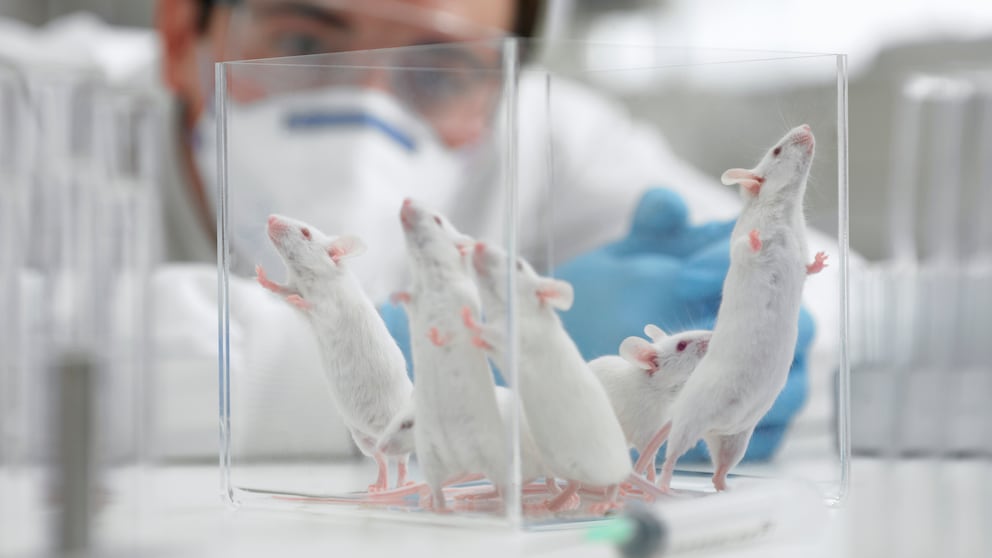
These are real horror scenarios seen in pictures and videos: dogs with gas masks inhaling toxic substances, rats being electrocuted, or monkeys infected with severe diseases and suffering. All this happens in the name of research and the companies that use animal testing. And all this, according to a demand from the coalition agreement of CDU, CSU, and SPD, is supposed to become even easier in the future.
Less Bureaucracy–but Also More Animal Suffering
The federal government is planning its own animal testing law, separate from the existing animal protection law. Specifically, this means: The animal protection law sets out how animals are to be treated, how they are protected, and what standards must be met. If it is no longer connected to the animal testing law, these protection guidelines would no longer apply to animal testing. This could result in less frequent or thorough inspections. Animal welfare organizations might also no longer be able to legally challenge compliance with the rules. The lives of animals in research labs would likely worsen significantly.
Also of interest: “Adopt, don’t shop”–the uncomfortable truth behind the slogan
However, if the law is passed, the animal testing lobby will benefit the most. Among other things, bureaucratic hurdles in research will be reduced, speeding up processes and research.

These Animals Have Poisonous Green Blood

New Testing Method Uncovers Flaws in Dog Toys
Over 80,000 Signatures on the Petition
But nothing has been finally decided yet. Among others, the animal protection organization “Peta” and the organization “Doctors Against Animal Experiments” jointly launched a petition opposing the new animal testing law. They demand that the regulations on animal testing remain in the animal protection law and that the protection of animals not be further weakened. The petition stated, among other things:
“There is a risk that what is currently punishable could be allowed, such as the systematic killing of surplus animals for economic reasons without applying a cascade rule. In addition, breeding for defects and interventions/killing/amputations without anesthesia could be facilitated, and the obligation for behavior-appropriate housing of animals could be lifted.”
After the petition was launched on July 20, 2026, it had already garnered over 80,000 signatures by August 31. For comparison: Only 30,000 signatures are needed to bring a petition before the Bundestag.
Also of interest: Investigators uncover cruel business with dogs
Recently, on October 12, it was discussed. Dr. Christoph Maisack from the “German Legal Society for Animal Protection Law” and Dr. Tamara Zietek from “Doctors Against Animal Experiments” stood before the Bundestag’s Petitions Committee and spoke to the members of parliament. Among other things, Dr. Christoph Maisack highlighted alternative methods to animal testing and emphasized that it might be sufficient to simply adjust the current animal protection law. Since the main issue is administrative simplification, the administrative regulations in the current law could also be changed. “Modernize the animal testing law–digitally, uniformly, and promptly. Strengthen the use of animal-free methods. But keep the test animals in the general nationwide animal protection law,” he said.
Alternative Methods to Animal Testing
There are now several ways to test medications, cosmetics, and more without animals. Leading the way are 3D cell structures. For a long time, cells in labs were only observed flat on glass slides under a microscope–just like in biology class. But there’s a big catch: In the human body, cells don’t lie flat next to each other; they grow and move in space. Today, research uses so-called 3D matrices. In these, cells can arrange themselves three-dimensionally and behave almost like in a real organism. Basic biological questions can already be answered entirely without animals using such cell cultures.
Also of interest: Why most animal testing in the EU is conducted in Germany
An even more modern method is the so-called organ chips. On thumb-sized plates, tiny versions of skin, heart, lung, intestine, kidney, liver, or even early stages of a brain grow. Connecting several of these chips with fine tubes creates an artificial bloodstream–and thus, a miniature human.
New active substances can be tested directly in the system. Researchers can see exactly how a drug travels through the bloodstream, is processed, and affects various organs. There is a significant advantage over animal testing: Since the chips use real human cells, the results are often much more precise and transferable than experiments on mice or rats.
Much progress has also been made in stem cell research. Scientists can now take ordinary body cells–for example, from the skin–and biologically “reset” them. This allows them to be stimulated to mature into almost any tissue or mini-organ.