


December 11, 2025, 1:55 pm | Read time: 9 minutes
Pet toys often look harmless—colorful, soft, cute. But whether they are truly safe is hard to determine from the outside. This is where Alexander Ebenbeck and Anja Armani from SKZ – Testing GmbH come in. The independent testing lab has been examining plastic products for over 60 years and has now developed a seal of approval for dog toys. In a PETBOOK interview, the two experts explain why even natural rubber can be problematic—and how an artificial dog mouth in the lab bites 10,000 times to detect dangerous weak points.
What Is My Dog Chewing on All Day?
PETBOOK: Mr. Ebenbeck, how did you personally get involved in pet toy testing?
Alexander Ebenbeck: “I joined SKZ three years ago. That’s when I learned from Anja that we were just starting to test pet toys. I found it immediately exciting because I have a dog myself. I would always stand in the store thinking, ‘What am I actually buying now?’ Everything says ‘healthy’ or ‘not dangerous.’ But I never saw any real proof. These are all voluntary self-commitments by manufacturers, self-declarations.
We actually come from the construction sector and test plastics—for example, for roof waterproofing or drinking water pipes. And many pet toys are also made of plastic. The idea came from colleagues who have dogs themselves and wondered, ‘What is my dog chewing on all day?’ And so the topic gradually developed.
Ms. Armani, what sets SKZ apart as a testing lab?
Anja Armani: “We are an independent, neutral testing lab, accredited according to DIN EN ISO/IEC 17025. With over 80 experts from engineering, natural sciences, and lab practice, the latest technology, and around 5,000 square meters of lab space, we test according to more than 1,000 standards and regulations—making us one of the major specialists in our field.
We also have many pet owners among our colleagues. And if you know our lab, you know there are a lot of machines around. At some point, colleagues just said: Come on, let’s clamp a frisbee—what can it actually withstand? And that’s how the whole idea started.”

“86 Percent of Pet Owners Would Pay More for Tested Toys”
I imagine many other dog owners are interested in this, too. Have you checked how high the public interest in such tests is?
Anja Armani: “Before we really got started, we conducted a survey through a market research institute—Appinio—among 440 buyers of dog toys in Germany. And one of the most important questions was: Would you pay more for tested toys? The result was very clear: 86 percent would be willing to spend more money if the toy was thoroughly tested. That gave us the necessary push.”
“We Initially Tested Everything We Could”
What did you specifically examine in the first development phase?
Alexander Ebenbeck: “We tried an incredible amount—just with what we had available in the lab. So, thickness, density, weight, and hardness. Hardness is important because products that are too hard can cause dental problems. A dog catching a frisbee from the air should not get injured.
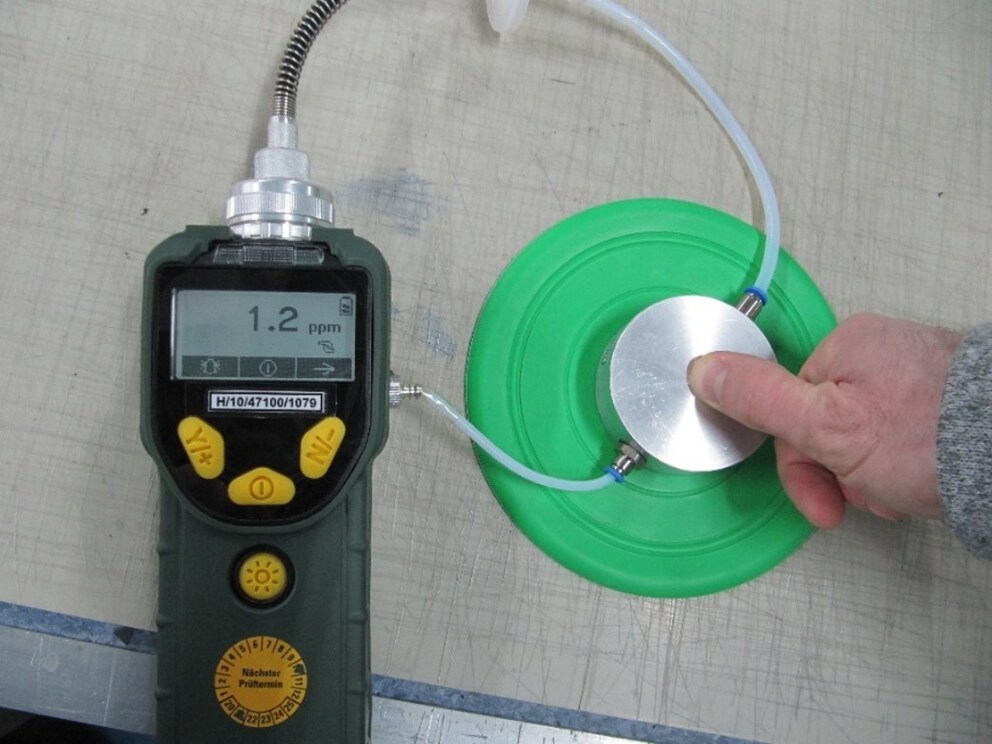
Tensile tests are standard for us, and we did those. Then we developed our own bite test. We also conducted aging tests, UV weathering—what happens if the frisbee lies in the sun for weeks. Saliva tests at 40 degrees to simulate artificial saliva. And then, of course, the whole range of analytical tests: pollutant analyses, material identification, emission measurements, sniffing test devices for volatile organic compounds, and more.
We just wanted to know: What is possible? And in the end, we focused on three main tests—but the path there was extensive.”
The “Würzburger Dog”–a Bite Test With Real Dog Teeth
You even developed an artificial dog mouth. How did that come about?
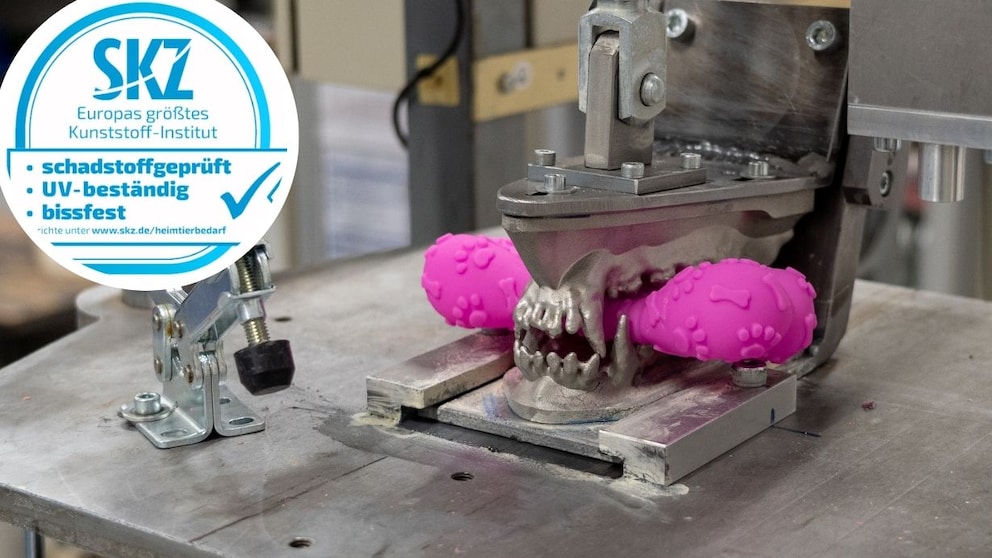
Anja Armani: “The first prototype had metal pins as teeth—functional but unrealistic. We consulted with veterinarians, and they quickly told us: That’s not real dog behavior. We needed something that corresponds to the jaw closure and tooth shapes.
So we digitized a real Golden Retriever’s teeth using a 3D scan. A former colleague of ours further developed a metal 3D printing process, and with that, the final teeth were made. Modular design: We can also install a different set of teeth at any time if we want to test cat or marten bites, for example.”
Alexander Ebenbeck: “We also evaluated scientific publications. In one study, 20 dogs were anesthetized, and the bite force was measured—around 200 kilos. We deliberately set our test criteria at 50 kilos. That’s realistic and covers many dogs. Of course, not every dog bites with the same force. But the important thing is: Our dog bites with consistent force and without deviation—no real dog can do that.”
One of your criteria is UV resistance. Why is that important?
Alexander Ebenbeck: “Because many people leave the toy in the garden. You don’t think about it, but a ball or a frisbee can stay outside for months. In artificial weathering, one week of testing corresponds to about a quarter of a year of real sunlight in Central Europe. And we’ve seen cases where the frisbee completely disintegrated after six weeks of testing—just crumbled, you couldn’t even punch out test specimens anymore.
Some materials also become harder—by up to 20 percent. And a frisbee that’s too hard can damage a dog’s teeth. That’s a real risk.”
Pollutants: “Natural Rubber Sounds Good—but It’s Not Automatically Good”
Which pollutants are particularly critical?
Anja Armani: “We orient ourselves, among other things, to toy standards for children. That means: phthalates (plasticizers), PAHs, heavy metals, nitrosatable substances, Bisphenol A, halogenated organic compounds, and many others.
Natural rubber is not a guarantee for a harmless product. It is originally a milky liquid from tree sap. To turn it into a solid plastic, additives are needed—for example, sulfur for vulcanization. These residues can remain in the final product.
The same applies to textiles: Cotton sounds good, but there can be pesticides in it. With leather, tanning agents or chromium compounds can be a problem.”
“Dogs Immediately Find the Weak Points–and They Are Always the Same”
What are typical weak points in toys?
Alexander Ebenbeck: “Anything that is delicate in terms of geometry: small ears, transitions from thick to thin, any protruding nubs. Dogs sense that immediately—no matter the dog. Those are the spots that get chewed off first. You can see it particularly well with bones.
Composite toys—combinations of rope, wood, and textile—are often vulnerable. The connection points are simple weak spots.”
Anja Armani: “We specifically test each of these points. We stress the product three times at different points with 10,000 bite cycles. Wear and tear may be present afterward, but there should be no spot where a part could be pulled out.”
“You Can’t Tell What’s Inside a Product Just by Looking at It”
Can consumers recognize anything when they are in the store?
Alexander Ebenbeck: “Honestly: No. You can’t tell what’s inside a product just by looking at it. Even well-known manufacturers have failed pollutant tests. Many retailers simply rely on their suppliers’ statements: ‘Everything’s okay.’ But whether it was really tested, they often can’t say.”
How transparent is your seal of approval?
Anja Armani: “The complete test report is available online with all measurements, photos, limit values, and results. Consumers can see exactly what was tested. The seal is valid for three years—but only if the manufacturer does not change the material or manufacturing process during this time.”
How did the first products perform in the test?
Anja Armani: “The first manufacturer met all the criteria. We can talk about that because the report is public. Other products from our early test phases were not intended for the market—we can’t say anything about them.”

Strayz Founders on Their Poor Performance in “Stiftung Warentest”
These Household Chemicals Promote Cancer in Dogs
“Why Hasn’t This Existed for a Long Time?”
Many readers wonder: Why hasn’t there been such a seal before?
Alexander Ebenbeck: “We wonder that too. (laughs) There have probably been attempts by competitors, but nothing has really established itself from our perspective. Probably because the effort is great and pet products are often considered ‘small stuff.’ But dogs carry their toys in their mouths much longer than babies do with their toys—the standard should actually be higher. And consumers often mistakenly believe: If it’s in the pet store, it must be tested. But that’s not true.”
Cat Trees, Horse Halters, and Leashes Could Also Be Tested
Do you plan to test other products like bowls, leashes, or beds?
Alexander Ebenbeck: “Yes. There are already inquiries, for example, about cat trees—but that was about stability. In principle, we can test a lot: durability, tear resistance, and pollutants. Harnesses and leashes would also be interesting because the dog can chew on them, and because owners hold the material in their hands for hours. That should also be tested.”
Do you notice more demand already?
Alexander Ebenbeck: “Yes, there are interested parties. Some are currently developing new products and are considering planning the seal. Others clearly say: ‘Too expensive.’ It depends on the quantity—for large manufacturers, it’s easier to distribute across many products. But we are sure: If consumers express the desire, there will also be a rethink among manufacturers and distributors. Because what is it all about for us? The well-being of our four-legged friends.”