

November 23, 2026, 12:10 pm | Read time: 5 minutes
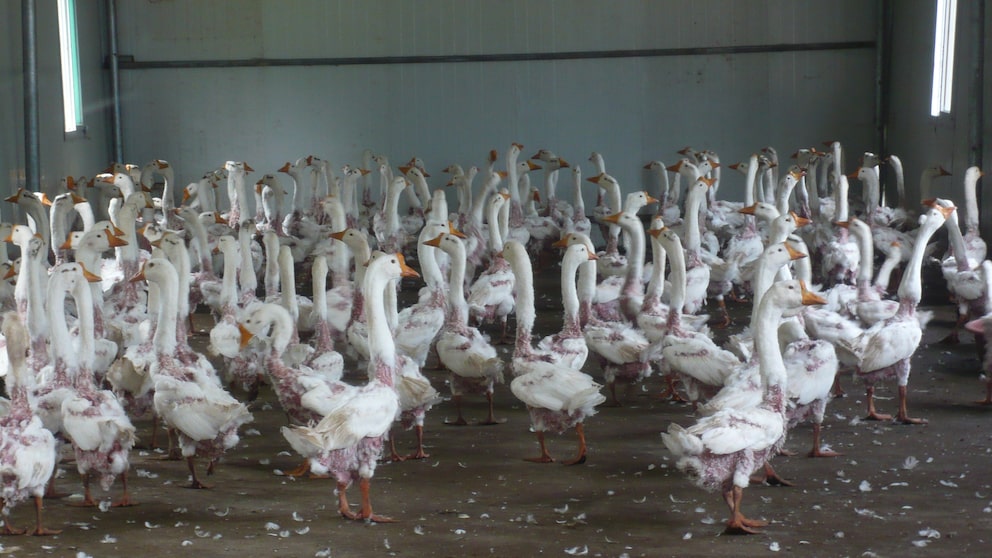
These are images that are hard to bear: The animal rights organization PETA has published material on its social networks showing geese having their feathers plucked while fully conscious. It also shows the person plucking the bird holding its neck down with a knee. It’s well-known that feathers from ducks and geese are used in bedding and down jackets. However, those who thought the animals were plucked only after slaughter are mistaken. PETBOOK explains what lies behind live plucking.
Why Ducks and Geese Are Plucked Alive
In many countries, it’s not uncommon to pluck the animals multiple times during their short lives while they are fully conscious, explains PETA specialist Johanna Fuoß in an interview with PETBOOK. Although live plucking is banned in most parts of Europe, there are exceptions and loopholes. In some countries, like China, this practice is still standard. But why? Wouldn’t it be much easier and, above all, more humane to pluck the animals after they have died?
Also interesting: 10 times older than usual! Chicken “Peanut” breaks age record
No, because it’s about money, says the expert. “It’s simply about increasing the profit per animal. The animals have a certain number of weeks of fattening time, and with geese, you can pluck them alive two to three times,” Fuoß explains. “This way, you can simply obtain three to four times the amount of feathers per animal.” However, this is to the great detriment of the birds, as they suffer hellish pain during and after the process.

Plucked Alive–All a Matter of Quality?
The down and feathers of the animals are supposedly softer and of higher quality when they come from still-living birds, Fuoß explains. However, there’s a major catch: There is no method that can ultimately show a difference between feathers plucked from live or dead birds. “Once the down is cleaned, it can no longer be clearly distinguished, as traces like blood on the shaft and everything else have been washed away.” Even under a microscope, no difference can be seen, according to the PETA spokesperson.
In principle, live plucking is banned in Europe, yet there are many exceptions during molting season. During this time, individual feathers may be removed.
While most birds have a molting phase where they shed their “worn-out” feathers, which then regrow, even during this physically demanding time for the birds, plucking is a torment.
»Whole Chunks of Skin Are Torn Off
“The problem is that an animal never loses all its feathers in one day; it’s a process that can take several days to weeks. To collect the feathers, so-called brigades come. That means workers are on the same farm for one or two days and then pluck all the geese’s down in shifts.” It’s obvious that not all birds can be in the molting phase at the same time, and the animals certainly don’t lose all their feathers simultaneously.
“As a result, it’s associated with very, very great pain for the animals because many feathers are still very firmly attached to the skin. This means that whole chunks of skin are repeatedly torn off, leaving the animals truly bloody.” According to reports, larger wounds on the animals are sometimes sewn up on the spot by workers–without anesthesia.

“The Animals Are Lucky if the Anesthesia Works Later in the Slaughterhouse!”
Additionally, the birds are restrained during plucking, which causes them additional pain and stress. “They are often really pressed to the ground, partly so they can’t resist as much. The knee is pressed on the animals’ necks to keep them firmly in control.” All this, the animals must endure fully conscious and without anesthesia, reveals Johanna Fuoß from the animal rights organization PETA.
“The animals are lucky if the anesthesia works later in the slaughterhouse because the rate of failed anesthesia is–regardless of whether they are plucked alive or dead–very, very high for ducks and geese.” This is because the anesthesia often takes place via an electric water bath and doesn’t work equally well for all. “Last year, we released footage from a regular slaughterhouse in Poland. So not an exceptional case, but really more of a best practice.” In the footage, it was clear that there were several failed anesthesias.

What to Consider When Buying Down Jackets

Whether From a Blackbird or a Pigeon, Taking Bird Feathers is Prohibited
»Failed Anesthesias Still Occur During Slaughter
“Each animal has a different threshold for when unconsciousness occurs when the electricity is applied. Individual animals still visibly raised their wings strongly after the throat cut had taken place.”
Particularly shocking: The electric water bath anesthesia, where the animals are pulled headfirst through a water bath and receive electric shocks through the water, is one of the most widespread anesthesia methods, also used here in Germany. This is supposed to ensure that the anesthetized animals don’t notice the subsequent throat cut. But with failed anesthesias, the slaughter may not be painless for all animals.

Can Consumers Check Where the Down Comes From?
But how can consumers tell if the feathers in bedding or down jackets in stores come from such a source? Essentially, they can’t. You can’t even rely on certificates that promise “ethically” produced down. “Don’t be misled,” says PETA’s website. The animal rights organization criticizes that these certificates only contain “vague formulations, inadequate controls, and insufficient animal welfare requirements.” Additionally, it often can’t be ruled out that the animals come from foie gras production.
“For us, the only solution is an animal-free alternative,” Fuoß concludes. There are now many jackets and bedding filled with animal-free plant-based or synthetic materials that are just as warm and light as feathers.
- peta.de, “Down–The Animal Suffering Behind Certifications”, (accessed on 11/23/2026)
- kvgd-stiftung.de,“Live Plucking for Down Production”, (accessed on 11/23/2026)
- dgs-magazin.de, “Electric Water Bath Anesthesia for Broilers: A Phasing Out Model?”, (accessed on 11/23/2026)
- verbaende.com, “Where Have All the Birds Gone? / Molting Makes Birds More Secretive”, (accessed on 11/23/2026)