

November 26, 2025, 4:44 am | Read time: 4 minutes
Animals with human eyes, elephants with dog snouts, and beavers with fish tails—were medieval artists just bad at painting? Not at all. There’s more to these quirky creatures than meets the eye.
When you think of medieval paintings, what comes to mind first? How would you describe the style and depiction of people and animals? Don’t worry—you don’t need to conduct an art historical analysis. But perhaps you’ve wondered why medieval depictions sometimes look so odd. The techniques and perspectives are quite different from what we know today. Sometimes questionable scenarios are depicted, leaving many questions unanswered. And if those aren’t strange enough, there are also these peculiar animal drawings.
An elephant that looks more like a dog with a trumpet than the familiar trunked animal. A beaver that resembles a hybrid of a cat and a marten with a fish tail. And then those human eyes—many animal depictions look as if a person has donned some fur or feathers. There are numerous accounts online that post the quirkiest depictions of such drawings. But why do the animals look so strange? And why do so many have human eyes?1
Why Animals in the Middle Ages Had Human Eyes
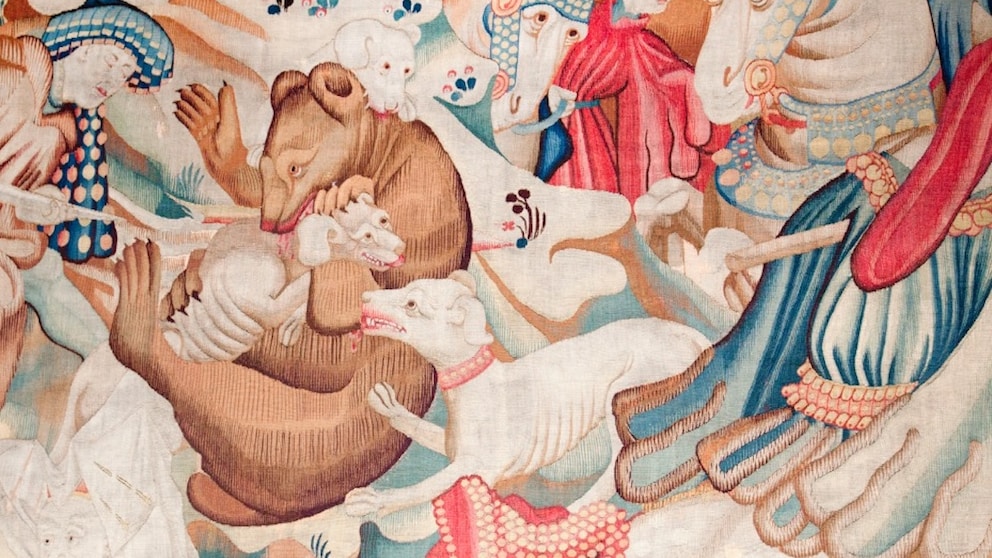
At first glance, everything looks normal: a crouching dog with shaggy fur. But upon closer inspection, the animal looks odd. The eyes, in particular, are striking—they bizarrely resemble a human face. It makes you wonder: “What was the artist trying to convey?” In fact, medieval paintings were very thoughtful and full of meaning and symbolism. The human eyes were not a lack of technique but a deliberately chosen representation.
Large paintings or frescoes in the Middle Ages were much more than decoration. They told stories of wars, victories, tragedies, and fables or staged Christian scenes. Animals were mainly painted in contexts with fables. A characteristic of fables is that human traits are assigned to various animals. A classic example from the late Middle Ages is “Reynard the Fox”—a character also adopted by Goethe in his works.
The human eyes thus served as a means to give the animals a corresponding expression and to bring the paintings to life a bit more. 2
Also interesting: Why Horses in the Middle Ages Were Much Smaller Than Thought

Pigs on Trial? The History Behind Animal Court Cases

All Dogs Have at Least One Behavioral roblem
Elephant Looks Like a Dog
Perhaps you’ve noticed animal drawings where you couldn’t guess which animal was actually depicted. If it’s not due to the strange facial features, then it’s probably due to unnatural proportions or the fact that the animal looks more like a mix of five different animals.
There’s a relatively simple explanation for this. Horses, dogs, and cats can be quickly identified in medieval drawings—even if their faces often leave room for interpretation. But when it comes to beavers, elephants, camels, or snails, artists seem to particularly enjoy being creative. There are some depictions of elephants that correspond to reality in very few ways. A vivid example is the size of the elephants. Surprisingly, in some depictions, they are extraordinarily small—almost smaller than the people around them. The heads of the elephants also have extremely strange proportions and shapes—some heads are heavily flattened, and in many cases, the characteristically large ears are even missing. 3
How Medieval Artists Painted Animals They Had Never Seen
A quick thought experiment: If three people were to paint a flower right now, you would get three different flowers as a result. That’s quite normal because everyone has their own idea of a flower. It gets more interesting if you have to paint something you’ve never seen before. This was similar for people in the Middle Ages, especially in the Eurocentric realm.
An elephant or a camel was almost nonexistent in Europe. Yet there were reports about the animals. For artists, these writings or oral accounts served as sources. Depending on how detailed they were, the painted depictions varied. If a source described a leopard as a spotted cat, the artist used their own imagination and interpretation for the type of spots, the size of the animal, or the shape of the head when details were lacking.
What makes us smile today was once a window into a world full of symbolism, fantasy, and storytelling—where every brushstroke revealed more about the person than the animal.