

February 5, 2026, 12:51 pm | Read time: 10 minutes
Animals in court–with charges, defense, and verdict? Stories about animal trials in the Middle Ages seem bizarre. But were pigs, rats, and beetles really defendants, or are we perpetuating a myth? PETBOOK editor and cultural scientist Louisa Stoeffler takes a closer look at sources, misconceptions, and the question of why people needed animals to bring order to chaos.
1522, France. Rats in Court.
In the French town of Autun, rats were reportedly summoned to an ecclesiastical court in 1522. The accusation: They had destroyed the barley harvests of entire villages. As church law required, the defendants were appointed a lawyer–the jurist Barthélemy de Chassenée. Not a quirky village attorney, but a highly educated legal scholar of the early modern period.
Chassenée took the case seriously. And that is what made it famous. He argued that his clients could not appear even if they had been informed of the summons in time: The journey to court was life-threatening. Their natural enemies–the region’s cats–lurked everywhere. According to the law, no one could be forced to appear in court if their life and limb were threatened.
The court saw the logic in this and dismissed the case. Not because they seriously expected the rats to appear, but because they felt bound by their procedural rules. As absurd as this story sounds, it is insightful. It not only shows how far people were willing to apply legal forms but also raises a more fundamental question: Was this trial actually conducted in this way? And what does it say about the relationship between humans, animals, and law in the pre-modern era?
“Fido in Court”–a Distorted Image of the Middle Ages
In popular portrayals, animal trials often appear as curiosities from the “dark Middle Ages.” Headlines like “Dog Before the Judge” or “Pigs on the Dock” suggest grotesque, superstitious, and arbitrary legal practices. The impression: People treated animals like persons–out of naivety or religious delusion.
However, this interpretation falls short. Many of the most frequently cited cases today do not originate from the Middle Ages but from the early modern period. The famous trial against the rats in Autun, for example, dates to 1522–a transition to the legal formalization and legal culture of the modern era.
Another interpretation adds to this: Animal trials may have been less practical criminal proceedings than legal thought experiments. Scholars debate whether they served to clarify fundamental legal questions–such as who is even capable of standing trial, when a summons is valid, or what rights defendants have who cannot speak. The solutions developed for these questions were later applied in proceedings against human groups, such as so-called heretics. They referred to the symbolic animal trials to show: Even here, formal rules, defense, and legal boundaries apply.
Between Records and Anecdote
Many recorded cases seem bizarre. For example, in 1520, woodworms were reportedly summoned to an ecclesiastical court in a French village because they had so severely gnawed the bishop’s chair that it collapsed under the weight of the cleric.
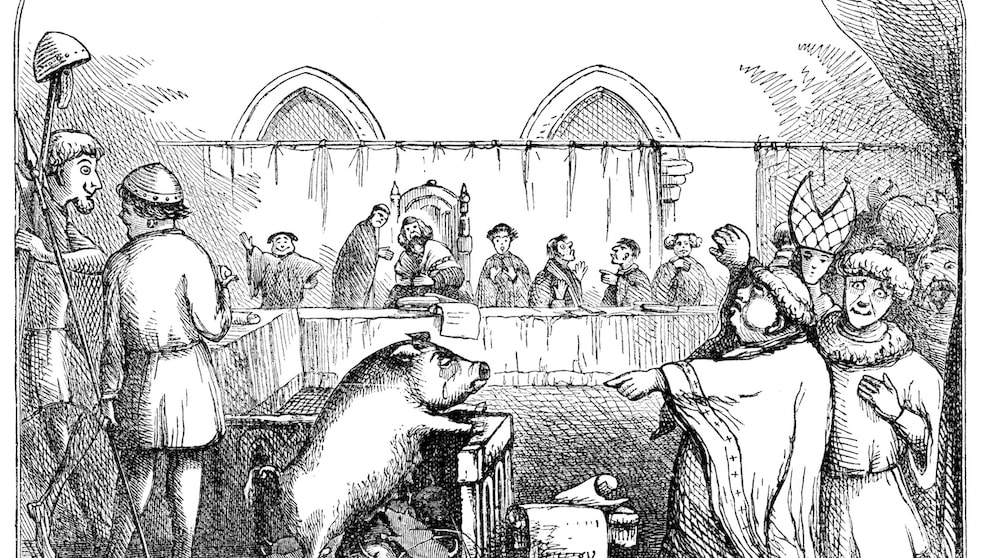
Other reports are equally disturbing. A particularly frequently cited case is the late medieval trial of a domestic pig in 1386, accused of fatally injuring a child. According to the law at the time, the animal was sentenced, mutilated, and publicly hanged under the principle of talion–a punishment that was less about the animal itself and more about the symbolic restoration of an order perceived as violated.
Modern research focuses on such prominent examples. Not every recorded case is equally well-documented. For some, there are no primary sources, meaning not every dramatic account comes from contemporary court records. Much was later embellished, morally charged, or simply invented to serve as evidence of the “absurdity” of medieval thinking.
Really Happened or Exaggeration of the 19th Century?
The image of the “animal in court” was heavily exaggerated, especially in the 19th century, when the “dark” Middle Ages were often portrayed as a counterpoint to modernity. Whether and how often animal trials actually took place is historically disputed today.
From this perspective, the trials appear less as expressions of delusion and more as part of an academic discourse. Anecdotes about rats, pigs, or beetles provided a projection surface to test legal principles–without immediately triggering political or religious escalations.
What can be established, however, is that where animal trials are documented, they did not follow mere whims. They were religiously grounded, legally framed, and socially functional–an attempt to make order visible in a world marked by great upheavals.1
Animal Trials vs. Animal Punishments
At this point, it is worth taking a step back. Because when people today talk about “animal trials,” they often mean everything at once: pigs at the gallows, rats before the judge, roosters on the pyre. But this is where another misunderstanding begins. Historical legal science clearly distinguishes between two phenomena that are often conflated today: ecclesiastical animal trials and secular animal punishments.
Animal Trials–Theology in the Guise of Law
The actual animal trials were conducted not by secular but by ecclesiastical courts. They were not directed against individual pets but against collectives of wild “pests”: rats, mice, locusts, beetles, or worms. It was not about bloodshed but about crop failures, famines, and the threat to divine order.
Similar reports exist from Switzerland and the Alpine region: leeches accused of damaging fish stocks, or field mice and moles urged to emigrate–sometimes with safe conduct for pregnant animals. Such details seem absurd today but mark the point where law, theology, and ritual intersected.
Importantly, these proceedings did not aim at punishment in the criminal sense. It was not about guilt or atonement but about symbolic conflict resolution. The animals were personified procedurally so that they could be banished, admonished, or expelled. That they did not respond was anticipated.
When the Animal Becomes an Omen
Not all famous cases can be clearly categorized. The so-called rooster of Basel from 1474, which was burned because it allegedly laid an egg, was neither the subject of a classic animal trial nor an animal punishment in the strict sense. It was about religious danger prevention. The egg was considered a demonic sign, the rooster as a bearer of doom that had to be removed from the world.
A similar case occurred in 1582 in the Duchy of Jülich, where a pig was executed (secular punishment) for eating a consecrated host (ecclesiastical desecration). Here, the animal was punished as a perpetrator but killed as the object of a sacrilege. Such cases show how fluid the boundaries between law, theology, and superstition were. 2
Animal Punishments–Restoring Secular Order
Animal punishments, on the other hand, functioned quite differently. They were directed against individual, domesticated animals–primarily pigs–and were imposed by secular courts. The occasion was almost always the death of a human. If a pig killed a child, it was not only a personal tragedy but a massive disruption of social order.
The punishments were drastic and corresponded to those that also threatened human violent criminals: hanging, breaking on the wheel, burning. The most famous case is from 1386 in Falaise, France, where a sow was publicly executed after fatally injuring an infant. A similar trial occurred in 1457 in Savigny, Switzerland, where a sow was convicted, but her piglets were acquitted–not out of pity, but because only the specific danger object was to be eliminated. 3
Such cases are comparatively well-documented. Nevertheless, they were often less about legal processes in the modern sense and more about symbolic acts of punishment. The animal was publicly punished to repair a violated order–and to signal to the community that chaos had been banished.
The Ordo Concept: When Animals Disrupt Divine Order
Why could animal trials even appear as a sensible reaction? The answer lies less in individual cases and more in the worldview of the time–and in the massive crises that shook it. The late Middle Ages and early modern period were marked by profound upheavals: climate deterioration due to the so-called Little Ice Age, recurring crop failures, famines, the devastations of the plague, and political and religious conflicts that culminated in the Thirty Years’ War. The experience of loss of control was part of everyday life for many people.
The Christian-influenced legal thinking of the Middle Ages and early modern period was based on a fixed, God-willed hierarchy in which every being had its place. This so-called Ordo concept was significantly shaped by Augustine of Hippo and was effective for centuries.
In this hierarchy, animals were subordinate to humans: irrational, incapable of sin, and therefore not actually culpable. Moral responsibility lay solely with humans. But this is where the problem began. Because animals did not always behave as the “system” prescribed.
When free-roaming, hungry pigs killed children, the event was more than a practical catastrophe. They questioned the already shaky worldview itself. Chance, poor animal husbandry, or mere natural forces were not acceptable explanations. When animals caused suffering, it seemed as if they had left their intended place and disrupted the divine order. 4

Ruling on cloned giant sheep in the USA

Airline Lost Dog Mona–Court Rules She’s “Luggage”
Do Animals Have Rights or Duties?
At this point, it becomes clear why animal trials could even appear as a conceivable means. It was not about suddenly understanding animals as moral beings. It was about making the inexplicable explainable.
Modern psychology succinctly captures this mechanism: In human thought systems, “malice” has a place–mere chance does not. An accident without a cause is hard to bear. A perpetrator, on the other hand, can be named, judged, and punished. By treating animals as perpetrators, chaos could be pressed into familiar categories: guilt, judgment, punishment. 5
In his legal writings, Chassenée already emphasized that animals were not “evil” by nature but followed their nature. The question was not their guilt but how the law dealt with conflicts between humans and animals. Animals were not defended because they were legal subjects, but because the law could only create order if it remained consistent even toward the seemingly voiceless.
For this reason, many of these proceedings or show trials were formally astonishingly correct. Accused animals were summoned, there were charges, defenders, and verdicts. Not because it was expected that a pig or a rat would understand the proceedings, but because it had to work for the people. Law was less an instrument of justice than a technique of meaning-making. 6
What Rights Do Animals Really Have?
Even though the principles “Animals are not evil” and “Animals are not culpable” sound very modern, it does not mean they had more rights 500 years ago than today. Their procedural “equality” was not an expression of recognition but a means of stabilizing human power and belief systems.
Why is it worth discussing today? Because the question of the legal status of animals is more relevant than ever. Great apes, whales, or elephants are now being discussed as potential legal subjects. Animal protection is enshrined in the constitution, and while animals are treated under “property law,” they are not considered property. Every legal decision must consider that they are sentient beings.
The historical animal trials show how much law is an expression of human worldviews. Then as now, it is less about the animals themselves and more about the order we want to create. Today, we know more about animal consciousness, capacity for suffering, and social intelligence. And we must ask ourselves whether our modern law does justice to this knowledge.
The past had an answer–a brutal but consistent one. One that made animals defendants to keep the world explainable. Whether we are truly further today, when we no longer put animals on trial but use them industrially, hunt them seasonally, manage them legally, and morally overlook them, is an open question.