


June 15, 2026, 4:12 am | Read time: 5 minutes
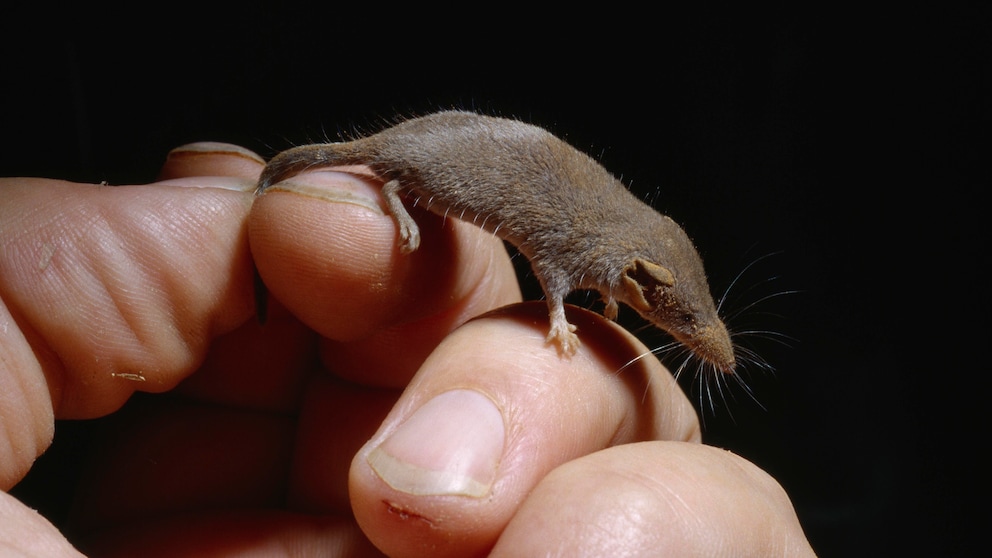
At just five centimeters in body length, the Etruscan shrew is considered one of the smallest mammals in the world. However, this size comes with some challenges. The animals must almost constantly consume food to avoid falling into a state of torpor.
The Smallest Mammal in the World–the Etruscan Shrew
If you thought house mice were small, you haven’t met the Etruscan shrew. With a body length of about five centimeters, it is not only the smallest known shrew species but also ranks among the smallest mammals in the world. It weighs just about two grams. For comparison, house mice weigh between 12 and 30 grams and are about twice as large. 1
But that’s far from all that makes Suncus etruscus, as the species is scientifically known, a mammal of superlatives…
Where Does the Smallest Mammal in the World Live?
Etruscan shrews are found in North Africa, from Asia Minor to Afghanistan, and in South Asia (Indomalayan region). They also inhabit Southern Europe, but only in the Mediterranean area. Nevertheless, the likelihood of encountering the world’s smallest mammal there is relatively low. They live in open forests, bushy areas, and grasslands and are predominantly nocturnal.
Also interesting: The 12 Heaviest Animals in the World
Etruscan Shrew Is Almost Exclusively Busy Searching for Food
While the house mice we know are omnivores, Etruscan shrews feed solely on meat. Their diet mainly consists of insects and earthworms. However, they also prey on young amphibians, lizards, and rodents—animals that are almost the same size. For such a small shrew, this is a huge meal, but that’s exactly what they need. The smallest mammal in the world has an incredibly rapid metabolism. 2
To continuously supply their bodies with energy, these tiny shrews must eat several times their own body weight—this can be around 15 crickets or mealworms a day. To achieve this amount, the shrews are almost exclusively busy searching for food and are remarkably efficient at it.
With their long snouts, Etruscan shrews dig in the soil or under leaves. Using their sensitive whiskers, they detect their prey and capture it with lightning-fast attacks. A strike takes an average of 200 milliseconds, and in the fastest case, only 80 milliseconds, as researchers have found. This means the shrews can sense things faster than a human could perceive them. 3
No Time to Sleep
The Etruscan shrew is not only the smallest mammal in the world; it also holds the record for the most breaths: the tiny shrews breathe in and out 900 times per minute. Their hearts beat up to 1,500 times per minute. You could say these animals are constantly hyperactive. They can’t afford to sleep for long periods because this incredibly fast metabolism must be continuously supplied with energy. Only when the shrews don’t encounter 15 crickets do they fall into a physiological sleep state known as torpor.
Torpor occurs in some smaller mammals and birds and is comparable to a kind of lethargy, where metabolic and energy turnover processes are reduced to a minimum, and all body functions are kept “on the back burner.” This phenomenon was first demonstrated for the Etruscan shrew in an experiment in 1973. 4
From 6 to 900! How bats get their heart rate up to full speed
The World’s Smallest Snake Is Barely Wider Than a Piece of Spaghetti
Is the Etruscan Shrew Really the Smallest Mammal in the World?
For a long time, the Etruscan shrew was considered the smallest mammal in the world until the bumblebee bat (Craseonycteris thonglongyai) was discovered in 1974. Also known as the Kitti’s hog-nosed bat, these animals live in caves in Thailand and Myanmar. With a head-body length of just three centimeters, it is theoretically even smaller. However, with a wingspan of 13 centimeters, it appears significantly larger than the Etruscan shrew. Today, both species are considered the smallest mammals in the world.
Unfortunately, unlike the Etruscan shrew, the bumblebee bat is considered endangered. Human activities primarily threaten the animals in their nesting caves. There are reports from animal rights activists that the caves are used by monks for meditation, but also by drug users seeking refuge. Additionally, tourists increasingly visit the caves to catch a glimpse of the tiny bats. 5
Biologically, It Can’t Get Any Smaller
The Etruscan shrew is not only one of the smallest mammals on Earth—it also seems to be close to a biological limit of what is possible for mammals. Scientists believe that the body size of mammals cannot shrink indefinitely. The reason lies in a fundamental physical principle: The smaller an animal becomes, the larger its body surface area is in relation. As a result, it loses heat to the environment particularly quickly.
For tiny mammals, this poses a problem. Their bodies must constantly produce energy to maintain their own temperature. At the same time, due to their small body mass, they have very little energy reserve available. The result is an extremely high metabolism. The Etruscan shrew weighs on average only about 1.8 grams, making it the lightest living mammal in the world today. Researchers suspect that it is already very close to the lower limit allowed by mammalian physiology. 6