

October 24, 2025, 8:24 am | Read time: 3 minutes
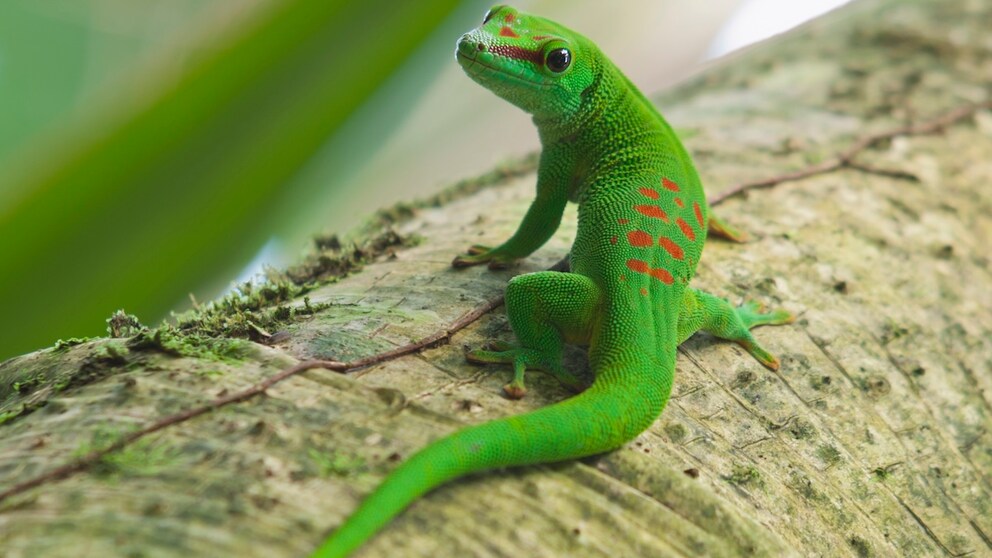
In English, animal names are often delightfully quirky–from “butterfly” to “ladybug.” In contrast, German names tend to sound straightforward and orderly, just as zoologists prefer. However, the entire classification of “Eidechse” went awry. PETBOOK editor and linguist Louisa Stoeffler explains how a linguistic misunderstanding became an official animal name.
Why All Lizards Are Actually “Dechsen”
Few realize that the word “Eidechse” in its current form is not a natural product but a linguistic one. The spelling actually stems from a misunderstanding–and a learned man who, in his attempt to bring order to the animal kingdom, left behind a bit of linguistic disorder.
Strictly speaking from a linguistic history perspective, the word “Eidechse” is a misdevelopment–the animal should simply be called “Dechse.”
The second part of the word “-echse” comes from the Greek echidna (meaning “snake”) or the Latin lacerta (meaning “lizard”). In Old High German, the animal was originally called agidahsa or egidehsa–a combination of “egis” (snake, reptile) and a suffix dehsa or dahsa, depending on the spelling, which meant “little creature.” Over the centuries, the word for “little snake creature” evolved phonetically, was simplified, and eventually became eidehsa in Middle High German.
“Sweating Like a Pig” Is Actually Nonsense

Why do people say “That drives the dog crazy in the pan”?
A Typo That Made History
And here is where the consequential error occurred: Early on, writers assumed the first part “ei-” was related to an egg–thus to the reproduction of the animals. The “egg” remained, even though it had nothing to do with the original meaning.
In the early 19th century, it was naturalist Lorenz Oken (1779–1851) who permanently recorded the linguistic error by incorrectly separating Ei-Dechse. To him, it was only logical–after all, lizards lay eggs, right? Thus, the original “Dechsen” animal became what we now commonly know as “Eidechse” due to a simple word separation mistake.
But the original root was not the “egg,” but rather this old Germanic sound structure that later disappeared. The word should have evolved into “Dechse”–which would have been completely logical according to the sound development into High German. However, the error was quicker, through incorrect word part separation into “Ei” and “Dechse.”
The Error Becomes Official–Thanks to Lorenz Oken
Thus, Oken, one of the first to attempt to standardize German names for animal species, made the medieval error official. Oken adopted many terms from the vernacular–and recorded them in his zoological works.
However, Oken was a biologist, not a linguist. When he used the name “Eidechse,” he simply considered it correct. And so the medieval typo found its way into scientific literature–and eventually into common language. An error that has survived because it sounds so plausible.
And so the “Eidechse” continues to crawl through life with a linguistic appendage it never actually had. Today, the word is a fixed part of the German language–even though the original form “Agidahsa” managed without “egg.” Linguistically, the word is a prime example of how language develops not according to logic, but through misunderstandings and oral traditions. The result: A typo that has endured for over a thousand years–and still basks on every warm stone.