

April 27, 2026, 6:34 am | Read time: 6 minutes
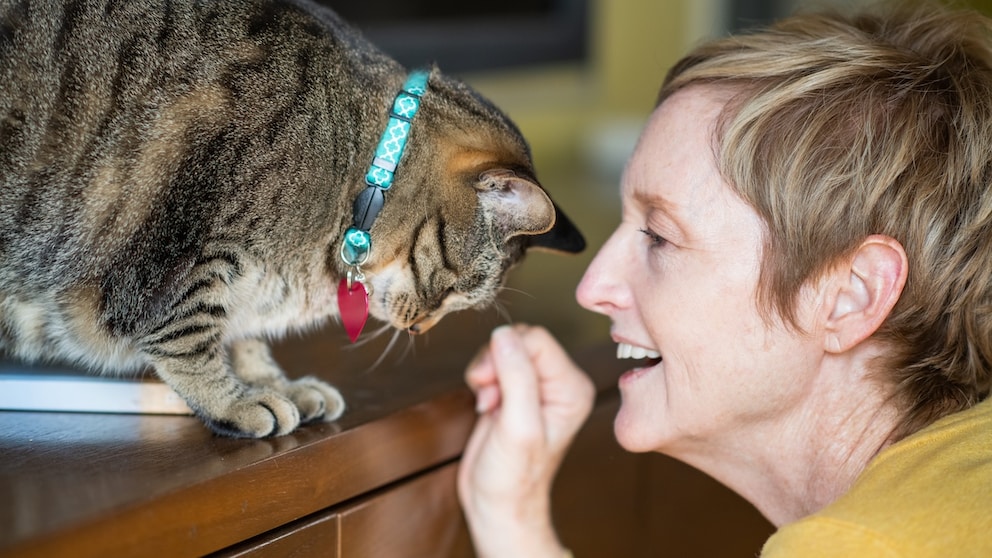
Anyone who lives with a cat may have tried it before: playfully meowing as a greeting or in response to the animal’s sounds. But what do cats actually think when humans address them this way? Can they even interpret our imitation—or does it just sound like a strange noise to them? PETBOOK editor Louisa Stoeffler offers insight into linguistics and cat behavior.
What Cats Aim to Achieve with Meowing
Every young cat meows—it’s part of normal development, as kittens call for their mother when they’re hungry, cold, or need closeness. However, this behavior changes significantly as they grow up: adult cats rarely meow to each other. Both young and adult cats use their meowing strategically to communicate with humans. Thus, meowing serves as a “social bridge,” primarily to convey needs: attention, food, opening a door, or simply a greeting.
Physical signals play a major role in cat language: tail position, ear orientation, gaze direction, and movement intensity often reveal more than the sound itself. Numerous studies over the past decades also show that meowing is a particularly complex form of human-cat communication. It was only in the 1990s that it was proven that adult cats meow specifically for us—and even use frequencies similar to those of a baby’s cry.
A 2002 study also found that humans can roughly assess a cat’s emotional state based solely on the tone of the meow. At the same time, research from 2015 to 2020 shows that audio alone, without body language, is difficult to interpret. You can learn more about this topic in this article: Why Cats Meow So Much at Humans.
Meowing Is Not a Language
From a linguistic perspective, meowing cannot be considered a full-fledged language in the human sense. A language has a systematic, learnable set of rules—a code with grammar, recurring structures, and clear meanings. Meowing, on the other hand, is not codified and does not follow fixed rules. Instead, it primarily works with paralinguistic features, such as changes in pitch, duration, intensity, and melody, which are emotionally colored and vary situationally.
It’s also important to note that each animal develops an individual “sound repertoire” over its lifetime. What a particular meow means is highly context-dependent and not automatically identical between different cats. Unlike human languages, which can convey messages independently of the speaker, meowing is not standardized—it remains a flexible, personal form of expression.
For communication between cats and humans, this means: While we can recognize certain patterns, we cannot speak of a stable, universal cat language. The interplay of vocalization, body language, and situation remains crucial.
How Cats React When We Meow at Them
And yet, many people intuitively meow back. The reaction depends heavily on the animal’s character and the specific situation:
- Reserved or sensitive cats often remain silent, blink, or slightly turn their ears to the side—a sign of irritation or curiosity, but not stress.
- Social cats rub against your leg, purr, or respond with their own meow. This response meow is often shorter and higher, almost like a follow-up question.
- Playful animals sometimes interpret the unfamiliar sound as an invitation to interact and begin rubbing against the person’s leg with a raised tail or small hops.
For cats, meowing back is less a linguistic exchange and more an unexpected acoustic stimulus that they incorporate into their own behavior situationally. Cats are very attentive to human sounds, but they quickly filter out whether these are linked to an action, expectation, or routine. So, frequently meowing back reinforces the behavior, but it doesn’t lead to a “conversation” in the traditional sense with the cat.
Why Our Meowing Doesn’t Sound Real to Cats
Human imitation of a cat sound differs significantly from the original. We can hardly reproduce the frequencies, modulations, and nuances of cat language with our voice. Not only because our vocal cords are built differently, but also because cats communicate in a much higher frequency range.
A genuine cat sound is melodically finely tuned, often modulated within milliseconds, and carries subtle emotional information. To a cat, the human “meow” sounds more like an isolated, foreign noise that doesn’t fit into their repertoire. Many cats recognize that we’re saying something, but not what we mean–at least not in “cat language.”
It’s important not to underestimate how teachable cats are. Studies show that they can associate human words with specific meanings if they frequently occur in the same context. My cat Remo, for example, knows very well what “dinner,” “treat,” or “come here” mean—not because cats understand our grammar, but because they link the acoustic form of the word with an expectation or action. Human words work as recognizable signals for cats, while our artificial “meow” does not.

Purring Reveals More About Cats Than Meowing

Dogs Can Recognize “Yes” and “No” From Tone of Voice
Body Language and Habits More Important Than Meowing
What a cat wants is usually evident from its behavior. If it approaches a person meowing and rubs against their legs, it’s often a joyful signal. If it meows particularly insistently just before its usual feeding time, it may simply want to get its food earlier.
To better understand your pet, you should pay attention not only to sounds but also to gestures, facial expressions, and routines. Taking the time to analyze the situation is the easiest way to understand their meowing and respond appropriately.
If the tone of the meowing changes or the animal seems lethargic and withdraws, it can indicate discomfort—a behavior often observed in sick cats.
Conclusion: Misunderstandings Excluded
Even if the human “meow” is not understood by cats as a real language signal, there’s no need to fear an offended reaction. Even if the cat looks confused when we meow back, it likely won’t take it as an insult, wrong emphasis, or worst-case scenario, a curse word. It will probably just wonder what we’re trying to convey.

About the Author
Louisa Stoeffler has been working as a cat sitter since 2016 and knows the subtle nuances of cat behavior from years of practice. In addition to pet care, she advises owners on all “furry” matters. She studied English/American Studies, Spanish Philology, and Cultural Studies with a focus on linguistics–a combination that helps her today to classify animal communication as precisely as it is comprehensible. Since 2022, she has been writing as a specialist editor at PETBOOK, covering topics such as cat care and behavior.