

June 20, 2026, 11:53 am | Read time: 4 minutes
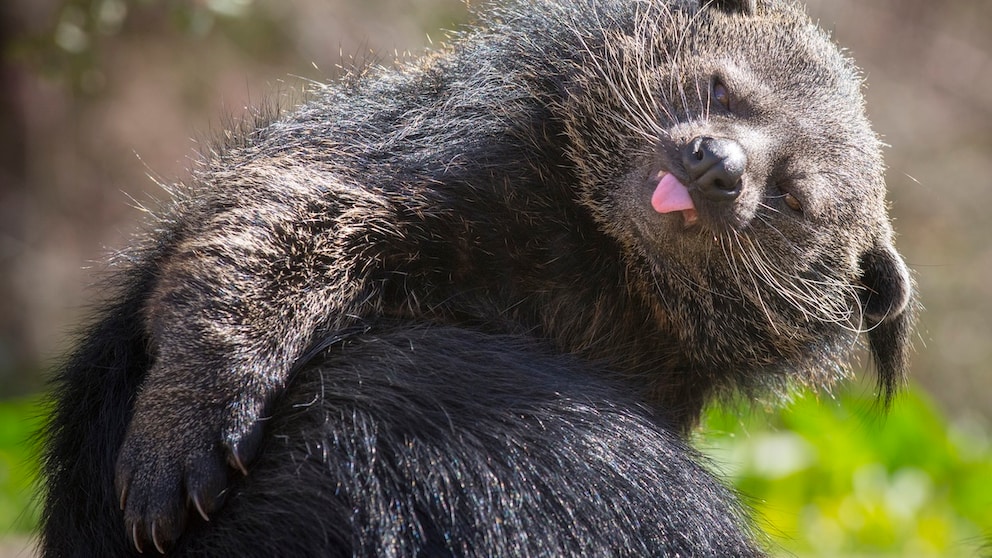
It looks like an unusual mix of a cat and a bear and smells surprisingly like fresh popcorn: The binturong is truly unique in the animal kingdom. This nocturnal climbing artist primarily lives in the treetops of Southeast Asia and typically avoids human settlements. Nevertheless, it is often portrayed as a supposedly cute pet on social media. PETBOOK, with the help of an animal welfare expert, explains why the binturong smells so extraordinary and why it should never be kept as a pet.
The Binturong–Neither Cat nor Bear
The binturong, also known as the bearcat, always looks a bit like it has been up all night–and it usually has. This cute animal is mainly active at dusk and during the night. Its habitat is in the tropical rainforests of South and Southeast Asia. Those hoping to encounter a binturong on the ground will rarely be lucky, as the animal primarily lives in the treetops. Its unique, prehensile tail is a special helper, allowing it to hold onto branches. For this reason, the animals, which are about 24 to 38 inches long (excluding the tail), appear relatively clumsy on the ground. However, when it comes to climbing, they are true professionals.
Biologically, the binturong belongs to the family of viverrids (Viverridae), which are mainly found in Asia and Africa–though it is only distantly related to the domestic cat. Its closest relatives include civets, genets, and linsangs. With its strong, elongated body and dense, dark fur, the so-called bearcat is perfectly adapted to life in the rainforest. There, it can move almost silently through the canopy and embark on its nocturnal forays unnoticed–though it is more of an opportunistic predator. Although it belongs to the order of carnivores, meat is rarely on its menu. Instead, the omnivore prefers plant-based food, especially figs, which are among its favorite snacks.1
Also of interest: Raccoons in the city–how to behave correctly

Eyes Bigger Than the Brain–The Tarsier Is Full of Surprises

Hardly anyone knows these 16 wild cats
Mammal with Special Traits
In addition to its muscular prehensile tail and unique appearance, the binturong has other features that set it apart from other rainforest inhabitants. The animal has a distinct smell that suspiciously resembles fresh popcorn. This is due to special glands under the bearcat’s tail, which are used for marking territory.2
At the same time, the binturong is one of the few mammal species where the fertilized egg does not immediately implant in the uterus. The female can consciously delay this process, waiting until external conditions such as food availability or climate are particularly favorable for offspring.3
The Binturong as a Pet? No, Thanks!
Even though the binturong stands out for its rather cautious and laid-back nature and appears particularly tame in videos, this does not mean it is suitable as a pet. This is confirmed by Christoph May, press and media officer of the World Animal Protection Society (WTG e.V.): “Wild animals do not belong in private households, as their natural needs, such as food or contact with conspecifics, cannot be adequately met there. The problems are very evident in the case of binturongs. They are nocturnal and mainly stay in trees–and these are just two factors why keeping them as pets cannot be animal-friendly.”
At the same time, the binturong is officially classified as “vulnerable” according to the IUCN Red List of Threatened Species. This is primarily due to the steadily increasing deforestation of Southeast Asia’s rainforests. Poaching and illegal trade also threaten these mammals. For this reason, there are special rescue centers and conservation breeding programs in some countries to protect the animals. Yet, even here, the special needs of the species are evident.
“From our animal protection project in Vietnam, where binturongs rescued from the wildlife trade live and can no longer be released back into the wild, we know how demanding their care is even in a professional sanctuary. Binturongs in private ownership are thus a clear case of animal suffering,” May explains. He also emphasizes how important it is for users not to engage with such videos on social media to avoid increasing their reach and, consequently, the demand for cruel animal keeping.