

August 5, 2026, 4:14 am | Read time: 4 minutes
Sloths always seem to have a relaxed smile on their lips, making them appear friendly and cute. The natural habitat of these leisurely tree dwellers is the tropical rainforests of Central and South America, where they lead a laid-back life. However, this is only until they face the weekly challenge of going to the bathroom–a task that can actually be fatal for sloths. Why they still undertake it and why it’s worth it is explained by PETBOOK below.
Why can a sloth die when going to the bathroom?
Sloths have one of the slowest metabolisms in the entire animal kingdom. This is due to their sparse diet: They mainly eat low-energy leaves. These grow right in front of their noses high up in the treetops, so not much movement is needed. Yet, about once a week, some sloths leave their safe spot in the branches. And that’s when they are in great danger.
Researchers believe that a significant portion of documented deaths among three-toed sloths occurs during these risky ground visits. Exact numbers are hard to determine, as sloths live extremely hidden lives and many causes of death in the rainforest go unnoticed. On the ground, the animals are almost defenseless. To cover a distance of just 100 meters, sloths can take up to 30 minutes. Against predators like jaguars, ocelots, or large snakes, they stand little chance.
Particularly fatal is the fact that the entire body structure of sloths is designed for an upside-down life in the trees. Their long limbs, gripping claws, and muscles are perfectly adapted for hanging–but not for quick escape movements on the ground. What is an evolutionary advantage in the treetops becomes a deadly weakness below. But why do sloths take this risk at all? 1
Two-toed or three-toed–a crucial difference
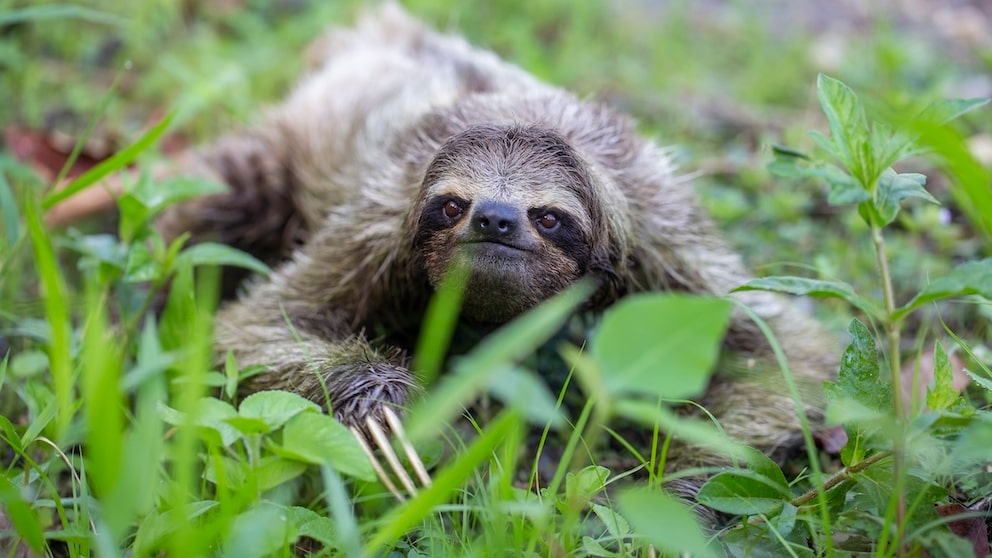
To answer this question, one must distinguish between two genera: the two-toed and the three-toed sloths. They can actually be differentiated by the number of hook claws on their front paws.
Two-toed sloths are generally more agile. They often do their business directly from the treetop, simply letting their waste fall to the ground. Three-toed sloths, on the other hand, usually descend completely from the tree about once a week, find a small depression, and deliberately deposit their feces on the forest floor. This unusual and dangerous behavior almost exclusively affects three-toed sloths–and is far from an evolutionary mistake. 2
Green algae in sloth fur
The fur of sloths is not greenish by chance. In the frequent rains of the tropics, algae settle on the wiry hairs, providing the animals with excellent camouflage in the rainforest canopy. Additionally, moths, beetles, bacteria, and fungi live in the sloth’s fur–a small ecosystem right on their body.
Researchers have shown that three-toed sloths carry significantly more moths in their fur than their two-toed relatives–on average about 15 instead of just around 4.5 animals. At the same time, they found a significantly larger algae biomass in three-toed sloths: about 125 grams, which is around 2.6 percent of their body mass.

Would You Have Recognized the Animal in the Picture?

Hardly anyone knows these 16 wild cats
A risky but rewarding symbiosis
These observations led to a surprising insight: The dangerous bathroom trip is part of a complex symbiosis between sloth, moth, and algae. The moths prefer to lay their eggs in the sloth’s feces.
By deliberately placing their dung on the ground, three-toed sloths enable the insects to reproduce. The hatched moths later return to the fur and provide important nutrients through their excretions or decay, which further promote algae growth.
The algae, in turn, are more than just camouflage for the sloths: They contain about 45 percent more fat than the leaves the animals primarily eat. Thus, they provide an additional, easily accessible energy source–a crucial advantage with an extremely slow metabolism. Additionally, this “algae kimchi” allows three-toed sloths to become significantly larger and heavier than their two-toed relatives. 3
Rewarding triangular relationship between sloth, moth, and algae
This fascinating interplay was discovered by researchers from the University of Wisconsin-Madison in the Costa Rican rainforest. Until then, it was assumed that the three-toed sloth fertilized “its” tree by depositing feces on the forest floor. Now it is clear: The reason for the life-threatening bathroom trip, with the risk of accidentally dying, is much more complex.