

July 24, 2026, 12:05 pm | Read time: 7 minutes
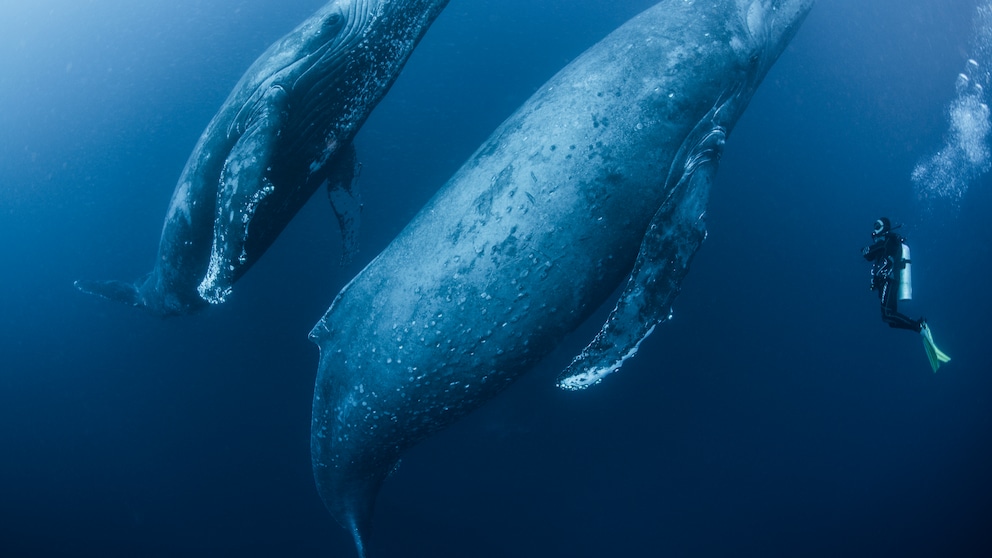
How can a 100-ton mammal live more than 200 years without developing cancer? And how do blue whales, weighing up to 150 tons, remain healthy despite their massive size and millions of cells? Researchers have uncovered the remarkable adaptations of the two largest creatures on Earth, the bowhead whale (Balaena mysticetus) and the blue whale (Balaenoptera musculus).
The Bowhead Whale: Longevity Through Precise Cell Repair
An international research team led by Vera Gorbunova, Andrei Seluanov, and Jan Vijg (University of Rochester and Albert Einstein College of Medicine, USA) investigated why the bowhead whale lives exceptionally long and rarely develops cancer.
The results, published in the journal “Nature,” show that the bowhead whale has exceptionally efficient DNA repair mechanisms that keep defective cells intact and eliminate genetic damage before it becomes dangerous.
The study focuses on the protein CIRBP (Cold-Inducible RNA Binding Protein). It enhances the repair of DNA double-strand breaks—the most dangerous form of DNA damage—and ensures that few errors occur in the process. Bowhead whale cells repair their DNA faster and more accurately than those of humans, mice, or cattle.
Moreover, both main pathways of DNA repair, Non-Homologous End Joining (NHEJ) and Homologous Recombination (HR), are exceptionally active in the bowhead whale. CIRBP protects DNA ends, reduces chromosome instability, and increases radiation resistance. The decay of chromosome ends has become a particular focus of research and could be one of the most important factors in preventing cell aging and degradation.
This makes it clear: The bowhead whale prevents cancer not by breaking down damaged cells (like elephants), but through error-free repair—a strategy that could also explain its extremely high age. 1
The Blue Whale: Gigantism as an Evolutionary Success Story
As early as 2023, researchers led by Felipe André Silva investigated why some whale species—especially the blue whale, the largest known creature on Earth—became so enormous without their cells degenerating.
A key finding was the discovery of a gene formerly responsible for tooth formation, which changed its function in baleen whales. This mutation enabled the development of baleen plates—a filtration system that allows whales to efficiently consume large amounts of krill and plankton. This opened up an evolutionary niche that favored the emergence of particularly large body sizes.
Additionally, researchers identified four genes that not only promote growth but also have cancer-preventive properties. This genetic makeup apparently helped control the risks of a high cell count—namely increased cell division and potential mutations. Thus, the blue whale study provides another evolutionary explanation for how whales could grow so large without a higher incidence of cancer. 2
Why Blue Whales and Bowhead Whales Became So Huge
Blue whales and bowhead whales are among the largest creatures ever to exist on Earth. The blue whale reaches up to 30 meters in length and about 150 tons in weight, while the bowhead whale weighs up to 100 tons. Both species are true giants among marine animals.
The team analyzed the genomes of 19 whale species, seven of which reached a body length of over ten meters. The focus was not only on tooth formation genes but also on eight others that play a central role in regulating growth and cell division. Five of them control the production of so-called insulin-like growth factors, which regulate cell growth. The remaining four genes are known from research on land animals such as pigs, cows, or sheep. For although it may not be immediately obvious: Whales are descended from land animals.
Their ancestors were once small, four-legged mammals that lived on land and gradually adapted fully to life in the water. These were small, hardy ungulates like the deer- or mouse-deer-sized Indohyus and the wolf- or dog-sized Pakicetus. These relatives of whales lived about 50 million years ago on four legs. Thus, pigs, as well as blue whales, belong to the order of ungulates, strange as that may sound.
The gigantism of the blue and bowhead whale, however, developed only about five to ten million years ago, although the first whales existed around 50 million years ago. Today, about 86 whale species live in the oceans, including dolphins and porpoises. These toothed whales are significantly older than the long-lived baleen whales—and also much smaller.
Feeding as the Key to the Gigantism of Baleen Whales
There have long been various theories about why whale species like the blue and bowhead whale reached such massive sizes. A frequently mentioned explanation is the independence from gravity in water. This makes it easier for large creatures to support their own weight.
Likewise, the abundant food availability in prehistoric oceans likely played a role, as reported by the “New York Times.” However, a particularly compelling hypothesis from the study by Felipe André Silva and his team relates to the feeding habits of marine mammals. This differs fundamentally between toothed and baleen whales.
Toothed whales locate their prey using biosonar (echolocation) and actively hunt individual fish or squid—sometimes even at great depths. Baleen whales, on the other hand, have developed a completely different strategy. They open their massive mouths, let seawater along with krill, plankton, and other small organisms flow in, and then press it out through their baleen plates. Only the food remains in the mouth—a form of filtration considered particularly energy-efficient.

Decades of Assumption Disproved! Large Animals Do Get Cancer Faster

Why Mammoths and Saber-Toothed Tigers Were So Huge
Evolutionary Advantages of Giant Whales
This method of feeding through filtration apparently gave baleen whales a crucial evolutionary advantage. Not only did the tooth gene lose its function, but it also enabled the development of baleen plates, considered an evolutionary innovation. This allowed baleen whales to consume large amounts of food with minimal energy expenditure—an ideal condition for the emergence of gigantism.
Normally, however, the risk of cancer increases with body size. The larger an organism, the more cells it has—and the more frequently they divide. Each cell division carries the risk of DNA damage, from which cancer cells can arise. From a cell biology perspective, the largest whales should have had significantly poorer survival chances.
The opposite is true, however—and this is where the bowhead whale study comes in: It shows that some whale species have developed cancer prevention strategies over the course of evolution that go far beyond what was previously known. While the 2023 study identified four genes that promote growth and simultaneously suppress cancer cells, the international research team led by Vera Gorbunova found in 2025 that the bowhead whale takes a completely different approach: It actively prevents mutations by repairing DNA damage with extreme precision.
The protein CIRBP efficiently and flawlessly repairs the most dangerous DNA injuries. As a result, the cells remain stable, even over centuries. While evolutionary giants like the blue whale developed genetic adaptations to control growth and cell division, the bowhead whale perfected the repair of its genetic material—making it resistant to the effects of its own aging.
Significance of Giant Whales for Evolution and Medicine
This combination of gigantic body structure and cellular precision is unique in the animal kingdom. It explains why baleen whales, despite their size and high cell count, are exceptionally long-lived and cancer-resistant. For medicine, this opens up fascinating perspectives: From the gene regulation of large whale species to the molecular DNA repair of the bowhead whale, new approaches could emerge in the future.
They not only expand the understanding of how extreme body sizes and lifespans can develop but also open new perspectives for biomedical aging and cancer research. If mechanisms like the DNA repair of the bowhead whale or the growth-regulating genes of the blue whale could be specifically activated, strategies could emerge in the future to prevent cell damage in other animals and humans or to slow down aging processes.
Textual collaboration by Ninja Sinke