

November 4, 2026, 12:19 pm | Read time: 3 minutes
Camels store water in their humps, which is why they can go so long without drinking in the desert. This sentence appears in countless textbooks and children’s quizzes, but it’s incorrect. In reality, something entirely different is in the humps. The reason camels can survive with so little water is due to other factors. PETBOOK explains what’s in the humps, how much they can hold, and how camels endure the heat.
What’s in the Humps?
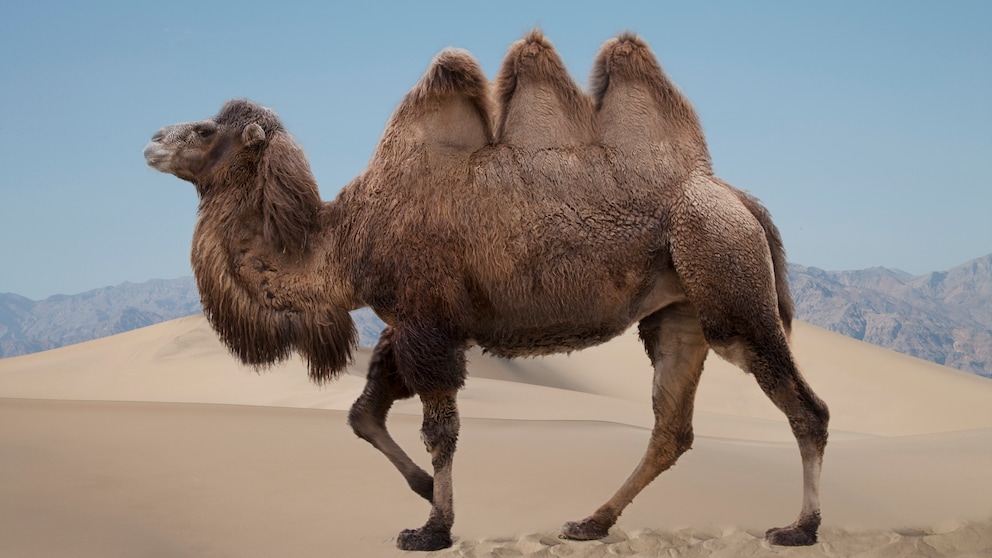
Camels’ humps actually contain fat. They serve as fat reserves and, contrary to popular belief, do not contain water. A camel relies on this fat when it can’t find food for a long time. When the fat is depleted, the humps droop to the side. Once the animals eat again, the humps refill.1,2
Also of interest: Camel or Dromedary–how to tell the difference
How Much Fat Fits in a Hump?
A U.S. zoo organization states that a hump can hold up to 80 pounds (about 36 kg) of fat. The size depends on how well the animal has eaten. A hump is not a solid body part but an indicator of the animal’s nutritional status.3
Why Is the Fat Specifically in the Humps?
There is a plausible explanation for this. When the fat is concentrated in the hump, the rest of the body is less insulated. During the day, heat can escape more easily, and at night, the body releases warmth to prevent the camel from getting too cold. The Heidelberg Zoo explains that the concentrated fat also allows the animals to move more efficiently.

When the Tail Ensures Survival–The Curious Story of Fat-Tailed Sheep

Why Cats Can Drink Saltwater
How Do Camels Survive Without Water?
The secret lies in the entire body:
- Drink a lot at once: A thirsty camel can drink 150 to 200 liters at once. Sources vary widely on how quickly this happens, ranging from three to 15 minutes.4
- Allow body temperature to fluctuate: This can vary by up to nine degrees, from about 34 degrees at night to 42 degrees in the midday heat. This reduces the need for sweating.
- Lose little: A camel excretes about one liter of urine per day. In comparison, a horse excretes around ten liters. Additionally, camels can close their nostrils to lose less water while breathing.
- Withstand high water loss: A camel can endure the loss of up to a quarter of its body weight. For humans, about 10 percent is considered life-threatening.
- Special blood cells: The red blood cells of camels are oval instead of round. They are more elastic and continue to flow well even when the animal is dehydrated.
How long a camel can go without water still depends on the conditions. Estimates range from almost a week to several weeks.5
Why Do Some Camels Have Two Humps, Some One, and Others None?
This involves different animals: Bactrian camels have two humps. They originate from colder Asian deserts like Mongolia and China and need more energy to withstand heat and cold. Dromedaries have only one hump. Alpacas, llamas, guanacos, and vicuñas also belong to the camel family but have no humps and live in South America.