


October 2, 2025, 2:07 pm | Read time: 4 minutes
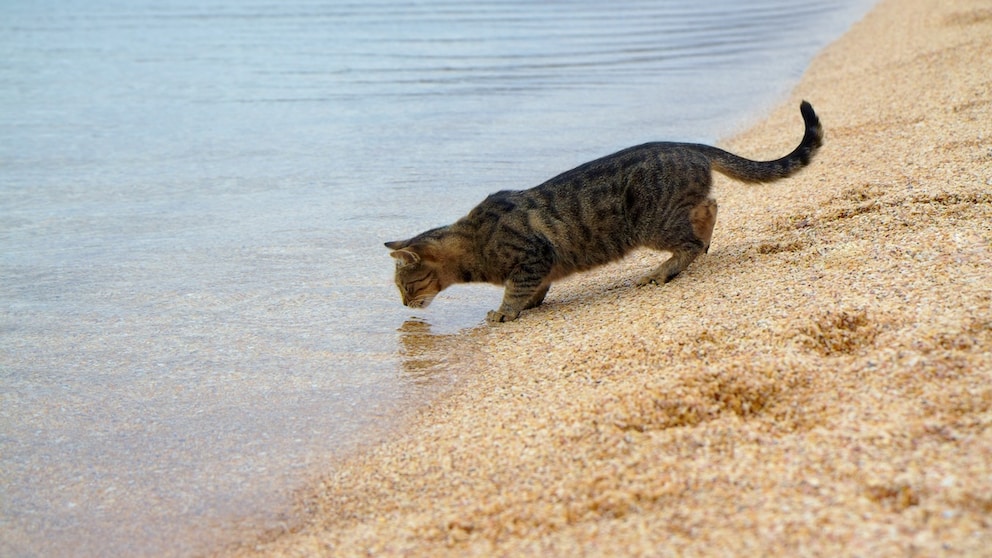
You often read that cats can drink saltwater. But how does that fit together? After all, these animals have quite sensitive kidneys and generally aren’t fond of drinking. PETBOOK editor and biologist Saskia Schneider has explored this question and explains why salt in water can even have positive effects for cats.
As children, we learn that drinking saltwater is not a good idea—even if you’re very thirsty. The salt in the water is so highly concentrated that it only dehydrates the body further. This applies not only to humans but also to animals. Only a few have developed special mechanisms that allow them to drink saltwater without losing water, such as seabirds like gulls. You wouldn’t expect cats to have this ability, given their sensitive kidneys. Yet, you occasionally hear that cats can drink saltwater. So, what’s the truth?
Can Cats Drink Saltwater? Here’s What Research Says
As incredible as it may sound to cat owners, science has long known that cats can drink saltwater. A study published in 1959 in the “American Journal of Physiology” demonstrated that cats can drink seawater without dehydrating: “Under certain conditions, where food provides sufficient calories but too little water for a dehydrated cat, these animals are proven to rely on seawater intake. They generally drink enough seawater […] to thrive and even compensate for a previously caused water deficit,” the study summary states.
But how do cats manage not to lose more water from saltwater? The secret lies in their kidneys, which are usually considered a weak point for these animals. In fact, this organ in cats can excrete excess sodium, or salt, allowing saltwater to provide them with fluid. This ability likely traces back to the cat’s origins as a desert and steppe dweller. Water was scarce there, which is one reason why cats are naturally poor drinkers. They primarily meet their fluid needs through their food. The cat’s kidneys are very efficient at filtering high salt levels from food, enabling cats to drink saltwater in emergencies.1
Cats Can Tolerate Four Times the Salt Levels Humans Can
While this ability has its limits, cats could theoretically meet their entire fluid needs with seawater for one or two days. A five-kilogram cat requires about 250 milliliters of water. This amount of seawater contains about 8.75 grams of salt. Since the lethal dose is about four grams of salt per kilogram of body weight, the cat would survive. In comparison, for humans, a dose of 0.5 to 1 gram of table salt per kilogram of body weight is considered lethal. Cats can tolerate four times the amount of salt. 2

What Happens When Cats Eat Too Much Salt

7 tips to get cats to drink more water
Salt Can Have Positive Effects for Cats
Several studies have shown that salt in cat food can even have positive effects. Researchers examined how increased salt content (sodium chloride) in food affects cat health. The results showed that salt-rich food leads cats to drink more and urinate more. This is particularly beneficial for animals prone to urinary tract diseases, as increased drinking and urination help flush out harmful substances.
A common concern was that too much salt might damage the kidneys or heart. Long-term studies with healthy, even older cats show that no harmful effects on blood pressure, kidney function, or heart were observed over years. Even cats with slightly elevated creatinine levels at the start of the studies showed no negative effects. The data suggest that salt-rich food is safe for healthy cats—though caution is still advised for existing kidney disease.3, 4, 5
Should I Add Salt to My Cat’s Drinking Water?
Even though cats can drink saltwater without harm and salt in food can have positive effects, you should refrain from adding salt to your cat’s water or food. The ability to drink saltwater is a survival strategy, not a preference. While cats can tolerate high salt levels, it stresses their organs and should remain an absolute exception. Still, it’s good to know you don’t need to rush to the emergency room if your cat takes a few sips from a saltwater pool or nibbles on salty ham.
A species-appropriate diet and fresh, clean tap water are enough to keep your cat healthy. Since some animals are poor drinkers, it can make sense to offer meat broth instead of water—but please, without salt. There are also special cat soups or drinks, which are especially useful for cats that eat only dry food.
We’ve compiled more tips on getting cats to drink more water here.
About the Author
Dr. Saskia Schneider is a biologist with a Ph.D. During her studies at the Free University of Berlin, she focused on zoology and animal behavior. In addition to training as an editor, she completed training as a behavior consultant specializing in cats.