

November 4, 2026, 4:02 pm | Read time: 6 minutes
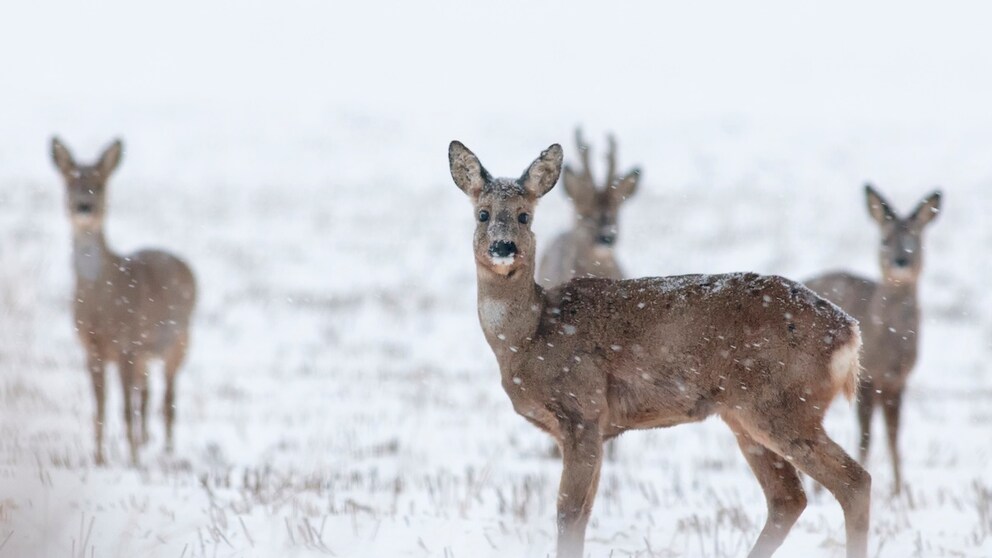
In winter, deer find significantly less food than in summer. But what do deer eat when grasses and herbs become scarce? Healthy animals typically don’t need food from passersby, as they are adapted to the food-scarce season. Why well-intentioned feeding attempts can even be dangerous and how people can help wild animals instead is explained by Jenifer Calvi, press officer of the German Wildlife Foundation, to PETBOOK.
Deer Are Picky Gourmets
Instead of eating large amounts of random plants, deer prefer easily digestible and nutrient-rich food. “Deer like to nibble,” explains Jenifer Calvi to PETBOOK. “They wander here and there, mainly looking for easily digestible, fresh leaves, young shoots, grasses, and tender buds, as well as tasty meadow herbs like dandelion, clover, or primroses.”
Deer not only seek out forests and adjacent meadows for food but also sometimes parks and gardens. Therefore, it’s not unusual to see a deer nibbling on fresh grave decorations, such as rose leaves, in cemeteries, the expert further reports.
Deer Need Several Kilograms of Green Matter a Day
Like all deer species, deer are ruminants. They regurgitate already ingested food and chew it a second time. Only then can they fully digest their plant-based diet. How much a deer needs daily depends on factors such as weight, season, and available food supply. “A deer weighing about 20 kilograms needs between two and four kilograms of so-called green matter per day,” Calvi provides as a guideline.
Throughout the year, not only does the animals’ diet change, but their body weight also fluctuates. “From September to early November, the animals gain weight–in the fall, they build up fat reserves to bridge the food shortage in winter.” These reserves are an important adaptation to the cold season. In winter, hardly any fresh herbs and grasses grow. Frozen ground and a closed snow cover can further complicate the search for food.
Also interesting: Did you know that Bambi is not actually a deer?
What Deer Find in Nature During Winter
Even in the cold season, our native wild animals remain active. They neither hibernate nor go into winter dormancy. Their food supply becomes significantly scarcer but does not disappear completely: “In winter, they rely on the green leaves of blackberries, raspberries, and ivy stems or nibble on rose hips. When snow covers the ground, they scrape away mosses and lichens with their hooves.”
For the animals, structurally rich habitats are therefore important. Hedges, forest edges, bushes, and areas with diverse wild plants not only provide them with food but also cover. Especially in an otherwise barren field landscape, species-rich wild plant stands can help the animals during the cold season.
What Deer Should Never Eat
Walkers and residents should not offer deer self-selected food. Even seemingly natural or well-intentioned food can heavily burden the sensitive winter digestion of ruminants. Therefore, Calvi warns against feeding deer as a layperson, even in a long, frosty winter: “This is purely a professional matter.” This does not only concern kitchen waste, food scraps, bread, or sweets. People should also not independently lay out fruit, vegetables, grains, chestnuts, and ordinary hay. Even food that appears fundamentally plant-based or natural can be problematic in the wrong composition or amount.
It is particularly crucial that the animals’ digestive system adjusts to the scarce food supply in winter. “The rumen of ruminants holds about 60 percent less food in winter than in fall. Since grasses, herbs, acorns, and chestnuts are hardly found, a reduced digestive system paired with rest is nature’s perfect adaptation,” according to the German Wildlife Foundation.
Suddenly offered or unsuitable food can disrupt this natural adaptation. Additionally, there is a risk that deer will become accustomed to feeding sites and thus to the proximity of humans. If such a site is near roads or settlements, additional dangers can arise for the animals.
“Only during prolonged frost periods and icy snow cover are the animals dependent on species-appropriate supplementary feed (such as a special hay mixture). Whether such an emergency situation exists is decided by the responsible authorities; the establishment of feeding sites is then exclusively handled by hunters and foresters in the respective areas,” Calvi explains.
Healthy Deer Usually Manage Without Feeding
The notion that wild animals must be supplied by humans in winter is incorrect. Deer are adapted to the seasonal changes and the associated shortages.
When asked if the animals can get through the winter without human feeding, Jenifer Calvi answers unequivocally: “Yes. In late summer and fall, deer build up fat reserves that help them survive the food-scarce period. Like all wild animals, they are accustomed to the change of seasons and cope well with it–if humans leave them alone.”
Why Every Escape Costs Valuable Energy
Deer often react to disturbances with a few quick jumps, trying to reach the nearest dense underbrush or thicket. Their body is built for these quick movements through dense vegetation. “However, every escape costs the wild animal valuable energy–and it can hardly regain that in the cold season. If the animal expends too much energy through multiple consecutive escapes, it can become life-threatening in a long, frosty winter.”
People who suddenly appear cross-country in the forest are difficult for the animals to assess. Walkers and mountain bikers who leave forest paths can therefore become a significant stress factor. “When startled, it must suddenly ramp up its metabolism, which requires enormous effort. It’s similar to us jumping off the couch and sprinting for a longer distance. Only, humans can then return to their heated living room and eat a warm soup,” Calvi illustrates.
Also interesting: Found a fawn? Do not touch it
Why Many Hoofed Animals Are Ruminants–and Horses Are Not

What Do Hamsters Eat and How to Feed Them Properly?
Dogs Should Be Leashed in the Forest
A particular danger is posed by free-running and hunting dogs. Even if a dog does not catch or injure the deer, the pursuit alone can have significant consequences. Therefore, the German Wildlife Foundation appeals to everyone in the forest, fields, or a nature reserve that dogs must be leashed and that official paths should not be left.
How People Can Really Help Deer in Winter
Helping deer in winter mainly means leaving them in peace. Jenifer Calvi summarizes it this way: “The best way to help wild animals is to give them peace. Wild animals are adapted to the cold season. If they are healthy, they can get through lean times. Peace and no disturbances–that’s the greatest favor you can do for any wild animal.”