

May 13, 2026, 4:09 am | Read time: 4 minutes
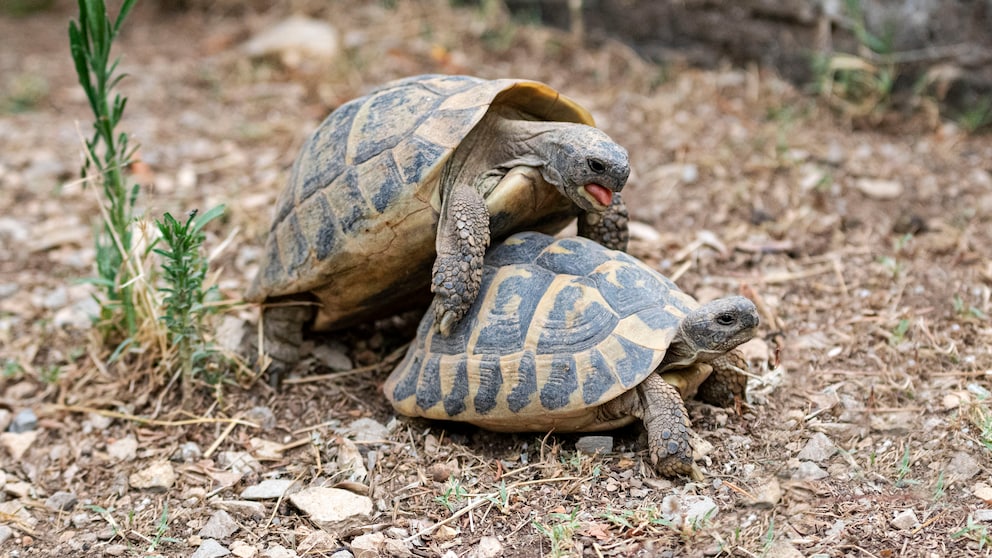
What sounds like a perfect retreat for animals is turning into a rather absurd and simultaneously tragic experiment of nature. Everything seems perfect in North Macedonia: no natural predators, a mild climate, and plenty of food. Yet, the Hermann’s tortoises on the small island of Golem Grad are in great danger. The reason seems almost trivial: The males are a bit too enthusiastic about flirting.
A Paradise Without Predators
The North Macedonian island of Golem Grad in Lake Prespa appears at first glance to be the perfect retreat for animals. It is strictly protected, free from typical predators like wild boars, stray dogs, or rats, and situated in a mild climate at about 850 meters elevation. For the Hermann’s tortoises (lat. Testudo hermanni boettgeri) living there, these are ideal conditions. So ideal that the population could develop almost undisturbed over the years.1
Long-term data from monitoring since 2008 show: With around 50 animals per hectare, one of the highest documented tortoise densities was reached here. This population was long considered stable, almost a model example of a functioning ecosystem. What initially sounds like a success story, however, has a bitter aftertaste.
When “Dating Stress” Becomes a Problem
The real problem is ironically related to what should secure the population: reproduction. The males take their role a bit too seriously. In the unusually dense population, an extreme form of competition arises, leaving the females hardly any peace.
The males constantly pursue them, repeatedly bump into them, and persistently try to assert themselves as sexual partners. What is fundamentally part of natural mating behavior turns into a constant stress scenario here. The females are not only physically burdened but also prevented from taking in enough food. Many are therefore significantly underweight, weakened, and thus less capable of reproduction.
When Flirting Turns Deadly
In some cases, it doesn’t stop at stress and exhaustion. The behavior can even be fatal for the females, reports Xavier Bonnet in the science magazine “Phys.Org.” Observations from long-term monitoring show that the males repeatedly push females toward the steep cliffs of the island.
In doing so, it happens that animals fall to their deaths from more than 20 meters high. This is a behavior that is hardly documented in the wild in this form and even surprises researchers.
How Hermann’s Tortoises Endanger Themselves
The effects of aggressive flirting are particularly evident in the gender ratio. While there is still a relatively balanced ratio among young animals, it shifts massively in adulthood. In 2009, 45 adult females were counted on Golem Grad. By 2024, there were only 20, and by 2025, just 15.
Currently, more than 700 adult males live there, but only about 40 females. Since many of them are weakened and no longer develop eggs, there are over 100 males for every reproductively capable female. Many of these tortoise females are in such poor physical condition that they also produce significantly fewer eggs. The population on the island is now seriously threatened.
The problem intensifies itself. The fewer females there are, the greater the competition among the males and the more aggressive their behavior becomes. This increasing pressure further stresses the remaining females, weakens them additionally, and thereby reduces their chances of survival and reproduction. It leads to a vicious cycle from which the population can hardly escape.
Just Four Kilometers Away, Everything Is Different
How extraordinary this development is can be seen by looking at a nearby comparison population, just about four kilometers away on the mainland. There, genetically almost identical animals live under similar conditions. The crucial difference: The environment offers more escape options, and there are no steep cliffs.
The females there are larger, heavier, and significantly more resilient to the behavior of the males. The gender ratio is balanced or even slightly skewed in favor of the females. As a result, the reproduction rate remains stable.

Why Male Mammals Often Die Earlier

Why Icelanders are throwing puffins off cliffs
Offspring Cannot Halt the Threat
Another problem arises: Hermann’s tortoises take about 15 years to reach sexual maturity. So even if offspring are produced, they cannot compensate for the losses quickly enough. At the same time, the males increasingly exhibit deviant behavior and even attempt to mate with unsuitable “partners”—including other males, juveniles, or even inanimate objects.
A Rare Phenomenon
Researchers speak of a kind of “demographic suicide.” They describe a development in which a population destabilizes itself in the long term through its own behavior.
Model calculations paint a correspondingly bleak picture. If this self-destructive trend continues, the last female could disappear in a few decades. The males would survive for a long time, but could no longer save the population without reproductive partners.