


September 3, 2025, 1:17 pm | Read time: 6 minutes
Finally, it’s here–one of the most popular podcasts is back from its summer break. The “Gemischtes Hack” podcast features the duo comedian Felix Lobrecht and the (not yet) book author, host, and comedy writer Tommi Schmitt. The conversations are usually a mixed bag of in-depth discussions, big questions, sometimes controversies, and amusing observations or experiences. In the first episode after the summer break, Tommi shares a somewhat peculiar summer highlight–the pigeon drama.
Visited by a Pigeon and Became a Father
Right in the first episode after the break, with the revealing title “I-Pünktelchen”, the male duo from the “Gemischtes Hack” podcast is back in full swing. When asked how Tommi’s summer was, he talks about the arrival of an unusual roommate–a female pigeon: At the end of May, Tommi got a new balcony plant. He didn’t reveal what type of plant it was–the important information was: a conifer with broad and flat growth. The new plant unexpectedly appealed to the Berlin pigeons. “Yeah, not bad, so flat here, I like it,” Tommi joked about the birds.
Two “Hideously Ugly” Pigeon Babies
Delighted by the feathered visitors in his city apartment, Tommi showed hospitality by providing the birds with seeds and water. Laughing, Felix interrupted him at that point: “I can already tell how this story ends.” And with this foresight, he was right, as one pigeon particularly took to the offer.
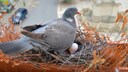
Unaware, Tommi was occupied elsewhere for one to two weeks. When he returned, he saw: “a pigeon house… by all the rules of art” on his plant. The pigeon stared at him from the nest with an attitude of: “What do you want here? I live here!” the comedy writer recounts.
So a pigeon was nesting on the podcast star’s balcony. Tommi rightly asked himself: “What do I do now?” After a little research, he came to two conclusions: This is a wild pigeon, which cannot be removed, “otherwise the pigeon police will come, a pigeon with a little blue light on its head,” the two podcasters joked. Tommi further reports that he flew on vacation shortly after. When he returned home, he was surprised by “hideously ugly baby pigeons.” After some time, they left their nest. For Tommi, it almost felt like he had raised the pigeons.
“Don’t Touch My Eggs”
This is by far not the first quirky animal story in the podcast. Tommi’s pigeon spectacle is thus part of a whole series of crazy bird encounters. Not only did the pigeon babies cause a stir, but also the behavior of the female pigeon. Tommi tells how he caught a moment when she had left the nest to water his plant. Carefully, he approached the conifer with the nest. At that time, he knew nothing of the pigeon’s luck and was quite amazed when he saw two small pigeon eggs nestled in the nest. As he then let his gaze wander over the treetops, he realized he was being stared at continuously by the soon-to-be pigeon mother. True to the motto: “Don’t touch my eggs!”
Bird Invasion at Felix Lobrecht’s
Felix also has some bird experiences to share. Twice, birds have visited him: once in his apartment in Berlin and another time in a shared apartment in Marburg. He remembers the story from Marburg well. Back then, he was awakened by wild fluttering and quickly reacted. He didn’t question why a bird had found its way into his room–there was no time for that. He went to his human roommate Johnny, who took care of the animal without further questions and freed it with the words “All right, the bird is out again.”
By the way: What to do if a wild bird gets into your apartment is explained by the colleagues at MyHOMEBOOK in this article.

Danger to Life from Birds in the Chimney! What Homeowners Need to Know
What to Do About a Pigeon Nest on Your Balcony
How to Identify Different Pigeon Species
They are called “the rats of the sky.” Pigeons are considered dirty, and people assume they are full of pathogens. That there’s not much substance behind this is explained by PETBOOK in this article: On the animal-friendly handling of city pigeons. They are quite intelligent and diverse animals. There are about 300 different pigeon species worldwide. In cities, there are around 500 million pigeons globally–so it’s worth being able to distinguish some of them.
The most common pigeon species in Germany is the street pigeon, also known as the house or city pigeon. Their feathers come in numerous colors, but they are mostly gray. Classic for a city pigeon is the neck shimmering in green, purple, and pink tones.
Almost as popular as the city pigeon is the wood pigeon. It is recognizable by its namesake white neck ring. Otherwise, it looks quite similar to the city pigeon. Another in the group is the stock dove. You usually find them more in forests–but now also in towns. Unlike its relatives, it has a more uniform gray plumage with a green shimmering neck spot and deep dark eyes. There are many other pigeon species, but they mostly live in forests. 1, 2, 3
Can You Remove Pigeon Nests?
In summer, there can be more incidents of nest building, like with Tommi. If you also get an unexpected roommate, there are some things to consider before taking action. Important: All pigeons are subject to the bird protection guidelines imposed by the EU. This means that their nests, eggs, and chicks are protected. So you should not remove nests or chicks–even pest control measures can only be taken with official approval by professional companies.
If you have a nest on your balcony, you should first determine the type of pigeon. For wild pigeons like the wood pigeon, the rule is: Leave the pigeons, nests, eggs, and chicks alone. Anyone who removes eggs or damages the nest must expect legal consequences.
It’s different for city pigeons: As part of their breeding, they have been bred with a reproductive urge. However, since there are no suitable habitats for this in the city, a so-called animal welfare-friendly reproduction regulation is possible. For this, pigeon eggs can be exchanged for plaster eggs.4