

April 20, 2026, 9:24 am | Read time: 9 minutes
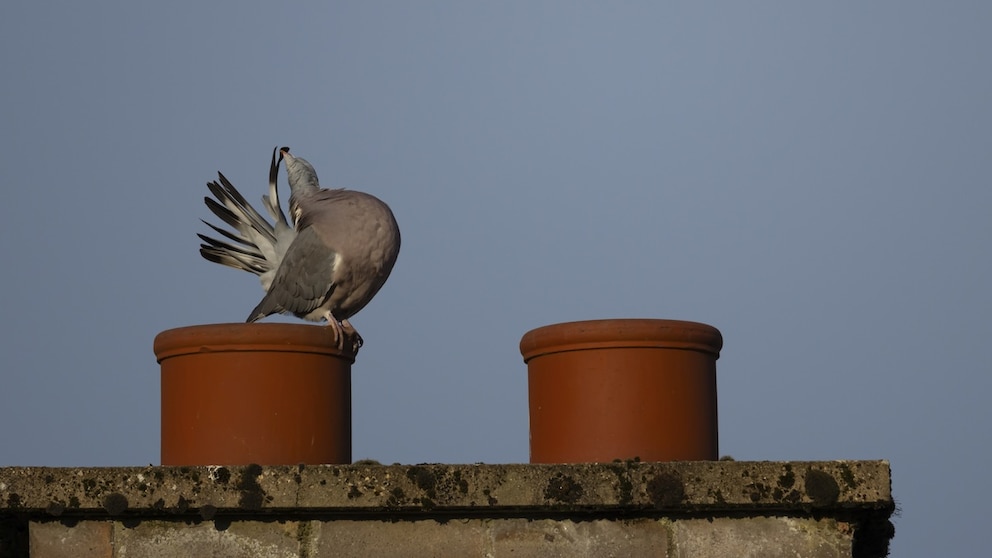
Chimney sweeps often find nests and carcasses of birds and small mammals. Pigeons, blackbirds, and even squirrels frequently fall into chimneys. Most do not survive the fall. Jackdaws, however, use chimneys as nesting sites, which can pose a danger to residents. A chimney sweep explains to PETBOOK how to protect these animals from dying in chimneys.
Chimney as a Death Trap
Some homeowners may have heard it: a scratching noise, scuffling, or cooing that seems to come from the chimney. Sometimes, a bird or even a squirrel has fallen into the chimney and is desperately trying to escape its dark prison. If the animals are not discovered in time, a fall into the chimney means certain death. “They usually starve and dehydrate,” says Iris Dohmen, master chimney sweep and spokesperson for the Federal Association of Chimney Sweeps.
If animals fall into the chimney in winter, they can also suffocate or burn. Pigeons, blackbirds, owls, or squirrels cannot simply fly or climb out of the narrow shafts. “We find their remains during our inspections,” says Dohmen. Young birds that have not yet learned to fly properly can fall into chimneys, as can adult birds that choose the edge of a chimney as a perch, lose their grip, or become unconscious from escaping gases.
Animals Fall Unconscious into the Chimney
“The exhaust gases are usually odorless, so the birds don’t notice when they inhale something,” explains Dohmen. When they become unconscious, they often fall into the flue. “They fall to the bottom of the chimney, from where they cannot escape if they regain consciousness.” In cities, pigeons are often found in chimneys, having settled on them for warmth.
Dohmen cannot provide exact numbers on how many dead animals they retrieve from chimneys. “But especially in cities, on average, about one dead bird per house is removed from a chimney each year, mostly pigeons.” Chimneys of gas-fired systems can become death traps. In contrast, fewer dead animals are retrieved from chimneys connected to fireplaces–the escaping smoke tends to keep birds away.
Jackdaws Like to Nest in Chimneys
Birds that accidentally fall into chimneys face a painful death. If they fall to the bottom of the chimney, do not block it, and are removed during the chimney sweep’s visit, they usually do not pose a significant danger to the residents. However, it is different if the chimney is completely blocked—for example, because a bird has built its nest there.
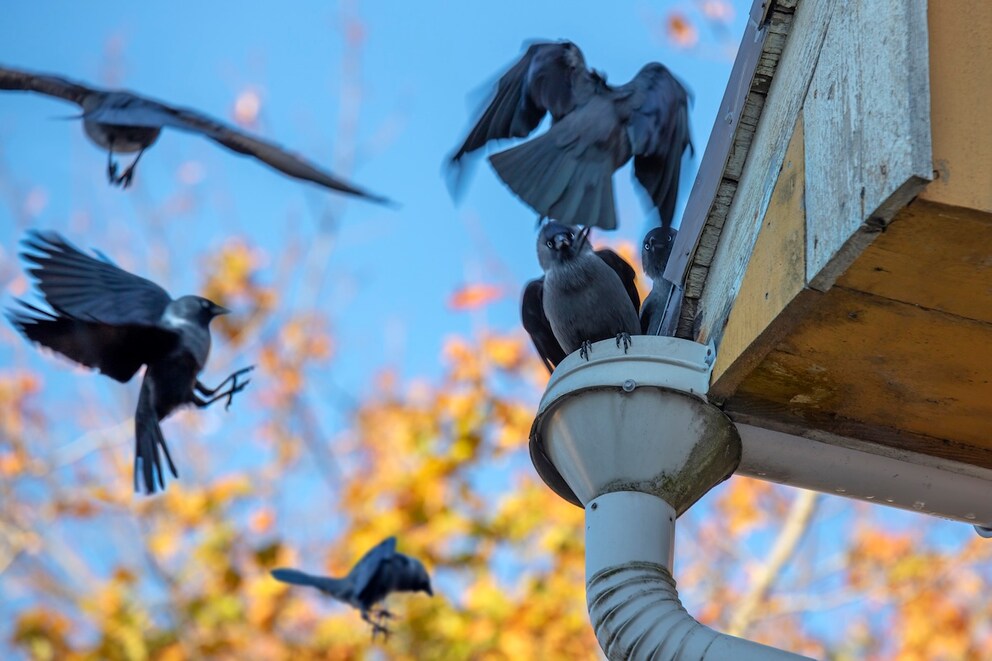
Anyone who thinks a bird would hardly choose a possibly still-used chimney as a nesting site is mistaken. Jackdaws, a type of corvid found throughout Europe in rural areas and increasingly in cities, like to nest in chimney shafts. The jackdaws, barely 16 inches in size, are easily identifiable by their dark gray-black bodies and distinctly light gray necks. They have light eyes, a pointed, strong beak, and a short neck, giving them a somewhat stocky appearance. The birds are not afraid to climb into the dark shafts, as the chimney sweep knows. “Jackdaws can thoroughly explore chimneys and pipes, walking along them.”12
Jackdaw Nests Can Act Like a Cork
Iris Dohmen recounts a particularly bizarre case from her own experience. Three jackdaws had entered a chimney and followed the pipes until they reached the fireplace. “They apparently followed the pipes and the light until they were in the fireplace.” However, the birds perished there because they could not find their way back. “And such a drastic case has only happened to me once,” assures the master chimney sweep. Nevertheless, jackdaws do thoroughly explore chimneys to see if they are suitable as nesting sites. “The birds are very intelligent and can usually climb out of a chimney unharmed.”
Since jackdaws are cavity nesters, they often resort to chimneys in cities due to a lack of suitable nesting sites. The problem: They build such large and stable nests that these nests can block chimneys like a cork. Even chimney sweeps struggle to remove such structures from the shafts, as the spokesperson for the Federal Association, Iris Dohmen, reports.3
Reach Deep into the Shaft
“When we find abandoned nests, they are often so firmly lodged that they can only be removed with effort.” Chimney sweeps report online that sometimes chimneys even had to be opened from the outside to remove stuck nests. Jackdaws prefer to build their nests in so-called drawn chimneys, as Dohmen says. These are characterized by not running straight down but having a bend. “This makes nest building easier.” However, a straight chimney does not necessarily protect against colonization by the birds.
To build a nest, the animals must create a kind of base. “They first throw sticks, twigs, and similar materials into the chimney,” says Dohmen. If a twig gets wedged, they can start building the nest on it. This results in jackdaw nests often reaching very deep and funnel-shaped into the shaft and being firmly anchored there before the actual nesting area begins. For their nest, the birds also use a variety of sturdy materials. “We have already removed nests that contained not only twigs, leaves, animal hair, and feathers but also fabric scraps and rags.”
Jackdaw Nests Can Have Dangerous Consequences
Chimney sweeps report that even trash and towels have been found in jackdaw nests. All these materials create a stable and compact structure that sits like a plug in the chimney. The nesting site in the chimney is usually not dangerous for the birds themselves. They breed in the spring when houses and apartments are hardly heated anymore.
And even if the chimney they have chosen is used again: Due to the compact construction of the nest, hardly any exhaust gases pass through, as Dohmen reports. The birds usually do not suffocate. However, jackdaws do not dismantle their nest after raising their young, says Dohmen. “It remains in the chimney when the heating season starts again.” For the residents of a house where jackdaws have settled in the chimney, such a nest can then have dangerous consequences.4
Carbon Monoxide Poisoning from a Blocked Chimney
Because exhaust gases and smoke cannot or no longer escape sufficiently, there is a risk of exhaust gas buildup and heating system failure. Incomplete combustion in fireplaces and other heating systems can also produce carbon monoxide. The gas is odorless but highly toxic and can quickly lead to unconsciousness and even death in humans if inhaled.
In 2008, a mother and her two children died in Herne, North Rhine-Westphalia, because a jackdaw nest blocked the chimney of their house, preventing exhaust gases from the gas heater from escaping outside. In 2014, a young couple and their two small children died in their sleep from inhaled carbon monoxide in Ahlen, Münsterland. An expert eventually found the cause: A jackdaw nest built one and a half meters deep in the house’s chimney had prevented the gas from venting.
Therefore, attention is advised when jackdaws are present around the house and near the chimney, says Dohmen. However, there is no need to panic. It is important to pay attention to the first signs that a fireplace may not be working properly. If the heaters are no longer sufficiently warm and the water remains cool, it should be checked. Not always is a nest in the chimney the cause. “But it is possible, especially in regions where jackdaws settle and there are drawn chimneys.” Suddenly occurring musty-damp smells in the house and moisture deposits could also indicate that the heating system and the associated chimney are not functioning properly.567
Jackdaw Grates Prevent Nesting
“And if sticks and similar materials are found when opening the soot flap at the bottom of the chimney, jackdaws may have been at work,” says Iris Dohmen. In such cases, the chimney sweep should be informed. Chimney sweeps know in which regions jackdaws occur and recognize the signs of colonization. “It is important that chimneys are regularly swept and inspected.”
Since nests are usually only discovered at the start of the heating season, when the spring-breeding residents have already flown out, removal is unproblematic, as explained by the State Office for Nature, Environment, and Climate of North Rhine-Westphalia (Lanuk) upon inquiry by PETBOOK. Although jackdaws are a protected species in Germany, “jackdaw nests in chimneys can be removed without further consultation and approval from the lower nature conservation authority,” says a spokesperson for the authority. The chimney sweep is best suited for this task.
However, if eggs or chicks are found in a nest, “the end of the breeding season should be awaited before removing the nest to avoid conflicts with the killing prohibition under the Federal Nature Conservation Act,” Lanuk concludes. In such cases, the affected heating system may be temporarily shut down, as reported by WDR. The breeding season typically lasts until the end of June, so no one has to freeze in winter.
How Small Changes in the Garden Can Help Amphibians Survive the Winter
What to Do About a Pigeon Nest on Your Balcony
Measures to Make the Chimney Jackdaw-Proof
If you don’t want birds to build their nests in the chimney or the chimney to become a death trap for other animals, you can take simple and inexpensive precautions: So-called jackdaw grates are available to fit any chimney size. The firmly mounted grates, which resemble grill grates, prevent jackdaws from climbing into the shaft and building their nests there. However, they are coarse enough to allow exhaust gases to pass through. Among other things, chimney sweep companies handle the ordering and installation of such grates, which are available online for less than 100 euros, depending on the size. “In general, it’s cheaper than having us regularly come out to clear the chimney of jackdaw nests.”
Because: “Jackdaws like to return,” the chimney sweep knows. “Once a nest has been removed, it doesn’t mean the birds won’t build a new one in the same spot the following year.” If the birds found good conditions and felt comfortable, they would not be deterred by a removed nest.89
Conclusion
Jackdaw grates reliably prevent nesting and other animals from dying painfully in the chimney. However, you can still do something good for the jackdaws by providing nesting opportunities. Those who are a bit handy can even build jackdaw boxes themselves. Instructions are available from the Nature Conservation Association.
Important: Jackdaw boxes must be installed at a suitable height. In addition to building facades and towers, tall trees are also suitable.