

October 29, 2026, 4:06 pm | Read time: 3 minutes
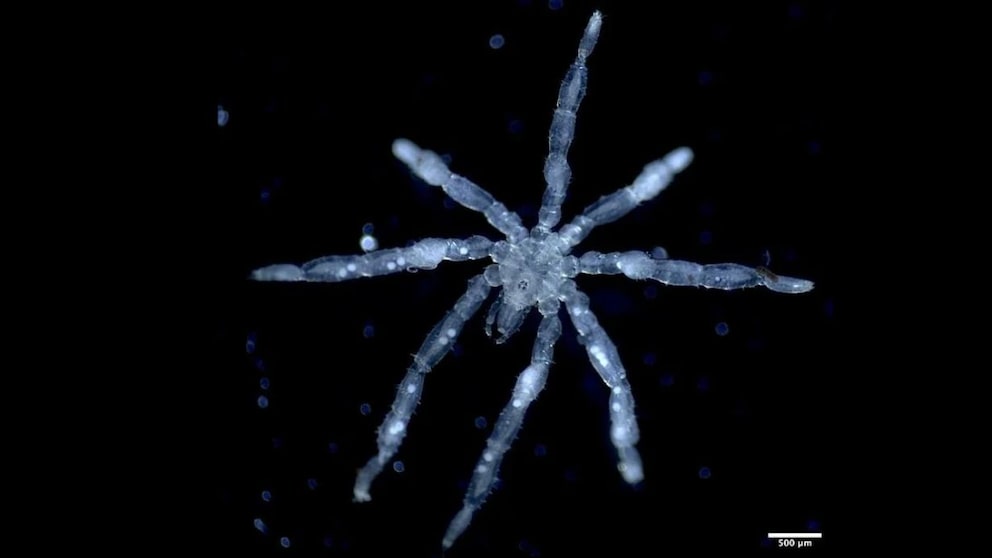
With red eyes, long legs full of curved spines, and a three-lipped mouth, the Callipallene pilosuspedes looks quite fearsome. Behind its curious appearance lies a scientific discovery: Researchers have described the tiny sea spider along with a second new species in the Salish Sea–the first such discovery in nearly a century.
A Sea Spider with “Hairy Feet”
Even the scientific name of Callipallene pilosuspedes hints at what makes this marine creature so extraordinary. The species name can be roughly translated to “hairy feet,” referring to the long, curved spines on the lower leg sections of the sea spider. For people with arachnophobia, this idea alone is enough to feel uneasy. But visually, the Callipallene pilosuspedes has even more creepy features to offer.1
In addition to the long hairy legs, it also has conspicuously red-pigmented eyes. Not curious enough? The sea spider also has a short proboscis and strong pincers with which it can grasp food. Its mouth opening consists of three lips and is surrounded by fine sensory appendages. This combination makes the creature, under strong magnification, look a bit like something out of a science fiction film. In reality, the examined sea spider is tiny.
Also interesting: This giant spider is faster than many joggers
It Can Literally Clean Its Legs
One detail might fascinate even those who usually flee at the sight of a spider. The Callipallene pilosuspedes has so-called ovigers. These special limbs can wrap around its own legs and literally brush them clean with small, comb-like spines.
The long extremities of sea spiders serve surprisingly many functions. Among other things, parts of the reproductive organs are located in the legs. Additionally, the males engage in brood care, meaning they take up the eggs and carry them on their bodies.
Not an Ordinary Spider Despite Its Name
Sea spiders, scientifically known as Pycnogonida, are exclusively marine arthropods. They look strikingly similar to spiders and, like spiders and scorpions, belong to the chelicerates, but they form their own ancient animal group. According to the University of British Columbia, their evolutionary history dates back about 500 million years.
And not all sea spiders are the same! Members of this group can measure less than a centimeter, while Antarctic species can reach enormous spans. Some small species live as parasites on larger invertebrate marine animals and take in food using their proboscis.
Also interesting: Span up to 3.7 meters! This is the largest crab in the world
Spanning Up to 3.7 Meters! This is the Largest Crab in the World
The Coolest Vampire Animals–From Real Bloodsuckers to Eerie Namesakes
Another New Sea Spider Species Discovered
Callipallene pilosuspedes was not the only new find. The research team also described Tanystylum kiixin. Researchers found entire populations of this species. Tiny parasites often sat on this species. Scientist Cormac Toler-Scott aptly described it as an “ecosystem within an ecosystem within an ecosystem.”
Why the Creepy Tiny Creatures Are Important for Research
Behind the spectacular images lies a serious research problem: Relatively little is known about the diversity of sea spiders off the North American Pacific coast. Without knowing which species are present in a habitat, it is difficult to assess how climate change and human interventions affect them.
So creepy? Under the microscope, definitely! But above all, the red-eyed tiny creatures show how much remains undiscovered even in relatively accessible coastal waters.