

June 22, 2026, 2:56 pm | Read time: 3 minutes
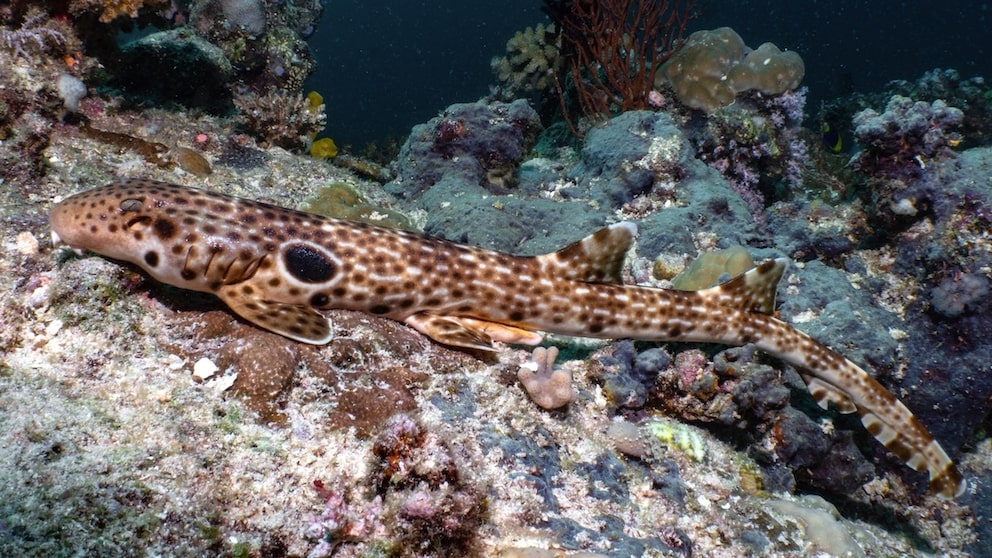
Sharks are considered elegant hunters, gliding through the oceans. But a newly discovered species does the exact opposite: It prefers to move by walking. Instead of swimming, the newly discovered specimens prefer to “walk” on the ocean floor. A research team led by Jessica-Anne Blakeway from Australia’s University of the Sunshine Coast discovered the previously unknown species off the coast of Papua New Guinea. The scientists have now officially described the shark in a scientific study.
The Shark Prefers Walking to Swimming
Sharks are typically known for gliding elegantly through the water. However, the newly discovered species belongs to the so-called walking sharks or bamboo sharks (genus Hemiscyllium). Instead of swimming through the open sea, these animals often use their pectoral and pelvic fins like legs to move across the sea floor. They primarily inhabit shallow coastal waters, seagrass meadows, and coral reefs.
For the local people, the fish is not a sensation. They have known it for a long time and call it the “lazy shark” or “dog shark.” Presumably because it prefers walking to moving through the water. However, science had not previously recognized it as a distinct species.
Accidental Discovery During a Night Dive
The researchers were actually searching for another bamboo shark species when they noticed the unusually patterned fish. When they shone a light on it, the animal remained motionless—a behavior likely intended to deceive predators. This allowed the scientists to examine the shark more closely.1
The striking spot pattern already made the researchers suspicious. In the following days, they found more specimens and took tissue samples. Subsequent DNA analyses finally confirmed the suspicion: The “walking shark” is indeed a previously unknown species.
Researchers Discover Deep-Sea Pokémon
Ghostly new shark species discovered in the deep sea
Surprisingly Robust Even Outside the Water
The unusual walking style is not the only peculiarity of these animals. The sharks often inhabit extremely shallow coastal areas and can even move between small water pools left behind at low tide. These areas often suffer from oxygen deficiency, which is a problem for many marine creatures. However, not for this bamboo shark. To survive the challenging conditions, it can lower its heart rate and adapt its body to the lack of oxygen.
The New Species Could Already Be Threatened
The excitement over the discovery is accompanied by concerns. According to current knowledge, the new shark species is found only in a small area off Papua New Guinea. Researchers estimate its range to be only about 7,000 square kilometers—the smallest of all known walking sharks.
Because the animals live in only a few coastal regions and hardly spread over larger distances, they are particularly sensitive to overfishing, habitat loss, and environmental changes. Scientists fear that the species could soon be classified as endangered.
With this discovery, the number of known walking shark species increases to ten. And it once again shows that even in such a well-known animal group as sharks, surprises still lurk in the sea.