

July 24, 2026, 2:29 pm | Read time: 6 minutes
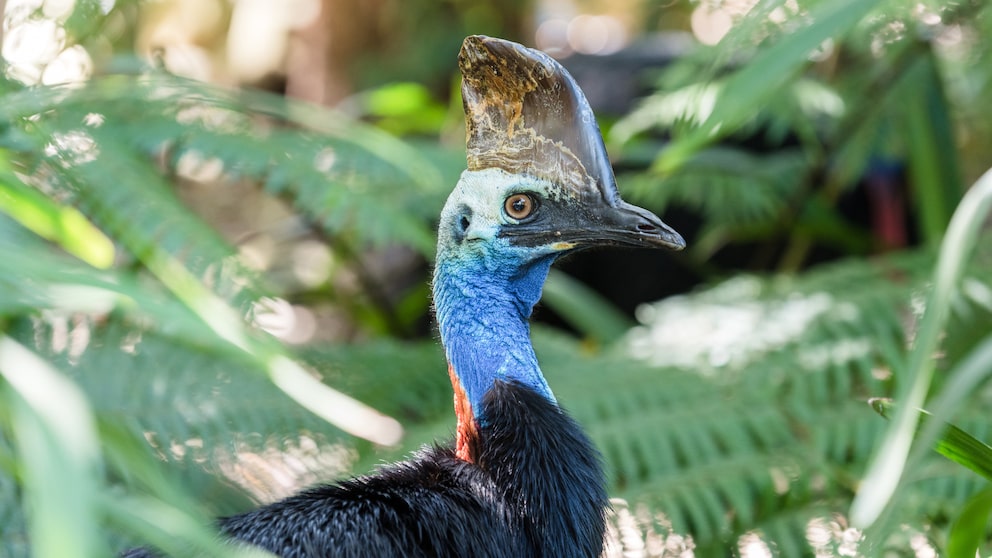
When people think of dangerous birds, many initially consider harpies, ostriches, or aggressive swans. However, the cassowary is often regarded as the “world’s most dangerous bird.” These colorful, flightless rainforest dwellers live reclusively in New Guinea, Australia, and surrounding Pacific islands, generally avoiding human contact. Despite this, the birds—also known as cassowaries—have earned the reputation of “murder birds.” But why? PETBOOK explains the story behind this image.
Why the Cassowary Is Known as the World’s Most Dangerous Bird
In 2019, a man in the U.S. state of Florida was attacked by a cassowary he kept privately. Apparently, he tried to remove an egg from the bird’s enclosure, which the helmeted cassowary did not take kindly to. This incident provides the first clue as to why cassowaries are considered dangerous—they fiercely defend their clutch, usually consisting of four eggs. Even before this incident, the cassowary was labeled a “murder bird.”
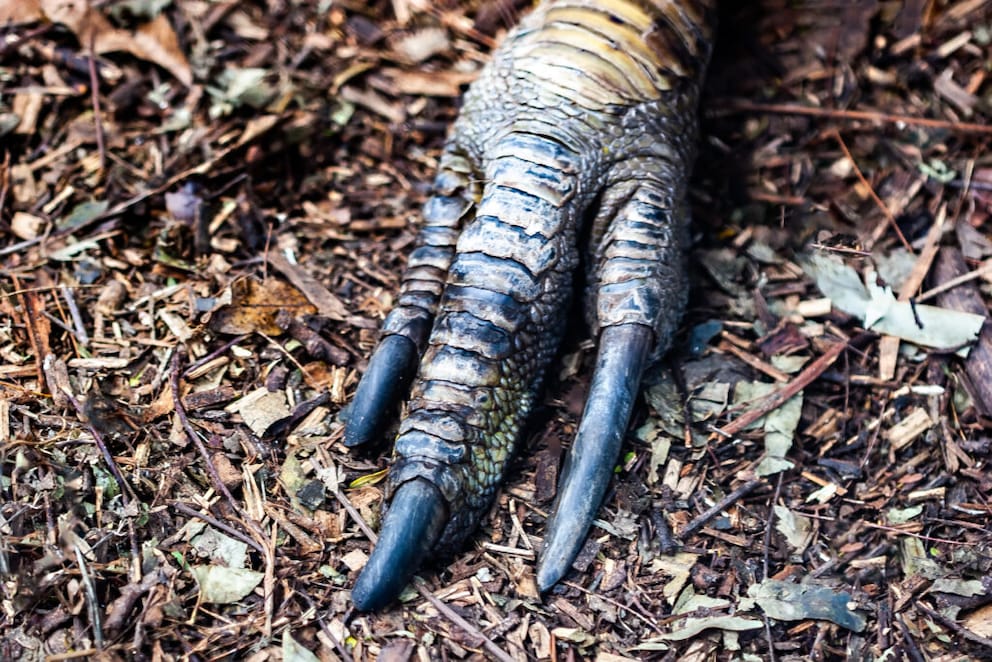
There is a report from 1926 of a boy in Australia who attacked a cassowary that had wandered onto a farm. Instead of leaving the bird alone, some people struck the flightless bird, prompting the cassowary to defend itself, which unfortunately resulted in the boy’s death. The bird, which can grow up to 1.8 meters tall and weigh 70 kilograms, has large, three-toed feet equipped with claws up to 10 centimeters long. Additionally, all cassowaries have very long and strong legs, allowing them to reach speeds of up to 50 km/h and deliver powerful kicks.
These two attacks, separated by 93 years, left such an impression on people that the cassowary even made it into the Guinness World Records as the “world’s most dangerous bird.” However, two confirmed incidents are far from enough to classify the cassowary among the world’s deadliest animals. Nevertheless, it has a reputation as a dangerous animal, which is even more puzzling when considering the lifestyle of these flightless birds.
Cassowaries Are Rather Shy Rainforest Dwellers
Cassowaries are indeed quite defensive, and their long claws can severely injure a person who disturbs them while nesting, attacks them, or gets too close. However, whether two known cases in the last hundred years, where a cassowary injured people so severely that they died, are really enough to justify its label as a “murder bird” is hard to determine.
In reality, cassowary species are very shy and typically flee when humans approach their habitats. They are found in New Guinea and the Australian state of Queensland. There are currently three known species: The helmeted cassowary is the most frequently sighted in tropical rainforests, as it prefers mid-altitudes. The Bennett’s cassowary and the single-wattled cassowary have smaller ranges and prefer lower and higher altitudes. The different species are usually distinguished by the various vibrant colors on their heads and their different crests. The body of these robust flightless birds is generally uniformly black.
In fact, the cassowary is also extremely important for the rainforests in which it lives. It primarily feeds on fruits and seeds, which it distributes throughout the forest with its droppings, making the forest fertile. The large bird can even metabolize and distribute avocado pits. Due to the many kilometers it covers each day, it acts as a landscape gardener in the rainforest, constantly “planting” new trees and shrubs that benefit other species as well. Sometimes cassowaries also eat insects and small mammals. Additionally, they consume carrion when they find it.
As the rainforests shrink, the cassowary is losing more and more of its natural habitat. Whether it is actually endangered is something researchers can only speculate about, as the animals are so shy that they are rarely seen.
Cassowaries Are Close Relatives of Carnivorous Dinosaurs
Cassowaries, like the flightless birds emu and ostrich, belong to the paleognaths. This means they are classified in the family of ancient jaw birds based on their beaks, which are still relatively closely related to flying dinosaurs and the velociraptor. In 2017, a dinosaur was described that already had wings and resembled raptors. This reminded researchers very much of the helmeted cassowary’s crest and could represent the link between the species.
In another study, scientists took a closer look at this crest. There was also a rumor that the cassowary used its crest to kill humans. Other theories suggested it was head protection in case the animals ran into trees in the rainforest. However, a study by Australian scientists in 2019 also provided insight into this. Cassowaries actually use their crest to regulate their body temperature. This is necessary in their tropical range and with their black feathers to prevent the animals from overheating. Similar structures are found in dinosaur humps, but also in modern birds.
Perhaps the special feathers of cassowaries also provide insight into their close relationship with extinct prehistoric animals. These feathers have a sheen that distinguishes them from all other ancient jaw birds and suggests an immediate relationship to dinosaurs. Instead of producing sheen with keratin layers like other birds, cassowaries have a unique feature in the tubular shafts of their feathers. There, eumelanin is anchored, which makes the feathers appear black. This is stored in special melanosomes (pigment storage cells) that prevent light reflection. This process simultaneously leads to higher mirror reflection and makes the cassowary’s plumage particularly shiny.
The Kākāpō Is One of the Strangest Birds in the World
Have you heard of the world’s most poisonous bird?
When Do Cassowaries Really Become Dangerous?
Many birds, including the cassowary, defend their clutch. Like emus, cassowary eggs are green. They are incubated by the male for about 50 days after laying, and the male also takes care of raising the young.
It is important to note that while cassowaries are fascinating animals, they can be potentially dangerous due to their claws and speed, especially if they feel threatened or cornered. If the unlikely event occurs that you encounter them in their natural habitat in New Guinea or Australia, you should not try to provoke or irritate them.
Feeding is also taboo, as if cassowaries become accustomed to receiving food from humans, they will demand it aggressively. This phenomenon is also known from seagulls or pigeons, but it hurts much less with smaller birds than when a cassowary is seeking food.
Sources
- Lü, J., Li, G., Kundrát, M., Lee, Y. N., Sun, Z., Kobayashi, Y., … & Liu, H. (2017). High diversity of the Ganzhou Oviraptorid Fauna increased by a new “cassowary-like” crested species. Scientific Reports, 7(1), 1-13.
- Eastick, Danielle L., et al. Cassowary casques act as thermal windows. Scientific reports, 2019, 9. Jg., Nr. 1, S. 1966.
- Eliason, C. M., & Clarke, J. A. (2020). Cassowary gloss and a novel form of structural color in birds. Science Advances, 6(20), eaba0187.
- Greenmatter.com, “Cassowaries Are Considered the Most Dangerous Birds in the World“ (accessed on June 23, 2026)