

August 7, 2025, 8:33 am | Read time: 5 minutes
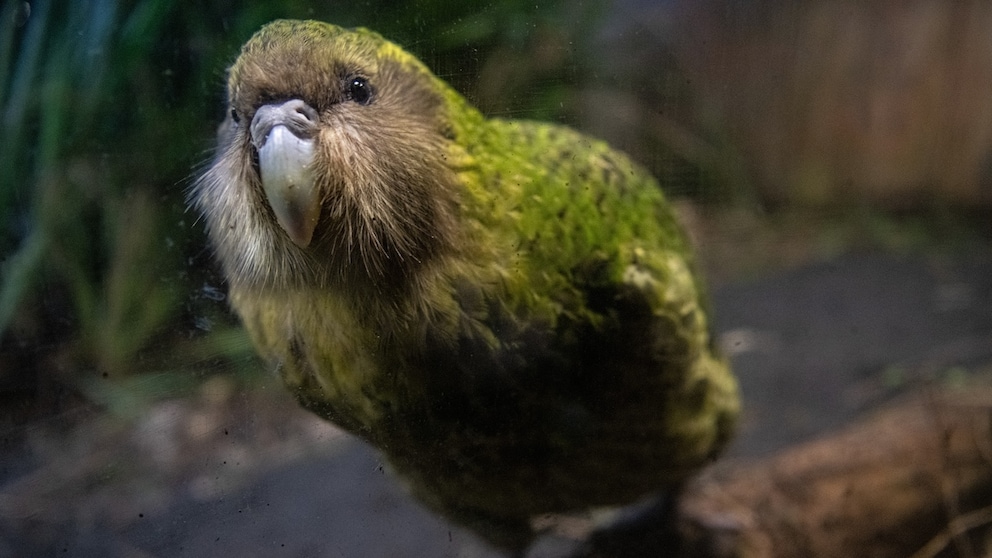
With its round stature and noticeably awkward gait, the Kākāpō almost seems like a creature from a fantasy novel. Yet behind its charming appearance lies a dramatic story—and a future that remains uncertain.
The Heaviest Parrot in the World
The Kākāpō, a nocturnal parrot, lives exclusively in New Zealand and, at up to 64 centimeters in length and weighing up to four kilograms, is the largest living parrot. But that’s not the only thing that makes this flightless parrot unique and fascinating.
Its name might evoke associations with dirty rear ends in German due to the long pronunciation of the vowels (“Ka-Ka-Po”). However, in the Māori languages, it simply means “night parrot.” Its Latin name, Strigops habroptila, roughly translates to “soft-feathered owl face.”
The fact that the Kākāpō cannot fly is evolutionarily determined. Like many other bird species in New Zealand, its ancestors lost the ability to fly after New Zealand separated from the landmass of the ancient continent Gondwana about 80 million years ago. This allowed many birds on the New Zealand islands to live undisturbed by predators and not have to escape through quick flights. This led to the development of flightless species like the Kiwis, Wekas, or Takahē.
Is the Kākāpō Also the Dumbest Bird in the World?
Its inability to fly has led to a strategy that has earned the Kākāpō a less flattering superlative: some call it the dumbest bird in the world. Because instead of being able to escape danger, the parrot often has no choice but to remain motionless. Against its original predators, including the extinct New Zealand falcon, this was an effective tactic. The Kākāpō’s green-yellow plumage serves as almost perfect camouflage in New Zealand’s dense forests.
However, this was of little help against hunting by the Māori, and the rats, ferrets, weasels, and house cats brought to New Zealand by European settlers. Only a few animals survived the settlement of the islands undetected in extremely remote regions.
By the 1970s, the charming parrot was considered beyond saving, as only surviving males were discovered in Fiordland National Park before a larger intact population was found on Stewart Island in 1977. These animals formed the foundation for all subsequent Kākāpō conservation programs.
The Coolest Vampire Animals–From Real Bloodsuckers to Eerie Namesakes
This “Murder Bird” is Considered the Most Dangerous Bird in the World
The Longest-Lived Parrot in the World?
So New Zealand conservationists have to get creative to ensure the survival of the 241 remaining Kākāpō. A so-called “ejaculation helmet”—a rubberized device with a textured surface for collecting sperm for artificial insemination—was developed by experts after one bird, named Sirocco, became famous for attempting to mate with human heads.
To maintain genetic diversity, conservationists are also using artificial insemination to help ensure that the species does not go extinct. 1
Because the solitary parrots do not often come together to mate, the sexual energy of male Kākāpōs sometimes gets redirected to objects. This could be because the solitary parrots do not often come together to mate. The parrots’ unique breeding makes it difficult for conservationists, as females often only mate once, resulting in many eggs remaining unfertilized. Since the females are solely responsible for raising the young, usually only one or two chicks survive.
More Fascinating Facts About the Kākāpō
Their quirky habits and cute appearance have earned the Kākāpō many fans worldwide. And the more the species is studied, the more fascinating facts about the hefty parrot come to light. For example:
- Kākāpōs smell like the mossy forest floor they live on
- Every known specimen has its own character and Māori name
- They use their shortened wings as a balancing aid when climbing
- They are completely nocturnal
- Females gain up to one kilogram of fat before the breeding season
- The feathers on their beak function like whiskers
- Their feathers are extremely soft, almost like fur on mammals
- For their courtship rituals, males dig holes in the ground, essentially as bass amplifiers for their calls
- Kākāpōs use their wings to “paraglide” from trees, but due to their body weight and low chest muscle mass, they can only manage crash landings
- The Kākāpō pulls leaves and fruits through its beak, chews them, and sucks out the nutrients—leaving only a fibrous spitball
- They are fond of purely plant-based “superfoods” like rimu fruits, supplejack berries, juicy tubers, and pine tips
- Named “Bird of the Year” in New Zealand in 2008 and 2020

Four Weeks in New Zealand and Not a Single Kākāpō
“The story of the Kākāpō is a fascinating example of evolutionary uniqueness—and the fragility of ecological niches. While I was in New Zealand, I was able to see many of the unique native birds, but not a single Kākāpō. And that’s a good thing.
Because Stewart Island and other predator-free islands can only be visited with special permission and after strict quarantine. I think that’s absolutely right to protect these remarkable parrots from predators and also from humans. Because like many other large parrots, they become tame, are extremely cute, fluffy, and popular on social media.”