

July 2, 2026, 2:55 pm | Read time: 3 minutes
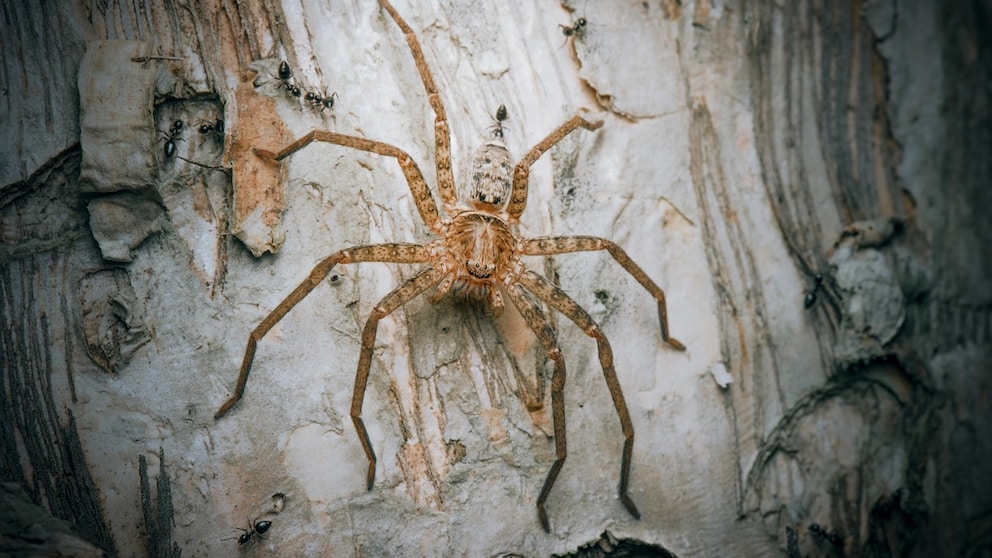
How fast can a spider actually run? Surprisingly fast, according to a new study: The Jungle Huntsman Spider reached nearly 13 kilometers per hour–outpacing all other spiders studied. For the largest study of its kind to date, researchers compared the running speeds of 258 spider species and analyzed the factors influencing their speed.
Nearly 13 Kilometers per Hour on Eight Legs
The approximately three-gram Heteropoda jugulans is among the larger giant crab spiders in Australia, with a leg span of up to about 14 centimeters. In the study, it reached a top speed of 3.59 meters per second. Known in English as the “Australian Jungle Huntsman Spider,” it outpaced all other 258 spider species studied, according to a research group from Imperial College London and the University of Greifswald led by first author Shreyas Kuchibhotla.
In media reports, Heteropoda jugulans has already been dubbed the “fastest spider in the world.” However, the study itself does not explicitly make this claim. It documents instead that the species achieved the highest running speed in the dataset examined.
Could It Outrun a Jogger?
At least over the first few meters, probably yes. With a peak speed of nearly 13 kilometers per hour, the Australian Jungle Huntsman would be faster than many people during a casual jog. However, the researchers only examined the animals’ maximum speed–not how long they can maintain this pace. Therefore, it’s unclear who would win a longer race.
The Largest Spider Speed Study to Date
For their study, researchers from the University of Greifswald and Imperial College London compiled the most comprehensive dataset on spider running speeds to date. Data from 258 species from 64 of the 139 known spider families were included in the analysis. The scientists examined 236 specimens from 162 species themselves, supplemented by previously published data from 96 other species.
The spiders came from the UK, Australia, North America, and Southern Europe, as well as some from terrariums. Before each trial, the spiders were weighed and then allowed to run over graph paper. High-speed cameras recorded their movements.

Tiger – 7 Fascinating Facts About the World’s Largest Big Cat
Researchers Reveal What Happens When Snakes Bite
Size Helps–But Long Legs Make the Difference
Contrary to popular belief, larger spiders generally run faster than smaller ones, according to the study. But body size alone doesn’t explain the differences. The key difference was leg length: spiders with relatively long legs ran significantly faster than similarly sized relatives. Whether the legs were particularly slender made little difference.
Behavior also influenced speed. Actively hunting spiders ran faster on average than species that wait for prey or build webs. However, this correlation was weaker than the influence of leg length and evolutionary history.
Speed Is Also a Matter of Evolution
The study shows that speed is not solely dependent on anatomy. Evolutionary history also plays a crucial role. Particularly high, size-adjusted running performances developed within the evolutionarily younger group of true spiders (Araneomorphae). Overall, body size, leg proportions, lifestyle, and common ancestry determine how fast a spider can run.
Even though the Jungle Huntsman Spider is remarkably fast, a race with humans isn’t on its agenda. They need their speed primarily for survival–not to make joggers break a sweat.