

July 2, 2026, 4:16 pm | Read time: 3 minutes
What is that mysterious glow in the water? Researchers from Nagoya University have discovered three previously unknown worm species in Japanese waters that can produce blue-violet light. Due to their eerie glow, the creatures reminded scientists of figures from Japanese folklore. As a result, they named two of the newly discovered species after demonic beings known as Yokai.
The Story Behind the Names of the Polychaetes Discovered in Japan
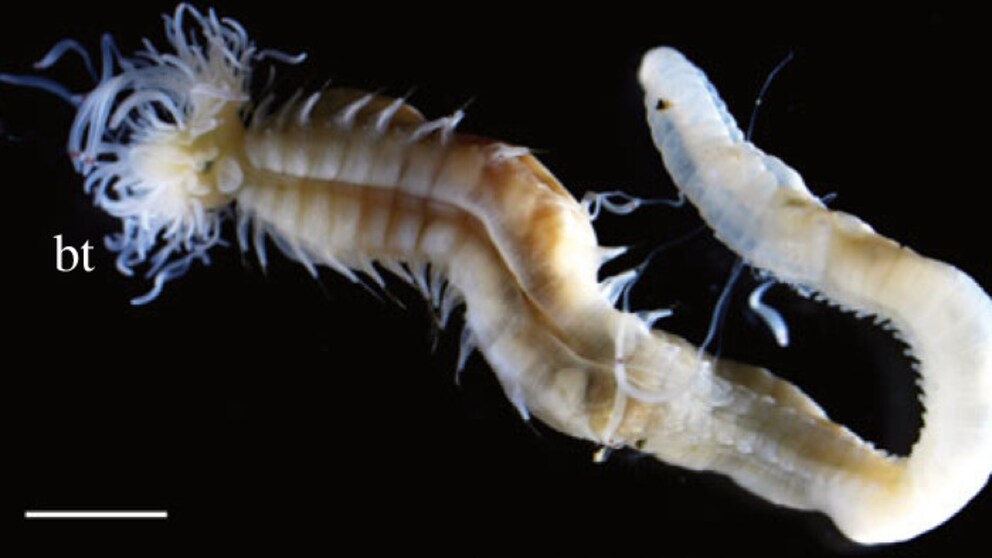
What has a long body, bristles that look like fringes, and glows blue-violet? No, it’s not an alien, but worms that live in the sea! Scientists from Nagoya University in Japan have discovered three species of polychaetes—segmented worms that (with few exceptions) live in the sea. The researchers present their findings in the journal “Royal Society.”
The worms may not be extraterrestrial, but they do have something supernatural about them. At least according to the researchers, who named two of the three new species after creatures from Japanese folklore. The creatures belonging to the genus Polycirrus all have something in common: They possess the ability of bioluminescence and can thus produce light themselves.
The worms, only a few centimeters long, were discovered in various waters of Japan. Until now, only four species of Polycirrus were known to produce light themselves. One of the newly discovered specimens was named after the former director of the Notojima Aquarium, Shinichiro Ikeguchi. The marine biologist contributed to the discovery of the species. Additionally, the worm was found in the Notojima region.

Much more mystical, however, are the names of the other two new worm species. Both bear the name of a yokai—fictional beings from Japanese folklore comparable to demons. “The murky violet-blue bioluminescence emitted by the Polycirrus species closely resembles the descriptions of these creatures in folklore,” said study author Naoto Jimi in a press release.
For example, the species Polycirrus aoandon alludes to the creature Aoandon: A being with blue skin, horns, and sharp teeth, carrying a blue lantern. Even more eerie is perhaps the namesake of the species Polycirrus onibi. “Onibi represents the soul of a deceased person or animal, manifesting as a floating blue flame,” the study states. Similar to a will-o’-the-wisp—or indeed a bluish-glowing polychaete.
Also interesting: Blue slime from the deep sea puzzles researchers
“Bioluminescence is a Treasure Trove for Unusual Processes”
The bioluminescence of the worms was studied both in nature and in the lab. Using special underwater cameras, researchers were able to film the creatures in the water. In the lab, the team stimulated the tentacles of a Polycirrus onibi and a Polycirrus aoandon with tweezers to trigger the glow.
Jimi and his colleagues found that when the worms’ limbs are stimulated, they usually blink only for a short time. Interestingly, the blinking of one tentacle did not trigger the blinking of another tentacle. Nor did the tentacles synchronize when several glowed simultaneously. After about 30 seconds of continuous stimulation, the intensity of the bioluminescence decreased. However, “the ability to emit light was restored after a few minutes,” the study authors write.
Also interesting: 8 marine animals you must see in Australia (via TRAVELBOOK)
According to Jimi, bioluminescence “is a treasure trove for interesting and unusual chemical processes.” Therefore, the topic is also important for bioscientific research and could support the development of new technologies in the future.