

September 30, 2022, 9:28 am | Read time: 3 minutes
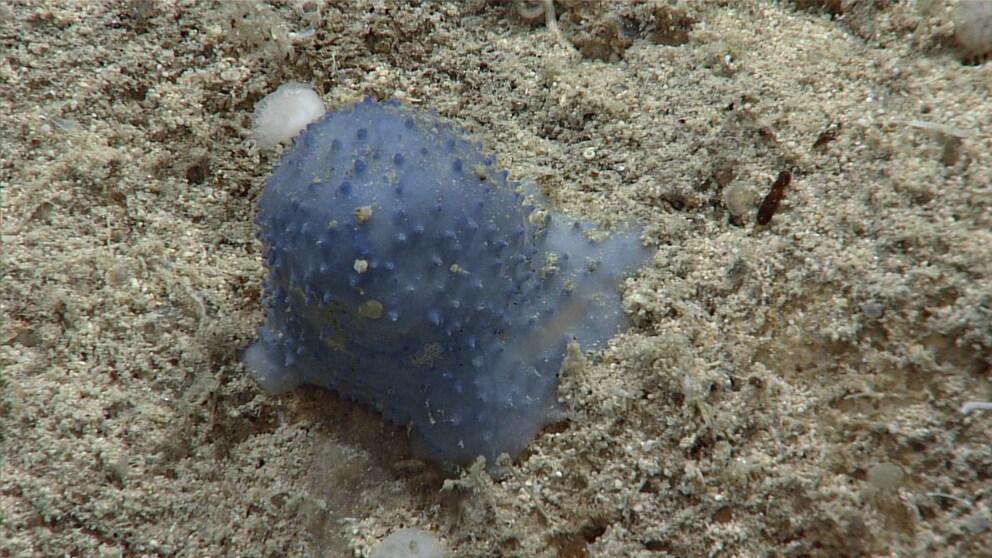
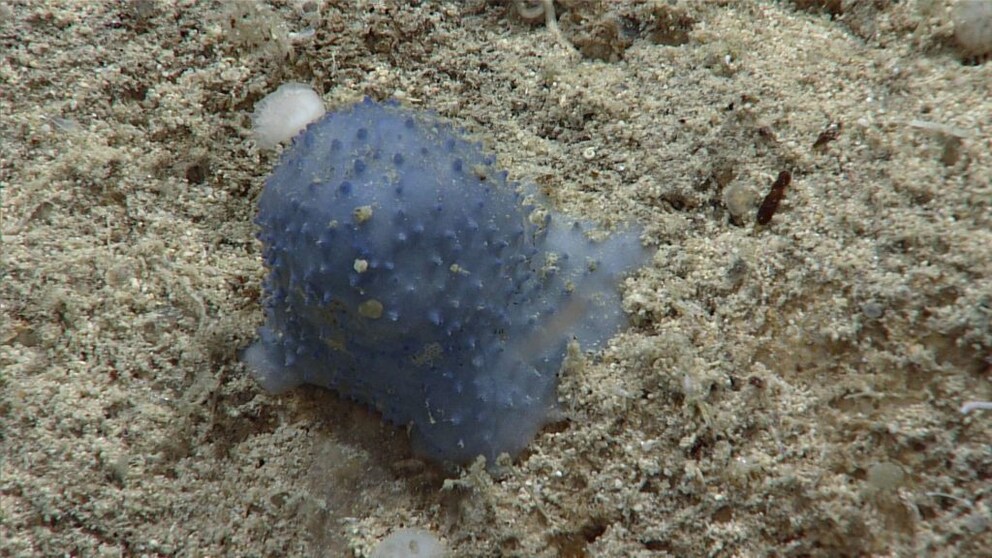
During a deep-sea expedition, U.S. researchers recently encountered creatures that puzzle them. No one yet knows exactly what the slimy, blue structures are or what type of living beings they might be. Where the blue slime was discovered and what is known about it so far.
The previously unknown creatures were discovered by scientists from the National Oceanic and Atmospheric Administration (NOAA), the U.S. national weather and oceanography agency. Over the past four months, the experts explored sections of the North Atlantic with a remotely operated deep-sea robot as part of the NOAA research series “Voyage to the Ridge 2022.” On August 30, they encountered the strange creatures between 407 and 611 meters on the seabed off the island of St. Croix (U.S. Virgin Islands).
Blue Slime Sighting Broadcast Live
As is customary with each dive of this expedition, NOAA live-streamed the footage, allowing deep-sea enthusiasts worldwide to follow the discovery. The footage shows soft bluish creatures. They appear to consist of small spheres and move back and forth in the water.
During the live broadcast of the expedition, the participating researchers discussed what the slimy spheres could be. “We have now seen a variety of them, and I think it’s a mystery,” said one participant. Due to their soft consistency and blue color, the experts refer to the structure as a “lumpy, blue thing,” “blue bio-mat,” or “blue slime.” Some speculate it could be a soft coral or a sponge. It might also be a tunicate, which are invertebrate marine animals sometimes referred to as sea squirts.
Also interesting: Fisherman pulls eerie creature from the deep–is it an unknown new shark species?

Blue Slime Remains a Mystery for Now
The expedition members agree on this first sighting only about what the mysterious creatures are not. “I can tell you it’s not a rock, but that’s all I can say,” joked one researcher. “But for now, it remains a mystery,” according to the NOAA website for the expedition.
The NOAA researchers now want to find out what the creature really is. They plan to send photos and videos from the dive to marine biologists specializing in sponges and corals. However, the species can likely only be definitively identified once specimens of the “blue slime” can be directly examined.
PETBOOK asked the Senckenberg Research Institute and Natural History Museum in Frankfurt am Main for an assessment of the sighting. Biologist Dr. Dorte Janussen from the Marine Zoology Department says, “I consider it quite clearly a sponge. The papillae are characteristic outflow openings for the Polymastiidae family, which do not occur in corals.” According to Janussen, Polymastiidae and Suberitidae are widespread in almost all marine habitats.