


August 5, 2025, 2:02 pm | Read time: 4 minutes
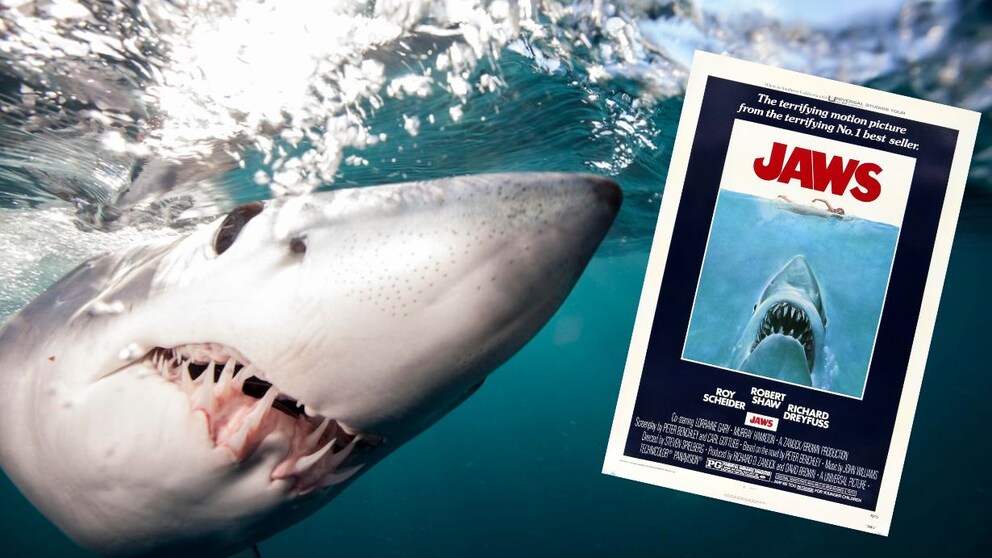
“Jaws” is one of the quintessential film classics and is likely responsible for many people viewing sharks as bloodthirsty, man-eating predators. Just the sight of the long-toothed mouth on the movie poster sends chills down the spine. But what many don’t know: The inspiration for the drawing on the Jaws poster was not a great white shark.
One of the most iconic posters in film history was designed by graphic artist Roger Kastel. He received instructions from producers Richard D. Zanuck and David Brown on what the poster should depict: a shark, a swimmer, and a reference to the location—the fictional town of Amity Island. Kastel was given access to some early stills and a rough cut of the film to help him grasp the tone, visual style, and themes of “Jaws.”1
Kastel Found Inspiration in Shark Specimens at the Natural History Museum
Kastel also wanted to draw inspiration from real sharks. He visited the American Museum of Natural History, which boasts an impressively large collection of various preserved sharks. One specimen particularly captivated Kastel and became the main inspiration for his final design of the movie poster. However, it was not a great white shark but a shortfin mako (Isurus oxyrinchus). This shark species is not only the fastest but also rivals the great white in its fearsome appearance.
The mouth is lined with long, crooked teeth arranged in multiple rows. Biologists refer to this as a “revolver dentition”: When a tooth breaks off, the next one immediately moves forward, like bullets in a revolver. This gives the shortfin mako a particularly eerie appearance.
Specimen Still in the Museum Today
The specimen that inspired Roger Kastel for the “Jaws” movie poster is still in the museum. Ryan Thoni, a curatorial associate in ichthyology (fish science), showcases the famous specimen on the American Museum of Natural History’s Instagram channel. Kastel reportedly took photos of various shark specimens—including the shortfin mako, which ultimately adorned the movie poster.

With a speed of 70 kilometers per hour, these sharks are considered the fastest in the world and can even perform jumps up to six meters high—a rare ability for sharks. Adult specimens reach a length of over four meters and weigh more than 500 kilograms. Shortfin makos are found in all oceans of the tropical to subtropical regions and primarily swim near the ocean surface. 2
Unique Sighting! Octopus Rides the Fastest Shark in the World

These Sharks Live in the Mediterranean and How Dangerous They Are
Are Shortfin Makos Dangerous to Humans?
The shortfin mako prefers to eat swordfish, tuna, mackerel, and other sharks. Its broad, triangular teeth, which likely played a significant role in inspiring the “Jaws” movie poster, make it easier to tear apart prey. This shark species is potentially dangerous to humans. In 2022, two women died following an attack by a shortfin mako in Egypt, as reported by outlets such as “Spiegel.”
However, according to the International Shark Attack File, the world’s only scientifically documented, comprehensive database of all known shark attacks, only nine bites by shortfin makos have been recorded. In comparison, there have been 354 “unprovoked” attacks by great white sharks without prior contact with the animal—57 of which were fatal.
Humans Are the Greater Threat to Sharks
Should we fear not only the great white shark but also the shortfin mako? Probably not! Both shark species are rather shy and tend to avoid contact with humans. Moreover, as with many other shark species, humans pose the greater threat. Overfishing has drastically reduced mako shark populations in all oceans. Additionally, shortfin makos have a low reproduction rate and are considered a delicacy in many places—especially their fins. In the Mediterranean, the species is already threatened with extinction. 3