

August 8, 2025, 12:37 pm | Read time: 5 minutes
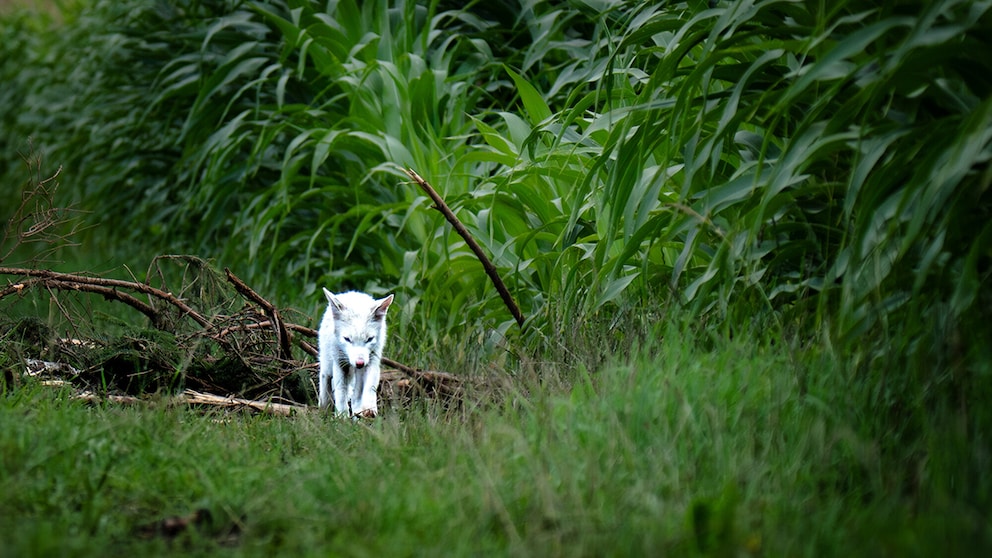
A rare discovery recently caused a stir in Bavaria: Near Munich, a nature photographer stumbled upon an animal at dusk that was hard to identify at first glance—a fox, completely white. PETBOOK explains the story behind this rare appearance and why it occurs not only in foxes.
A Very Special Moment at the Right Time
Nature photographer Dominik Reigl was on one of his usual exploration tours in the Munich district, as reported by “Die Süddeutsche” citing the dpa. Initially, without much success. Just before he was about to end his outing, he experienced a rare surprise.
“A small, completely white fox with blue eyes,” Reigl described the moment when he first discovered the animal. Photographer Dominik Reigl does not want to disclose where he encountered the white fox. This is to prevent the rare young fox from being disturbed or tracked by curious onlookers. According to the Bavarian Society for the Protection of Birds (LBV), the animal is a red fox—but with snow-white fur.
White Fox Is Not an Albino
At first glance, the young fox looks different from the Arctic fox, which has small round ears and is not native to Germany. Nor is it an albino, as one might next suspect. The animal’s unusually blue eyes would be red if it had albinism.
Instead, it is a genetic peculiarity called leucism, which makes its fur appear white but can also result in blue or brown eye color. The little red fox has a pigment disorder in its fur, more commonly seen in thrushes or crows.
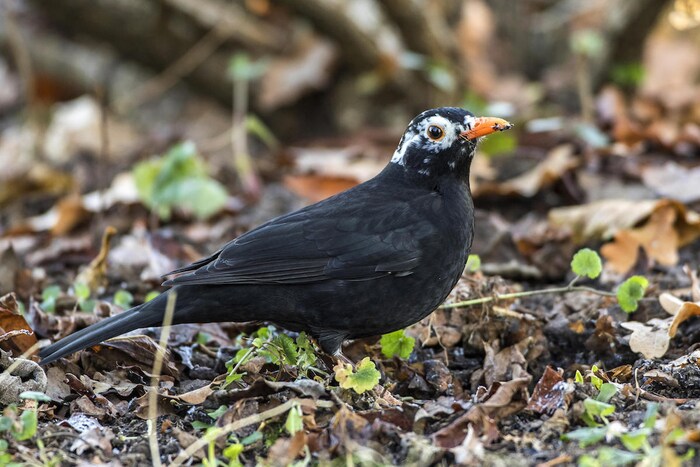
Especially in urban areas, you often see blackbirds with partially white plumage. Since the animals are normally black, their unusual appearance catches our attention. For humans and many animals, hair or feathers lose vibrancy and color with age. But that alone is probably not why some blackbirds “fade” or, in very rare cases, white red foxes appear.
Why Many Black Birds Develop White Plumage
The NABU reports on what lies behind the white feathers. The patchy absence of color develops in animals that originally have a different color, like the red fox. Sometimes the skin under the feathers or fur is also white.
The reasons for leucism are varied, as Stefan Bosch from the Nature and Biodiversity Conservation Union Baden-Württemberg told the dpa. According to the expert, other normally dark-colored birds like house sparrows, jackdaws, and carrion crows are also affected. However, leucism is particularly common in blackbirds.1
The reason for white feathers, according to Bosch, is the lack of color pigments. However, there is no single cause for this. Hereditary factors, diseases, or nutritional deficiencies play a role. In cases of a genetic cause, the animals, according to the expert, continue to fade throughout their lives.
Also interesting: 9 Facts About Sparrows You Didn’t Know

Do you know all the different colors and patterns of cats?

Whether From a Blackbird or a Pigeon, Taking Bird Feathers is Prohibited
The Difference Between Leucism and Albinism
It sounds complicated at first and sometimes leads to the same result: colorless fur or feathers. However, leucism is a naturally occurring mutation that is clearly different from albinism. In albinism, the ability to produce pigments is absent, even though the pigment-producing cells are present.
In leucism, the pigment cells in the affected areas are either not present at all or gradually break down over time. This is caused by genetic defects that prevent the formation of new pigment cells. This can affect skin, feathers, and fur, but not eyes, beaks, or feet.
As reported further on the NABU website, animals with leucism are not without challenges. They have an increased risk of not finding a mate or being caught by a predator. Exact numbers on the phenomenon of leucism are not available due to a lack of systematic surveys, as Stefan Bosch further reported. Their proportion is likely in the low single-digit percentage range.
“An obvious increase in cities and settlements may promote or reverse leucism,” said the ornithology and bird protection officer at the NABU state association.
Frequent Molting Can Promote or Reverse Leucism
Frequent molting, especially in urban areas, can lead to feathers losing color in patches, according to NABU. As birds age, more areas lose their pigment cells, and they develop more white spots.
Why the young red fox is completely white, however, can only be speculated. Other reasons for leucism can be nutritional deficiencies, similar to white spots on human fingernails. However, given the completely colorless fur of a relatively young animal like the red fox, it is assumed that it was born colorless.
Also interesting: 9 Facts About Sparrows You Didn’t Know

The White Blackbird from Steglitz
“There was a nearly completely white blackbird living in a neighborhood in Steglitz. When I first saw the bird, I thought a parrot had escaped. It was only when the male blackbird began to sing that it was clear it was a native bird. Residents often stopped to talk about the not-so-shy bird. The white blackbird was almost universally known in the neighborhood.”