


March 24, 2026, 4:31 pm | Read time: 3 minutes
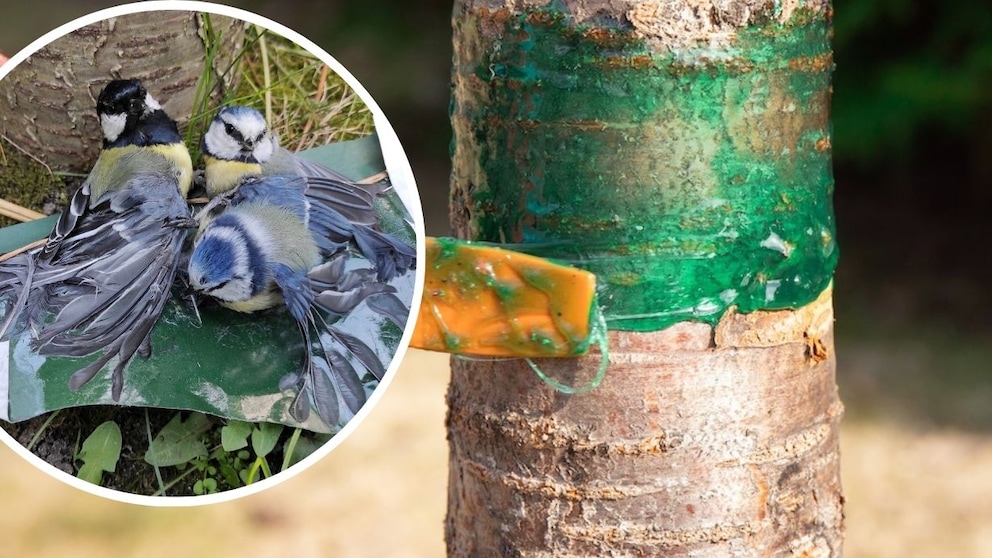
What is actually intended for insects becomes a deadly threat to birds: glue traps, which are freely available in Germany, repeatedly cause dramatic cases in wild bird rescue. Just a few weeks ago, five blue tits with completely glued feathers were brought to the NABU Wild Bird Station in Leipzig–one more was already dead. PETBOOK spoke with Karsten Peterlein from Nabu Leipzig about the still underestimated danger.
“Sometimes it affects several birds at once”
Five blue tits, their feathers completely glued, unable to fly, close to death. One is already dead when found. What sounds like a tragic isolated incident happens more often than many think–right in German gardens.
“We have five to ten cases every year where people find glued birds and seek help,” says Karsten Peterlein from Nabu Leipzig. Particularly tragic: The animals often do not get caught alone. “Sometimes it affects several birds at once–for example, when tits are attracted by alarm calls and also get stuck.”
What initially seems like a rare accident likely has a high number of unreported cases. Many animals die unnoticed. “We assume that glued birds retreat and perish under bushes or in building niches,” the expert says.
Agonizing struggle for survival
For the affected birds, an agonizing struggle for survival begins. Because the adhesive does not stay in one place. “As soon as feathers or legs come into contact with the sticky substance, the birds spread it further while preening,” explains Peterlein.
The consequences are dramatic: “Nine out of ten birds are so heavily glued that they are unable to fly and die agonizingly in the wild.” Without functioning feathers, they can neither find food nor escape predators. Many starve or become easy prey.
And even if they are found, help is not guaranteed. “The birds die if they are not found in time–or despite rescue due to stress,” says Peterlein.
An underestimated risk in the garden
A look at the numbers shows that such cases are not a fringe phenomenon. Between 2013 and 2025, a total of 4,039 birds were taken in by the Wild Bird Rescue Leipzig–75 of them were victims of glue traps.
Thus, while glue traps are not the most common cause, they are avoidable–and particularly cruel. Because: The traps do not distinguish between “pest” and protected wildlife.
“A balance establishes itself naturally”
The solution would be simple: “Garden owners should refrain from using such dangerous glue traps and instead enjoy the diverse nature,” advises Peterlein.
Because nature regulates many things on its own. “In an intact environment, a balance between pests and beneficial organisms establishes itself–control is often not necessary.” And this is where birds come into play: “Insect-eating species are effective pest controllers.”

Illegal Bird Hunting in Cyprus: Hundreds of Thousands of Migratory Birds at Risk
Interesting Facts About Chickadees That You Didn’t Know Yet
Call for stricter regulations
For NABU, it is clear: Glue traps should no longer be freely available. “We appeal to everyone not to use glue traps,” says Peterlein. At the same time, the association calls for the marketing of such products to be stopped.
Because what seems harmless in the hardware store ends up being deadly for many wild birds. Or, as this case shows: sometimes for several birds at once.
Did the tits survive?
Of the four still-living tits brought to the Wild Bird Station Leipzig, three actually made it, as Peterlein reports. “Since the blue tits were quickly brought to the wild bird station, three tits were saved there through multiple elaborate washing processes. They are still living in the station until they molt (renew) their feathers, which were too badly damaged.”