


March 11, 2026, 12:37 pm | Read time: 6 minutes
Humans have devised many ways to keep raccoons at bay: trash cans with tension straps, securely closed food boxes, or clever animal deterrent systems. To us, these seem like efficient tricks; to raccoons, the challenges become intriguing puzzles. But when is it worth their while to keep tinkering, and when do they prefer to rely on tried-and-trusted methods? A study shows that raccoons weigh curiosity and efficiency surprisingly well, following a principle known from classic foraging behavior.
Why Clever Urban Dwellers Learn from Curiosity
Anyone who has been in German cities knows the scene: a tipped-over trash can, scattered garbage—and somewhere nearby, likely a raccoon. The animals are considered curious, skillful, and remarkably adaptable. But how smartly they actually weigh “trying something new” versus “using what’s proven” is now impressively shown in a study.
The results were published in the journal “Animal Behaviour.” The surprising finding from the study: Raccoons continue to solve “puzzles” even when there’s no additional food reward—apparently to gather information for the future.1
Why Smart Decision-Making Is Crucial in Cities
The theory of “optimal foraging” suggests that animals try to gain as much energy as possible with minimal effort. But this requires not just hunger—but also brains.
Especially in cities, this is crucial for raccoons. These omnivores are particularly interested in “easy prey.” Trash cans provide an ideal supply, essentially serving as fast-food outlets for the animals. However, trash cans have different closures, and their contents change. Additionally, humans constantly alter the environment. To succeed here, one must decide:
- Is it worth trying a new, complicated trash can?
- Or should I stick to the known, safe source?
Raccoons have long been considered particularly adaptable. Their brains have a high density of nerve cells, they are flexible in their social behavior, and they continually develop new problem-solving strategies. However, it was unclear until now: Do they continue to tinker even when not forced to—or when already full?
Curiosity or Efficiency–Which Is More Worthwhile?
Researchers from the University of Wyoming and the USDA National Wildlife Research Center were involved in the study. At the center was an intriguing question: Do raccoons follow a so-called “exploration-exploitation compromise”?
This means:
- Exploration = Trying new things, gathering information
- Exploitation = Using proven strategies, staying efficient
In other words: Are raccoons curious adventurers—or calculating strategists?
The Experiment: A Puzzle Box with Nine “Tricks”
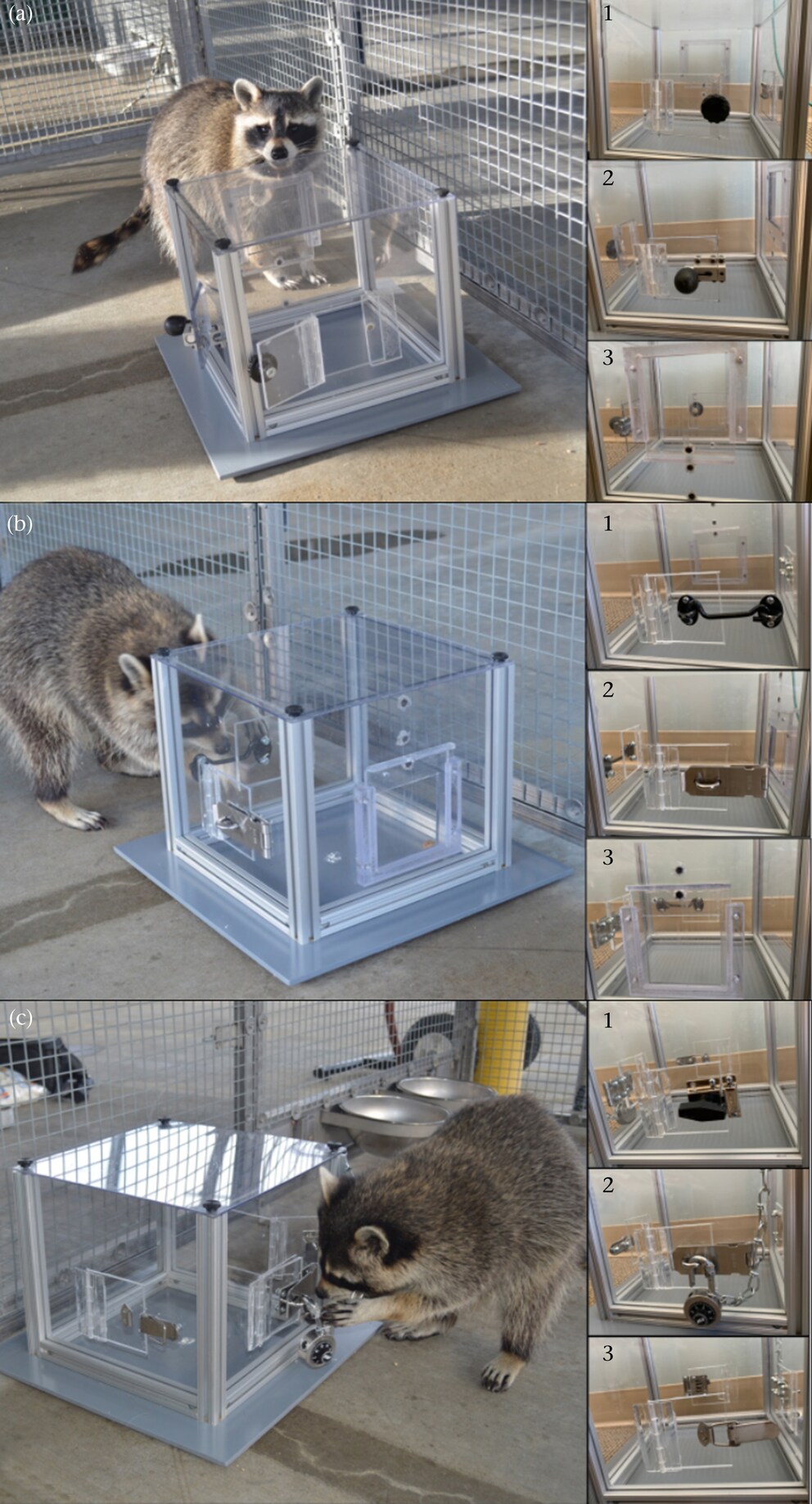
Sixteen adult raccoons were studied (14 completed all tests). The animals lived in spacious outdoor enclosures in Colorado. The centerpiece of the study was a so-called multi-access puzzle box—a box with nine different opening mechanisms, divided into:
- easy
- medium
- hard
Each trial contained only one food reward in the box. Each raccoon completed up to 50 rounds.
The twist: Unlike in previous studies, already solved mechanisms remained usable. The animals could continue to “work” on the box even after receiving the food—voluntarily and without additional reward.
More Than Just Food: Raccoons Gather Knowledge
The results clearly show: Raccoons adjust their behavior to the difficulty level of the puzzle. They were more experimental with easy tasks. The order of attempted solutions was also significantly more complex with easy tasks—the animals switched more frequently between different mechanisms.
The more time raccoons spent with the box without immediate success, the more different solutions they found overall. However, more exploration also meant they took longer to achieve the first successful opening.
Raccoons Are Curious–But Not Reckless
When things got complicated, the animals quickly switched to a fixed strategy. They stuck more often to the first successful solution and tried fewer alternatives. In other words: The more difficult the task, the more sparingly they used their curiosity. Particularly noteworthy was that the raccoons in the study tried new mechanisms even when they had already received the only piece of food.
“We didn’t expect them to open all three solutions in a single trial,” the science magazine “Phys.org” quotes the study’s lead author, Hannah J. Griebling. “They continued to solve problems even when there was no marshmallow left at the end.” Griebling and her colleagues interpret this behavior as active information-seeking. The animals invest time and energy to be prepared for future situations.
At the same time, their curiosity is not an end in itself. They reduce experimentation when the costs—such as high effort—increase. This precisely matches the predictions of an optimal exploration-exploitation compromise.
What Does This Mean for Our Cities?
In urban environments, conditions change constantly. Those who can flexibly switch between curiosity and efficiency have a clear advantage. For raccoons, this ability could be a key to their success–even here in Germany, where they have been spreading for decades.
This might explain why some animals seem “tirelessly” to test new trash cans, while others stick to proven food sources. “It’s a pattern familiar to anyone ordering in a restaurant,” said Griebling. “Do you order your favorite dish or try something new? If the risk is high—an expensive meal you might not like—you choose the safe option. Raccoons explore when the costs are low and quickly decide to play it safe when the stakes are higher.”

Clever Cockatoos Master Drinking Fountains – How the Birds Adapt to Urban Life

Can You Keep Raccoons as Pets in Germany?
Limitations of the Study
Even though the results seem quite significant, it must be considered that the raccoons were tested in captivity. Environmental factors such as competition or dangers from traffic and humans could influence the behavior of wild animals and thus also the time they have to engage with puzzles.
Additionally, all raccoons went through the difficulty levels in the same order (from easy to medium to hard). Learning effects cannot be completely ruled out—even though the data does not suggest mere habituation. With 14 fully tested animals, the sample size is typical for cognitive biology studies, but individual differences could play a role.
Conclusion: Strategists with a Research Spirit
Raccoons are far more than skillful “trash can crackers.” They are strategic decision-makers who weigh when curiosity is worthwhile—and when efficiency is more sensible. That they continue to tinker even without immediate reward shows: These animals learn not just for the moment, but possibly for the future. And that’s what makes them such successful—and sometimes challenging—cohabitants of our cities.