

November 11, 2025, 5:55 am | Read time: 4 minutes
Birds like crows, jackdaws, or magpies are highly intelligent and social. This raises the question of whether crows can be kept as pets. Is it a good idea–and is it allowed? PETBOOK investigated.
They make tools, recognize themselves in mirrors, and form close social bonds: Crows, part of the corvid family, are among the most intelligent birds. Because they sometimes seem so similar to humans in behavior, the question often arises whether they could be kept as pets. Experts from Nabu and the German Animal Welfare Federation provide insights on this.
Experts warn: Keeping crows is not appropriate
The answer is clear. “Wild animals should not be kept as pets; they should live freely in nature,” says NABU spokesperson Silvia Teich. Lea Schmitz, head of the press office at the German Animal Welfare Federation, emphasizes: “We fundamentally oppose keeping (raven) crows as pets. Crows are wild animals with complex social and flight behaviors that cannot be adequately met in private care.”
In the wild, crows are constantly on the move, foraging in an organized manner and living in stable pair and flock structures where they share information and coordinate behavior. These behaviors cannot be replicated in an aviary or at home. This fundamentally distinguishes them from typical pet birds like budgerigars or zebra finches.
Also interesting: Why crows look different in eastern Germany
Corvids are strictly protected by law
The legal situation is also clear: “Crows are specially protected under the Federal Nature Conservation Act. In most states, they are also subject to hunting laws,” explains Schmitz. This means they cannot be captured or kept privately.
This protection applies to all corvids native to Germany, including ravens, magpies, and jackdaws. Anyone attempting to keep or raise a crow is violating the law and must face legal consequences.
Exceptions prove the rule
Only in a few exceptional cases is keeping them allowed–and then only for qualified facilities. “An exemption is only possible in very special cases, such as for qualified rescue or care centers that temporarily care for injured or orphaned young birds,” says Schmitz. However, this requires official approval and proof of special expertise.
Such facilities usually work closely with conservation authorities. Their goal is not to keep the animals in captivity permanently but to release them back into the wild after recovery. For private individuals without special permits, keeping them is prohibited–even with good intentions.
Raven or Crow? How to Recognize the Difference
7 Exciting Facts About Corvids
Too much proximity to humans harms crows
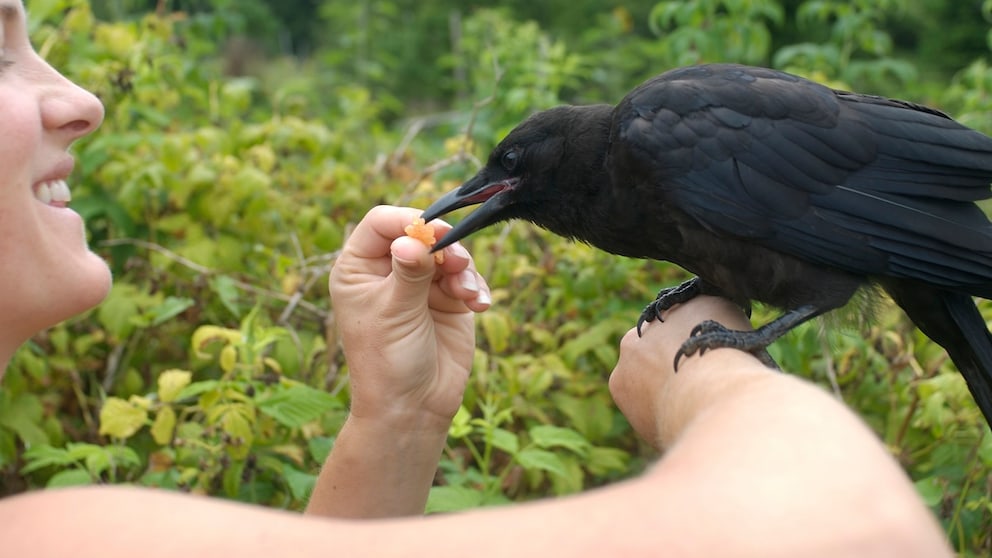
Even if keeping them were allowed, it would not be unproblematic for the animals. “Keeping crows in human care often leads to imprinting on humans. The birds do not learn their species-typical behavior,” warns Schmitz.
The consequences are severe: A hand-raised crow loses its natural shyness and can hardly be released back into the wild later. It becomes especially problematic when the birds reach sexual maturity–they often become aggressive toward humans. Ironically, the closeness people desire leads to conflicts.
Additionally, there is the need for companionship: “All corvids are very social animals that live in flocks or at least with a partner in the wild–solitary and aviary keeping contradicts their need for social contacts and freedom of movement,” says Schmitz. For an animal dependent on complex social structures, isolation means massive stress.
Observe instead of confine
Those fascinated by crows should observe them in nature–not keep them as “pets” in their living room. With some patience, you can even experience these intelligent birds in your own area: in fields, parks, or cities, where they have long found their place. Studying their behaviors, such as communicating, hiding food, or using tools, is exciting enough–without a cage.